
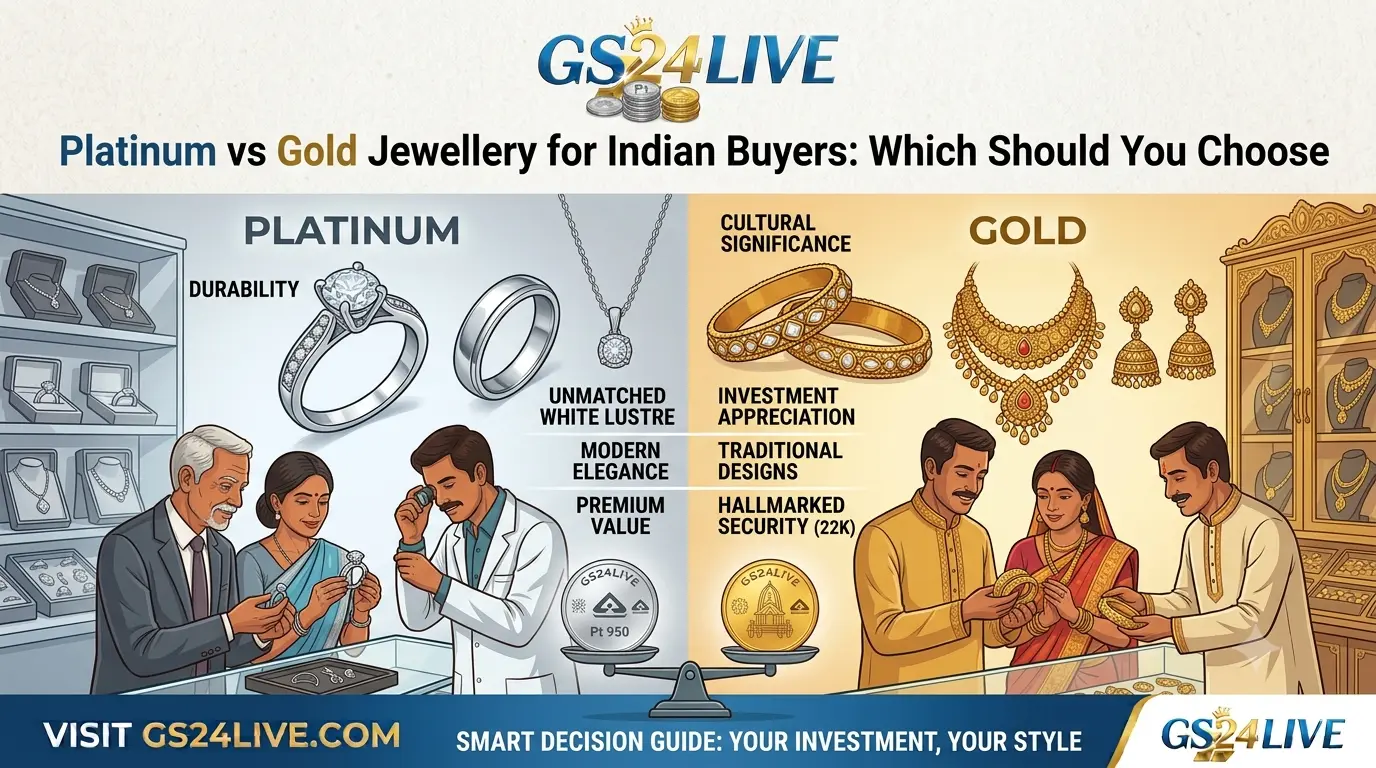
Walk past a premium jewellery counter in any Indian mall and you will usually see one small, quiet section set apart from the gold displays — pale, heavy-feeling bands marketed as platinum. The platinum vs gold jewellery India decision comes up mostly at engagement and wedding-band counters, where buyers are told platinum is "rarer" and "purer" without much explanation of what that actually means for price, durability, or resale a decade later.
This guide compares the two metals directly for jewellery buyers — not as an investment allocation question, since platinum plays a very different, much smaller role than gold in Indian household savings. For karat purity basics within gold itself, see our 22K vs 24K gold guide in one line only. Check GS24LIVE's gold price today page when comparing per-gram costs across metals.
Key Takeaways
- Platinum is denser and heavier than gold at the same volume, so a platinum ring of similar size weighs — and often costs — more than it visually suggests.
- Platinum is naturally white and does not need rhodium plating the way white gold does, which removes one recurring maintenance cost.
- Gold, especially 22K, dominates Indian bridal and cultural jewellery; platinum is a niche choice concentrated in rings and modern bands.
- Platinum's Indian resale and exchange network is far thinner than gold's — fewer counters quote it confidently, which matters at buy-back time.
- Making charges on platinum are typically higher as a percentage than on comparable gold pieces because the metal is harder to work and less commonly stocked.
Density and Price: Why a Platinum Ring Feels Different
| Property | Platinum | Gold (22K/18K typical) |
|---|---|---|
| Density | Higher — noticeably heavier per same volume | Lower than platinum, still dense versus most metals |
| Natural colour | Naturally white/grey | Naturally yellow (18K/22K); white gold needs rhodium plating |
| Typical purity marks | 950 platinum (common), sometimes 900 | 916 (22K), 750 (18K), 999 (24K) |
| Global price behaviour | Trades independently; historically has traded both above and below gold depending on the period | Larger, deeper global market with more household familiarity in India |
| Indian retail availability | Limited to select premium counters and cities | Available at nearly every jewellery shop nationwide |
A useful mental model: platinum's higher density means a same-size band uses more grams of metal than an equivalent gold band, so part of the price gap you notice at the counter is genuinely a weight difference, not only a "platinum premium" story.
Durability and Daily Wear Comparison
Platinum is a tougher metal at the molecular level — it does not lose material as readily as gold when scratched; instead, it displaces, which is why platinum jewellery develops a soft "patina" over years rather than visible metal loss. Gold, particularly higher-karat pieces, can show finer wear and thinning at friction points over long daily use. For most everyday scenarios — office wear, occasional knocks, years of use — both metals perform acceptably, but platinum edges ahead specifically for rings that face constant friction, such as wedding bands worn every single day without removal.
Gold's colour options extend beyond plain yellow — white gold achieves its pale tone through rhodium plating rather than platinum's natural colour, and that plating wears off and needs periodic renewal; our white gold vs yellow gold guide covers that alloy-and-plating story in one sentence, since it is a gold-only topic distinct from this platinum comparison.
Resale and Liquidity: Where Gold Clearly Wins
| Factor | Platinum | Gold |
|---|---|---|
| Counters that quote confidently | Few — mostly premium/branded jewellers | Nearly every jeweller nationwide, including local sarafs |
| Buy-back rate transparency | Limited reference points for buyers to check | Daily reference rates widely published and compared |
| Speed of resale | Slower — fewer buyers actively quoting | Fast — deep, competitive local market |
| Exchange toward new jewellery | Often only accepted back by the same or similar premium brand | Widely accepted for exchange across most jewellers |
This liquidity gap is the single biggest practical reason platinum remains a jewellery choice rather than a household savings instrument in India, unlike gold, which doubles as both ornament and store of value for most families.
Cultural Fit: Why Gold Still Dominates Indian Jewellery
Indian wedding and festival traditions are built around gold specifically — the mangalsutra, kada, and most bridal sets carry meanings tied to gold's colour and cultural symbolism that platinum, despite its rarity, simply does not inherit. India's continued preference for 916 gold in ceremonial jewellery is explained fully in our why 916 gold is popular guide in one line only. Platinum has carved out a modern niche mainly in engagement rings and contemporary wedding bands among urban, younger buyers who want a distinct look from family jewellery, but it has not displaced gold's role in ceremonies, gifting, or streedhan traditions across most Indian households, including the seasonal wedding buying rush covered in our wedding season gold demand guide.
Making Charges: Platinum's Hidden Cost Multiplier
Platinum's higher melting point and harder working properties mean workshops need specialised tools and more skilled labour time to shape it compared with gold, which pushes making charges higher as a share of the total bill on many platinum pieces. Gold's making-charge structures — per-gram versus flat labour, and what you recover at resale — are explained fully in our gold making charges guide; platinum buyers should expect a similar conversation at the counter but often with a steeper percentage, since fewer workshops specialise in the metal.
Care and Maintenance Differences Over the Years
Gold jewellery, especially higher-karat pieces, tends to need periodic polishing to restore shine after years of contact with skin, perfume, and daily friction, and softer high-karat pieces can pick up fine scratches that a jeweller buffs out during routine servicing. Platinum's toughness means it resists losing metal in the same way, but its surface develops a matte, brushed-looking patina from micro-scratches that some owners love for its understated look and others prefer to have re-polished back to a mirror finish periodically. Neither maintenance routine is expensive or difficult, but they are different enough that a buyer expecting "gold-style" upkeep on a platinum piece — or vice versa — may be surprised by how the metal actually ages in daily use.
Ahmedabad Counters: Where to Actually Find Platinum
Platinum stock in Ahmedabad concentrates in a handful of branded and premium showrooms rather than the wide network of sarafs that stock gold across every neighbourhood, so buyers should call ahead to confirm current availability and designs before visiting specifically for platinum. A practical local habit: if you are set on platinum for an engagement ring, ask the counter directly whether they will also buy back or exchange that piece in future — some premium brands support this, while smaller counters carrying a token platinum range may not, leaving you dependent on the original seller years later.
Risks of Choosing Platinum Without Understanding the Trade-Offs
Buyers who choose platinum purely because it is marketed as "rarer" or "more prestigious" sometimes discover only at resale time how thin the local market for the metal actually is. Others underestimate the making-charge premium and are surprised when a platinum band costs meaningfully more than an equivalent-looking gold band despite platinum's spot price not always trading higher than gold's. Understanding these trade-offs before purchase avoids disappointment later — platinum's advantages are real for the right buyer, but they are not simply "gold, but better" in every dimension.
Which Buyer Should Choose Which Metal
- Choose gold for bridal sets, cultural/ceremonial jewellery, pieces you may want to exchange or resell easily, and any purchase where liquidity matters.
- Choose platinum for a daily-worn wedding band with minimal maintenance, a distinct modern look apart from family gold, or if rhodium plating maintenance on white gold feels like an ongoing hassle you want to avoid.
- Consider both if budget allows — many couples now pair a platinum band for daily wear with gold pieces reserved for ceremonies and festivals.
Frequently Asked Questions
1. Is platinum more expensive than gold in India?
It depends on the day's global rates for each metal and the specific purity/weight compared — platinum is not always priced higher than gold, though making charges often push the finished piece higher.
2. Does platinum jewellery hold its value well in India?
The metal itself has value, but India's thin platinum resale network means realising that value can be slower and less transparent than selling gold.
3. Is platinum better than gold for daily-wear rings?
Platinum's durability and lack of plating maintenance suit constant daily wear well, but gold performs adequately too for most normal use.
4. Can I exchange a platinum ring at any jeweller?
Not reliably — many smaller counters do not actively deal in platinum; confirm exchange policy with the original seller or a premium brand before buying.
5. Why don't Indian bridal sets use platinum?
Cultural and religious symbolism in Indian jewellery is built around gold specifically; platinum has not displaced that tradition despite its physical qualities.
6. Are platinum making charges always higher than gold's?
Usually yes, as a percentage of the bill, because platinum is harder to work and fewer workshops specialise in it — always ask for the specific making-charge breakdown.
Data Sources and References
- World Gold Council — gold jewellery demand and cultural context.
- LBMA — international precious metal pricing benchmarks.
- BIS — hallmarking and fineness standards context.
- Reuters — precious metals market reporting.
Conclusion
Platinum vs gold jewellery in India is less a "which is objectively better" contest and more a fit-for-purpose decision. Platinum offers genuine durability and low-maintenance whiteness for a daily-worn ring, but it asks buyers to accept higher making charges and a much thinner resale market. Gold remains the practical, liquid, culturally anchored choice for almost everything else — bridal sets, gifting, and any piece you may want to exchange easily later.
If you want platinum's daily-wear qualities without abandoning gold's liquidity for the rest of your jewellery box, pairing a platinum band with gold ceremonial pieces is a sensible middle path many Indian couples now choose. And if you ever need to convert an older gold piece into rupees to fund a new platinum purchase, our sell old gold in Ahmedabad guide explains how that buy-back math actually works.
Disclaimer: This article is for informational and educational purposes only. Metal pricing, availability, and making charges vary by seller and city; verify current rates and consult the retailer directly before purchasing.
Keywords: platinum vs gold jewellery India, platinum jewellery India price, platinum ring vs gold ring, is platinum better than gold, platinum resale value India, platinum wedding band India.