
Standing at a jewellery counter in Ahmedabad, the first question after the price board is almost always about purity: should you pick 22K or 24K? The shopkeeper may quote both rates within seconds, but the right choice depends on whether you are buying a bridal necklace, a hallmarked coin, or building long-term savings. Karat is not a branding label — it defines how much pure gold sits inside the alloy you actually pay for.
This guide breaks down 22K vs 24K gold in plain language for Indian buyers: what the numbers mean, how BIS hallmarking works, how making charges and buy-back terms change your final rupee outcome, and which karat fits jewellery versus investment. It is educational content, not personalised financial advice. Confirm the live gold price today on GS24LIVE before purchasing.
Key Takeaways
- 24K (999 fineness) is the highest commercially traded purity; 22K (916) is the standard for durable Indian jewellery.
- Jewellery buyers usually get better wear resistance and design flexibility with 22K; pure 24K is too soft for daily bangles and chains.
- Investment bars, coins, and sovereign products typically track 24K-equivalent pricing; retail jewellery invoices include making charges on top of metal.
- BIS hallmark (HUID) confirms fineness — always verify the stamp and invoice purity line before paying.
- Buy-back value depends on documented purity and weight, not the original design premium you paid at purchase.
What Does Karat Actually Mean?
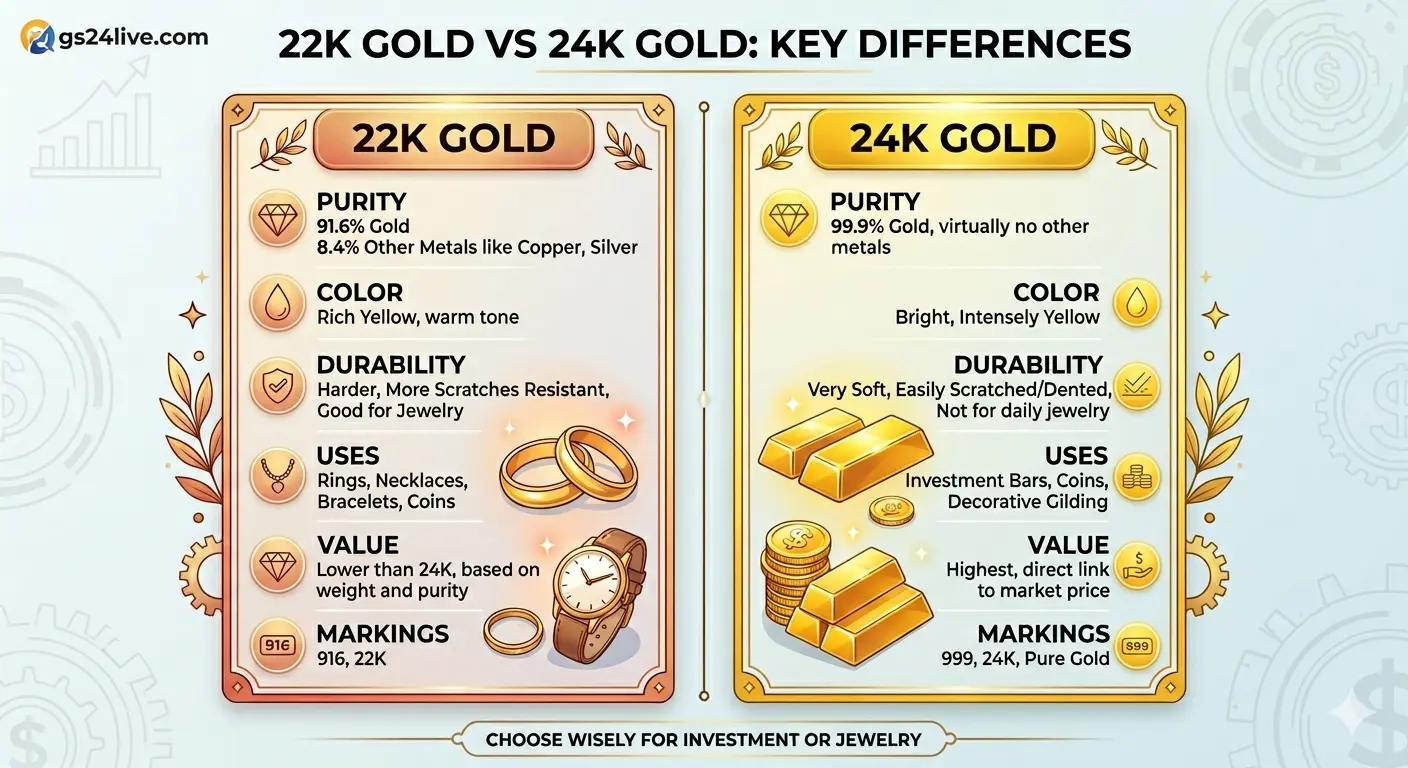
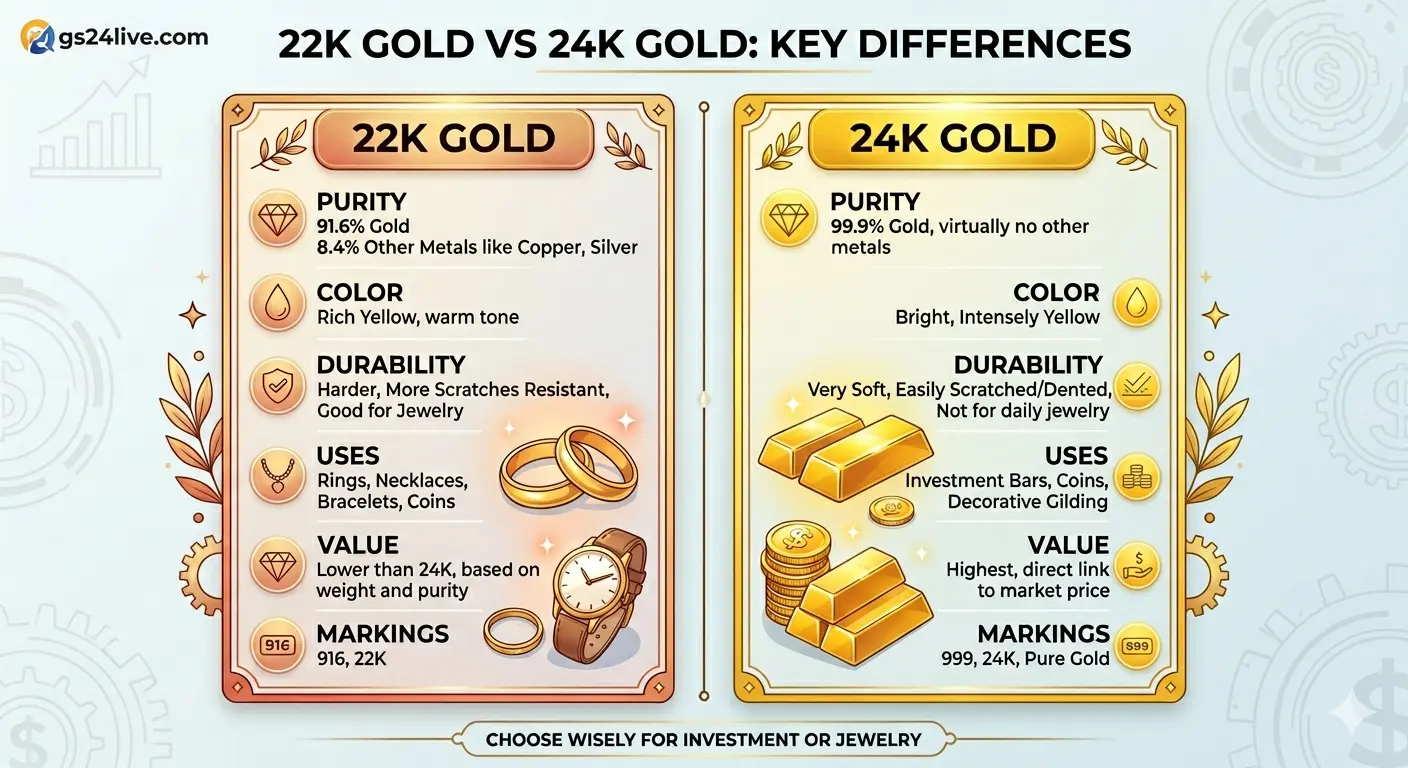
Karat measures gold purity on a 24-part scale. Twenty-four karat means 24 parts gold out of 24 — effectively pure gold. Twenty-two karat means 22 parts gold and 2 parts other metals such as copper or silver, added to improve hardness. In India, jewellers and refiners also express purity as fineness: 999 for near-pure gold and 916 for 22K.
The alloy metals are not impurities in a negative sense. They give jewellery structural strength so prongs hold stones, hinges survive daily opening, and bangles resist bending. That is why wedding collections across Gujarat are overwhelmingly 22K even when 24K bars trade at a higher per-gram quote on the bullion board.
Understanding 24K Gold (999 Fineness)
24K gold is the reference purity for international spot pricing and MCX benchmark contracts. Coins, small bars, and many digital gold products aim to mirror this layer. The metal has a rich yellow tone and maximum gold content per gram, which appeals to investors who want metal exposure without design markup.
Because 24K is soft, it scratches and deforms easily. Showroom staff rarely recommend unchecked 24K bangles for daily wear. Where 24K jewellery exists, it is often minimal — plain wire pieces or ceremonial items worn occasionally. For most Indian households, 24K enters the picture through investment channels rather than heavy bridal sets.
Understanding 22K Gold (916 Fineness)
22K gold balances purity with practicality. At 91.6% gold content, it remains highly valuable while tolerating the casting, stone setting, and polishing cycles that intricate Indian designs require. Ahmedabad's manufacturing clusters produce a large share of India's export and domestic jewellery in this grade.
When a saraf quotes a 22K rate, that number reflects the gold content portion only. Your invoice still adds making charges, GST, and sometimes stone value separately. Comparing a 22K necklace quote with a 24K bar price without separating these layers leads to incorrect conclusions about which purchase was cheaper.
22K vs 24K Gold: Side-by-Side Comparison
| Feature | 22K (916) | 24K (999) |
|---|---|---|
| Gold purity | 91.6% | 99.9% |
| Typical use in India | Wedding jewellery, chains, rings | Coins, bars, digital gold, SGB reference |
| Hardness / durability | Higher — suited to daily wear | Lower — bends and scratches easily |
| Colour tone | Rich yellow, slightly less deep than 24K | Deepest yellow |
| Making charges | Common on all jewellery pieces | Lower on plain bars; high on intricate 24K designs |
| Resale focus | Metal weight + purity; design premium largely lost | Near-full metal value on plain products |
| BIS hallmark fineness mark | 916 | 999 |
BIS Hallmarking and HUID: What to Check
Since mandatory hallmarking phases expanded across India, reputable jewellers sell BIS-certified gold with three marks: the BIS logo, purity/fineness (916 or 999), and a six-digit alphanumeric HUID unique to each piece. The Bureau of Indian Standards maintains the framework that aligns retail purity claims with assay standards.
Before paying, match the HUID on the tag with the entry on your invoice. For coins and bars, confirm the refiner's branding and fineness stamp. Counterfeit risk is lower at established Ahmedabad showrooms, but the verification habit protects you everywhere. If a seller refuses hallmark documentation, treat that as a red flag regardless of the discount offered. For a step-by-step walkthrough, see our guide on how to verify a BIS hallmark.
Price Per Gram: Why the Gap Looks Smaller Than You Think
24K quotes are higher per gram because each gram contains more pure gold. A 10-gram 22K bangle still carries 9.16 grams of pure gold, not 10. When comparing value, multiply weight by purity — do not assume the tagged weight equals pure gold content.
| Item (illustrative) | Gross Weight | Purity | Pure Gold Content | Sample Metal Value Layer |
|---|---|---|---|---|
| 22K necklace | 40 g | 916 | 36.64 g | Based on 22K day rate × 40 g |
| 24K bar | 10 g | 999 | 9.99 g | Based on 24K day rate × 10 g |
| 22K ring | 8 g | 916 | 7.33 g | Metal + making charge separately |
| 24K coin | 5 g | 999 | 4.995 g | Often lower making charge than jewellery |
Making Charges: The Hidden Swing Factor
Making charges vary by design complexity, not by karat alone. A lightweight 22K chain may carry ₹400–₹800 per gram making charge at a busy Ahmedabad showroom, while a heavy bridal set with hand work can run significantly higher. Plain 24K coins sometimes carry minimal making charges — occasionally a flat percentage — which is why investors favour them over ornate pieces.
Some retailers advertise low per-gram gold rates but recover margin through making charges. Always request a written break-up: metal value, making charge, GST, and stone charges if applicable. The cheapest quoted rate per gram is rarely the cheapest final invoice. Our detailed gold making charges guide explains how to read these break-ups before you pay.
Jewellery vs Investment: Which Karat Fits Your Goal
If the goal is wearable jewellery for weddings, festivals, or family heirlooms, 22K is the practical default in India. The alloy withstands years of use, accepts polishing, and matches buyer expectations at resale counters. Choosing 24K for a daily-wear kada often means faster structural wear and higher repair frequency.
If the goal is wealth storage without design dependency, 24K-equivalent products win on simplicity. Hallmarked bars, minted coins, sovereign gold bonds, and exchange-traded funds track investment-grade purity with transparent pricing. You sacrifice the emotional and cultural dimension of jewellery, but you also avoid losing 15–25% of capital to making charges upfront. If you are weighing metals for a portfolio, our gold vs silver investment guide compares returns, volatility, and storage — and you can track the live silver price today alongside gold before deciding.
When 22K Makes More Sense
- Bridal and festival jewellery with stone settings
- Pieces intended for regular wear over many years
- Gifts where craftsmanship and design matter
When 24K Makes More Sense
- Plain bars and coins for long-term holding
- Portfolio allocation through SGBs or gold ETFs
- Buyers who may sell metal back without design loss
Resale and Buy-Back Reality
Jewellery resale in India is primarily a metal transaction. Dealers weigh the piece, verify purity, deduct a small handling margin, and pay based on gold content — not on your original making charge. A ₹2-lakh bridal set might return a fraction of that if design premiums cannot be recovered. Plain 24K products typically see tighter buy-back spreads because the product is closer to raw metal.
Document everything at purchase: invoice, HUID, weight, and purity line. Ahmedabad wholesale lanes often pay faster on hallmarked 22K scrap with clear paperwork than on unmarked pieces requiring re-assay. Keep pieces in original condition; excessive polishing before sale can remove measurable weight over time.
Historical Shift in Indian Gold Purity Standards
Indian gold buying has moved from reputation-based trust to documented purity. For decades, 22K dominated jewellery and buyers relied largely on a shop's standing rather than uniform assay. The expansion of BIS hallmarking changed that by making fineness marks like 916 and 999 a visible, verifiable part of every tag.
The bigger shift arrived with mandatory hallmarking and the six-digit HUID, which added per-piece traceability and made counterfeit detection far easier for ordinary buyers. The practical takeaway is simple: today you can verify exactly what you pay for, so always insist on the hallmark and HUID rather than trusting a verbal purity claim.
Practical Buying Strategy: Which Should You Buy?
Start by naming the job the gold must do. If it must be worn, gifted, and admired at family events, default to hallmarked 22K and optimise making charges — not karat. If it must sit in a locker or portfolio for years, favour 24K plain products or paper alternatives that track investment purity.
Split budgets are valid: many Ahmedabad families allocate part of a wedding budget to a wearable 22K set and a separate 24K coin allocation for long-term savings. Avoid converting the entire budget into a single ornate piece if liquidity matters within five years. Request buy-back terms in writing at purchase — including whether the same showroom will repurchase at what spread.
When gold prices are elevated, lowering jewellery weight while keeping 22K purity often beats switching to lower karats like 18K without family approval. Purity downgrade saves metal cost but changes cultural expectations and resale behaviour. Stay at 22K for traditional jewellery unless the design specifically requires a harder alloy.
Frequently Asked Questions
1. Is 22K or 24K better for long-term value in India?
Format matters more than karat alone. Plain 24K bars and coins retain more metal value at resale; 22K jewellery loses making charges upfront. For daily wear choose 22K; for metal efficiency choose 24K-equivalent products.
2. Why is most Indian wedding jewellery 22K and not 24K?
22K survives daily wear, holds stones securely, and matches decades of consumer expectation. 24K is too soft for complex bridal sets that undergo frequent polishing and physical contact.
3. How do I convert between 22K and 24K price quotes?
Multiply gross weight by purity ratio. Ten grams of 22K contains 9.16 grams of pure gold; ten grams of 24K contains roughly 9.99 grams. Apply the respective day rates to the correct weight and purity line.
4. Does BIS 916 gold mean exactly 22K?
Yes. BIS fineness 916 corresponds to 22-karat gold at 91.6% purity. Fineness 999 corresponds to 24-karat gold. Always cross-check the HUID on your invoice.
5. Does BIS hallmark affect resale value?
Yes. Hallmarked pieces with HUID verify purity instantly at buy-back counters. Unmarked gold may need re-assay, reducing your payout and adding delay.
6. How do jewellers calculate making charges on 22K gold?
Charges are per gram or flat, based on design complexity — not karat alone. A plain chain may carry ₹400–₹800 per gram; hand-work bridal sets cost more. Always request a written break-up before paying.
7. Will an Ahmedabad jeweller buy back 22K jewellery at the same rate I paid?
Unlikely. Buy-back is based on current metal value and verified purity, minus a spread. Making charges and design premiums paid at purchase are generally not recovered.
Data Sources and References
- Bureau of Indian Standards (BIS) — official hallmarking standards, fineness marks, and HUID verification for gold jewellery in India.
- Multi Commodity Exchange of India (MCX) — benchmark gold futures pricing used by Indian jewellers and importers.
- World Gold Council — global gold demand research, investment trends, and purity standards context.
- London Bullion Market Association (LBMA) — international good delivery standards for gold bars and pricing benchmarks.
- Reserve Bank of India (RBI) — sovereign gold bond framework and macro policy affecting domestic bullion pricing.
- Reuters — international news on gold prices, import economics, and currency moves affecting Indian rates.
Conclusion
The 22K vs 24K gold decision is not about which karat is universally superior — it is about matching purity to purpose. Wearable Indian jewellery leans on 22K for strength and tradition; investment and plain savings lean on 24K-equivalent products for metal efficiency and simpler buy-back math.
Before your next purchase, write down three lines: the item's purpose, the verified purity with HUID, and the full invoice break-up including making charges. Those three details prevent more expensive mistakes than any single day's price movement on the bullion board.
Disclaimer: This article is for informational and educational purposes only. Precious metal investments are subject to market risks. Charts use illustrative data; verify live prices and consult a qualified financial professional before investing.