
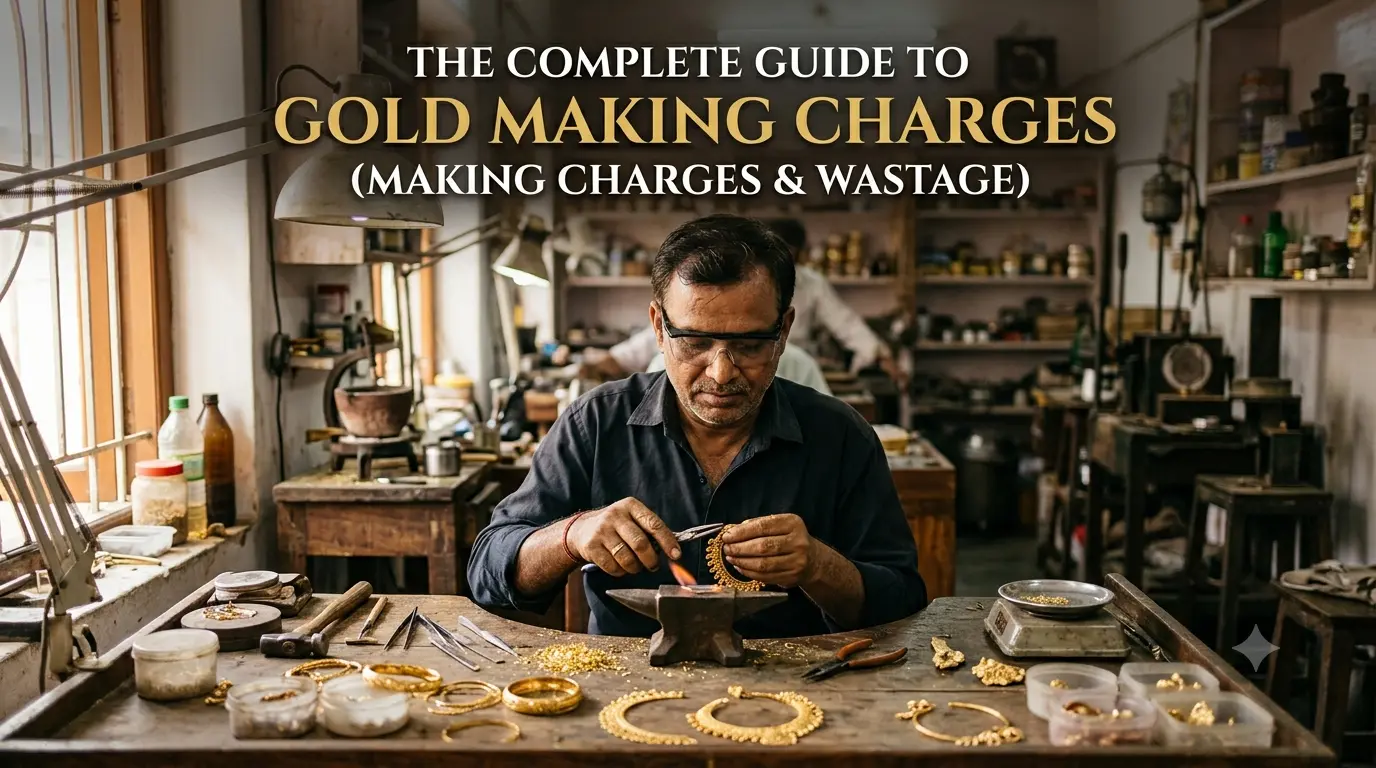
You walk into a Ahmedabad showroom, the board shows ₹9,800 per gram for 22K, and the salesperson says making is "only ₹650 per gram." Ten minutes later the printed estimate adds ₹1.2 lakh in labour on a bridal set you thought was priced like a plain chain. Making charges are the silent margin between the metal you can recover at buy-back and the rupees you actually pay at the counter — yet most buyers focus only on the per-gram gold rate.
This guide explains gold making charges in India: how showrooms quote per gram vs flat labour, what portion you lose when you sell or exchange, and practical negotiation habits on CG Road and in Surat wholesale lanes. For karat purity and hallmark basics, see our 22K vs 24K gold guide in one sentence only. For how MCX relates to the board number, see the MCX vs local market gold rate guide. Check today's gold price today on GS24LIVE before you compare quotes.
Key Takeaways
- Making charges are labour and design premiums on top of metal value — they are rarely fully recovered when you sell scrap or exchange old gold.
- Per-gram making is easier to compare across shops; flat-rate or "percentage of gold value" quotes need a calculator before you sign.
- Bridal sets with hand work and stone settings carry higher effective making per net gold gram than machine-made chains.
- "Zero making charge" festival offers often hide labour inside a higher gold rate or non-refundable stone bills — read the itemised invoice.
- Ask for buy-back terms on making recovery before payment; Ahmedabad counters differ sharply on plain chain vs ornate necklace.
How Showrooms Build Your Final Jewellery Bill
Retail gold jewellery pricing in India stacks four visible layers: metal value at the day's board rate, making charges (labour and design), GST on the combined taxable value, and sometimes separate stone or certification lines. The metal line tracks international spot, import duty, and dealer margin — for that stack see our MCX vs local guide in one link only. Making charges sit entirely on the jewellery side; they compensate the karigar, the wastage allowance, and the showroom's design inventory risk.
Coins and plain bars usually carry the lowest making — often quoted as a small per-gram add-on or a fixed rupee premium per piece. Bridal necklaces may quote ₹800–₹1,500 per gram on net gold weight while a machine chain sits near ₹400–₹600 per gram in Gujarat wholesale corridors. The same family budget buys fewer net grams when making eats a larger share.
Per Gram vs Flat vs Percentage: Charge Types Compared
| Quote style | How it appears on invoice | Buyer advantage | Watch-out |
|---|---|---|---|
| Per gram making | Net gold weight × rate + metal | Easy to compare two shops on same design weight | Confirm net gold after stone deduction |
| Flat labour (lump sum) | Single "making" line for whole piece | Can work for unique custom bridal | Divide by net grams to compare — often looks cheaper until you calculate |
| Percentage of metal value | 12%–18% of gold line (sample bands) | Common on antique reproduction sets | Rises automatically when gold price spikes |
| Included in rate | One all-in ₹/g board | Simple mental math at counter | Harder to see buy-back loss; ask for metal-only breakup |
Worked Example: 40-Gram Plain Chain vs 40-Gram Net Bridal Set
Illustrative 22K board at ₹9,600/gram — verify live rates on purchase day.
| Line item | Plain machine chain | Bridal necklace (40g net gold) |
|---|---|---|
| Metal value | ₹3,84,000 | ₹3,84,000 |
| Making style | ₹450/g × 40g = ₹18,000 | ₹1,10,000 flat labour |
| Effective making per gram | ₹450/g | ₹2,750/g equivalent |
| GST 3% on metal+making (sample) | ₹12,060 | ₹14,820 |
| Total invoice (excl. stones) | ₹4,14,060 | ₹5,08,820 |
| Illustrative buy-back on metal only | ~₹3,65,000 (sample spread) | ~₹3,65,000 on same metal |
| Implied making loss if sold as scrap | ~₹49,000 all-in premium lost | ~₹1,43,820 premium lost |
The bridal buyer paid nearly the same for metal but carries far more irrecoverable labour. That is not wrong if the ornament purpose justifies it — it is expensive only if you believed you were buying "investment grams."
Historical Making-Charge Bands in Indian Retail
| Period | Retail pattern | Buyer impact |
|---|---|---|
| Pre-2017 GST | Making often bundled opaquely in ₹/g | Hard to compare; VAT treatment varied by state |
| 2017–2020 | 3% GST on jewellery clarified metal vs making lines | Itemised invoices improved; negotiation shifted to making line |
| 2021–2024 | Online jewellers publish per-gram making bands | Offline shops face comparison pressure; festival zero-making ads rise |
| 2025–2026 | High gold prices push absolute making rupees up even when ₹/g rate flat | Same percentage making costs more in total rupees |
CG Road & Surat Lanes: How Sarafs Quote Making on Busy Weekends
Ahmedabad's CG Road and Ashram Road showrooms compete on board rate visibility, but experienced buyers know the negotiation happens on the making line after purity is fixed. Surat's wholesale jewellery lanes often quote lower per-gram making on machine sets destined for re-export, while bridal counters inside the same building charge a premium for local wedding season inventory.
- Ask for two estimates: one with itemised net gold weight from the scale reading, one with making shown separately — Gujarat buyers who photograph both pages report fewer disputes at exchange time.
- On Akshaya Tritiya queues, compare effective making per gram across two shops before you pay a token advance; board rates may match but labour lines diverge by ₹200–₹400 per gram on heavy sets.
- Manek Chowk scrap buyers pay on metal, not your making — if you might sell within five years, favour lower making plain designs over high-labour fashion pieces.
- Request buy-back policy in writing: some Ahmedabad chains refund 20%–40% of original making on exchange within 12 months; scrap sale recovers none.
Risks When You Accept a Festival "Zero Making Charge" Banner
Zero-making promotions are marketing events, not charity. Common patterns include bumping the gold rate ₹150–₹300 per gram above the wholesale-linked board next door, requiring stone purchases at non-refundable prices, or locking you into exchange-only exit without scrap buy-back. GST still applies on the taxable value — if making is hidden inside metal, you pay tax on labour anyway.
Another risk: quoting zero making on gold while charging a separate "design fee" or "cad charge" line that does not count as making in the salesperson's pitch. Read every rupee line before digital payment — UPI receipts are harder to unwind than unsigned verbal promises.
Practical Strategy: Seven Questions Before You Pay
- What is net gold weight after stone removal, and can I watch the weighing?
- Is making per gram, flat, or percentage — and what is the effective ₹/g?
- What buy-back or exchange credit applies to making if I return within one year?
- Does the invoice separate metal, making, stones, and GST clearly?
- How does this quote compare to a plain chain with the same net grams?
- Is the gold rate linked to today's board or a festival all-in rate?
- If I sell unpledged scrap later, what will I lose beyond metal spread? See our sell old gold guide for buy-back math after purchase.
Exchange Offers vs Scrap Sale: Where Making Charges Hurt Most
Some Ahmedabad chains advertise partial making refund when you exchange old jewellery for new within 12 months. That policy can recover 20%–40% of labour on the old piece while charging fresh making on the new design — net savings only if the exchange spread on gold rate is fair. Scrap sale at Manek Chowk or a licensed buy-back counter ignores making entirely; you receive metal value minus assay spread. Families holding high-labour bridal sets from a decade ago often discover the exchange window expired while the set sat in a locker — plan exit channel before you buy, not after gold rallies.
Coins and thin machine chains sit in the middle: making loss is smaller in absolute rupees, so scrap sale is simpler when you need cash. Ornate sets with ₹1 lakh or more in embedded labour favour exchange policies if the jeweller is solvent and the written policy survives management changes. Photograph the exchange terms on the original invoice; verbal promises at Diwali counters do not survive disputes.
Invoice Line Items Worth Checking Before UPI Payment
- Separate lines for metal weight, rate, making, stone, hallmark charges, and GST — not one bundled round number.
- HUID number matching the tag on the piece you weighed.
- Buy-back or exchange clause with month limit and percentage recovery on making.
- Stone weight listed separately from net gold — bridal sets often hide labour inside stone bills.
Frequently Asked Questions
1. What are typical gold making charges in India?
Machine-made 22K chains often fall in ₹350–₹700 per gram bands; bridal hand work can exceed ₹1,000 per gram equivalent. Coins and bars may use ₹50–₹200 per gram or a small flat premium. Bands vary by city, design, and season — always calculate effective ₹/g for your exact piece.
2. Are making charges refundable when I sell gold?
Scrap and open-market buy-back pay on metal purity and weight, not original labour. Some showrooms refund part of making on exchange for new jewellery within a policy window — not on cash scrap sale. Confirm before purchase.
3. Is GST charged on making charges?
Yes — GST on gold jewellery applies on the combined value of metal and making (current structure as per applicable tax law). A separate stone bill may follow different treatment; keep the full tax invoice for records.
4. Which is better: per gram or flat making charges?
Per gram is easier to benchmark across shops for similar designs. Flat quotes suit one-off custom pieces if you divide by net grams and compare honestly to catalogued alternatives.
5. Do coins have making charges?
Yes, but far lower than jewellery. MMTC and bank coins carry small premiums; compare per-gram all-in cost against a plain bar from a refinery-registered dealer.
6. How do I negotiate making charges in Ahmedabad?
Negotiate after purity and weight are fixed, not before. Ask for itemised breakup, compare a second shop the same morning, and trade making concessions against stone lines or future exchange credit — not against hallmark standards.
Data Sources and References
- Bureau of Indian Standards (BIS) — hallmarking rules affecting net gold weight on invoices.
- Multi Commodity Exchange of India (MCX) — wholesale gold reference behind retail boards.
- World Gold Council — India jewellery demand and retail market structure.
- Reserve Bank of India (RBI) — macro context for gold pricing and import economics.
- Reuters — bullion market news moving daily board rates.
Conclusion
Gold making charges in India decide how much of your jewellery bill survives a future sale. Compare effective labour per net gram, not just the headline board rate, and treat bridal labour as ornament cost rather than bullion savings. Itemised invoices, buy-back policies, and a same-morning second quote on CG Road prevent the expensive surprise of paying investment prices for fashion metal.
Before you wire an advance this wedding season, run the 40-gram worked example against your own estimate. The chain and the necklace can share the same purity — only making separates a wise buy from a beautiful loss.
Disclaimer: This article is for informational and educational purposes only. Precious metal investments are subject to market risks. Charts use illustrative data; verify live prices and consult a qualified financial professional before purchasing.
Keywords: gold making charges India, making charges per gram gold, gold jewellery making charges, buy back making charges gold, flat making charges jewellery, making charges Ahmedabad, GST on gold making charges.