
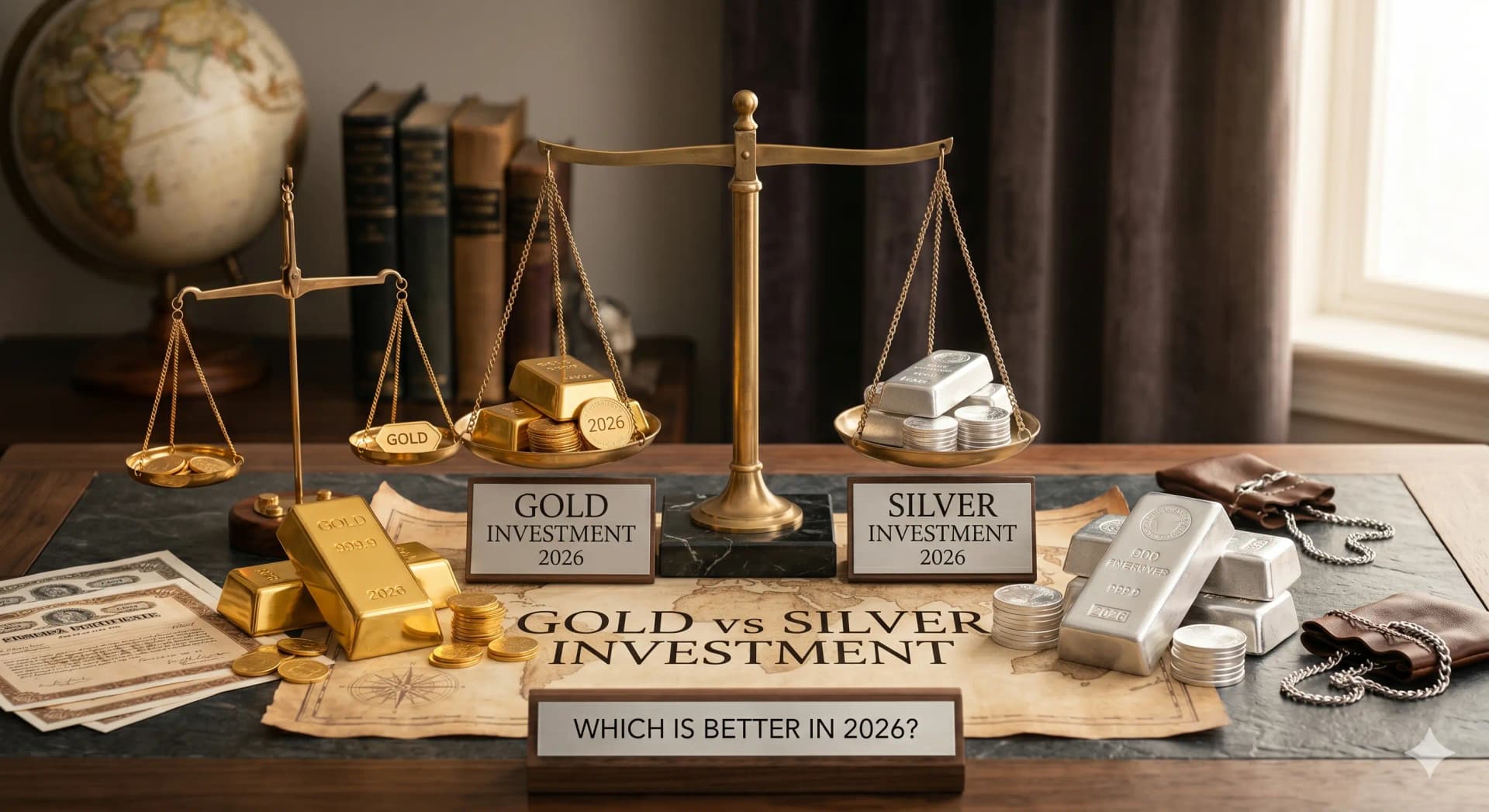
Walk into any bullion shop in Ahmedabad before a wedding season and you will hear the same debate: should we buy more gold, add some silver, or split the budget? Online, the question shows up as gold vs silver investment searches and late-night comparisons of gold price today versus silver price today. In 2026, with both metals on many investors' watchlists, the honest answer is not a single winner—it is a fit-for-purpose choice.
Gold and silver share a precious-metals label but behave differently in portfolios. Gold is deeply embedded in Indian culture, central-bank reserves, and safe-haven narratives. Silver carries a heavier industrial footprint, which can accelerate rallies and deepen corrections. This guide compares both sides for Indian readers who follow MCX screens, visit local saraf markets, or build long-term allocation through ETFs and sovereign products.
Nothing here is personalised financial advice. The goal is education: how each metal has performed, what risks matter on MCX, and how Ahmedabad bullion participants think about timing and purity when choosing between the two. Before you size a purchase, check live boards on gold rate today Ahmedabad and silver rate today Ahmedabad, then estimate metal value with our gold calculator or silver calculator.
Key Takeaways
- Gold is often favoured for stability, cultural demand, and long-term wealth preservation.
- Silver can offer higher percentage swings because of industrial use and a smaller market.
- Neither metal guarantees returns; both respond to global macro, rupee moves, and policy.
- MCX gold and silver contracts help traders hedge; retail buyers still focus on all-in counter prices.
- Many Indian portfolios use gold as a core holding and silver as a smaller satellite position.
- Match karat and fineness before comparing quotes — see our gold purity guide for 24K, 22K, 18K and BIS marks.
Gold vs Silver Overview
At the simplest level, gold is primarily a monetary and jewellery asset globally, while silver is both a precious metal and an industrial commodity. That dual identity is why silver price today can jump on solar or electronics headlines even when gold is quiet. Indian investors feel both channels through import parity, GST, and local premia.
| Feature | Gold | Silver |
|---|---|---|
| Primary role in India | Jewellery, savings, weddings | Jewellery, gifts, selective investment |
| Typical volatility | Moderate | Often higher |
| Industrial demand share | Smaller globally | Large (solar, electronics, EVs) |
| MCX liquidity | Very deep | Deep but can gap on news |
| Storage and purity concerns | High awareness, hallmarking | Similar, plus tarnish for physical bars |
| Beginner friendliness | High cultural familiarity | Requires more volatility tolerance |
The chart below illustrates how analysts often bucket attention across macro themes that touch both metals. It is a teaching graphic, not a prescription for how much to buy of each.
Why Investors Buy Gold
Gold's case in India rests on generations of trust. Families buy for marriages, festivals, and as a store of value that sits outside the banking system. Institutional investors add gold for diversification when equities wobble or when real yields compress. Central banks worldwide have also increased reserves, reinforcing the idea that gold remains a strategic asset.
Practical advantages for Indian holders include wide acceptance at jewellers, established hallmark standards, sovereign gold bonds for paper exposure, and liquid ETFs on exchanges. Gold tends to draw the first allocation when households decide to add bullion exposure.
From a portfolio perspective, gold often acts as the ballast when equity indices correct or when the rupee weakens against the dollar. It does not require investors to forecast semiconductor cycles or solar installation targets—themes that matter more to silver. That simplicity is one reason financial planners discussing safe haven investment in India usually mention gold before other commodities.
Why Investors Buy Silver
Silver attracts investors who accept more volatility in exchange for participation in industrial growth themes. Renewable energy build-out, consumer electronics, and mobility supply chains consume silver in ways gold does not. When those sectors accelerate, sentiment can lift silver faster than gold on a percentage basis.
Silver coins and bars are popular in India, though the market is thinner than gold in many towns. Price-sensitive buyers sometimes favour silver for lower entry tickets per gram, but making charges and spreads still matter at the counter.
Investors who follow silver market analysis closely often pair physical holdings with occasional MCX exposure when they have risk controls in place. The metal can reward patience during multi-year industrial upcycles, but it punishes leverage used without stop-discipline. Treating silver as a smaller satellite rather than a clone of a gold position usually produces calmer outcomes.
Gold vs Silver Historical Performance
Calendar-year returns rarely line up neatly. Silver has delivered standout years when industrial demand and speculative flows align; gold has shown steadier grinding uptrends during uncertainty phases. Comparing them only on the best year for each metal can mislead beginners.
| Year | Gold Return % (illustrative) | Silver Return % (illustrative) |
|---|---|---|
| 2021 | +4 | -5 |
| 2022 | +12 | +6 |
| 2023 | +13 | +8 |
| 2024 | +22 | +28 |
| 2025 | +18 | +32 |
Past performance does not guarantee future results. Use historical tables to understand dispersion, not to forecast the next twelve months.
Volatility Comparison
Volatility is the practical difference many MCX traders notice first. Silver's smaller market and industrial beta can produce wider intraday ranges. Gold often moves more slowly except during macro shocks. Beginners who panic on a five-percent silver dip may be better served with a higher gold weighting even if they admire silver's upside stories.
| Metric (sample week) | MCX gold | MCX silver |
|---|---|---|
| Typical daily % range | Narrower | Often wider |
| Gap risk on news | Present | Frequently larger |
| Margin sensitivity | High on leverage | Very high on leverage |
The line chart uses indexed sample data to show how macro channels such as currency strength can coincide with bullion moves. Gold and silver do not always react identically to a firmer dollar.
Inflation Hedge Comparison
Both metals are discussed as inflation hedges, but the linkage is imperfect over short horizons. Rising inflation can lift bullion sentiment while simultaneously pushing bond yields higher, which may cap gold on specific days. Silver can inherit the hedge narrative and industrial demand story at once, creating mixed signals.
For long horizons, many Indian families still treat gold as a purchasing-power anchor. Silver may complement that view when investors believe industrial growth will support prices, accepting that manufacturing slowdowns can hurt silver independently of gold.
Industrial Demand Impact
Industrial demand is the clearest structural difference. Gold's technology use is meaningful but smaller relative to jewellery and investment. Silver's pipeline into solar panels, electronics, and electric vehicles ties it to global capex cycles. Policy support for clean energy can lift sentiment even before physical shortages appear.
When industrial data softens, silver can underperform gold despite sharing the same safe-haven headlines. Investors comparing gold vs silver investment in 2026 should track manufacturing PMIs and sector earnings, not only central-bank speeches.
The demand-sector graphic highlights how global gold consumption is often discussed by category. Silver's industrial slice would look larger in a silver-specific breakdown; the lesson is that demand composition drives behaviour.
MCX Gold vs MCX Silver Analysis
MCX offers regulated futures and options for both metals, with contracts sized for different participant types. Gold contracts anchor hedging for jewellers and banks; silver contracts attract traders seeking beta. Spreads, rollovers, and margin requirements differ, so a strategy that works on gold futures may be too aggressive on silver without resizing.
Daily sessions often open with overnight global cues. A steady international gold price can still produce active MCX gold if the rupee moves. Silver may amplify the session if industrial metals are strong overseas. Always confirm contract specifications on the exchange website.
Best Investment Option for Beginners
Beginners with limited experience in bullion volatility often start with gold through familiar channels: small bars, coins, or regulated paper products. Silver can be introduced later once they have observed a full market cycle and understand drawdowns.
If the entry ticket is the constraint, silver's lower price per gram can be attractive, but total cost includes spreads and storage. Sovereign gold bonds and gold ETFs remove locker risk for gold; silver ETFs exist but check liquidity and tracking. Avoid leveraged MCX positions until risk rules are clear.
Long-Term Investment Strategy
A common framework among Indian advisors is a core-satellite approach: gold as core bullion exposure, silver as satellite. Systematic accumulation—monthly or quarterly—reduces timing stress. Rebalancing once a year prevents silver from dominating after a strong industrial year.
Pair bullion with equities, debt, and emergency cash. Precious metals should complement, not replace, diversified financial assets. Tax treatment varies by instrument; verify current rules with a qualified professional.
Some families allocate a fixed rupee amount into gold monthly and review silver only after gold targets are met. Others split a single bullion budget seventy-thirty in favour of gold. Either approach can work if it is written down and reviewed annually rather than changed after every headline.
Risk Factors
| Risk | Gold | Silver |
|---|---|---|
| Price volatility | Moderate | Often higher |
| Industrial cycle exposure | Lower | High |
| Storage and theft | Physical risk | Physical risk |
| Regulatory and tax changes | Affects all formats | Affects all formats |
| Leveraged trading loss | MCX margin calls | MCX margin calls, often sharper |
Emotional buying around headlines remains a risk for both metals. Stick to written rules for position size and holding period.
Gold & Silver Outlook for 2026
Commentary for 2026 centres on the interaction of rates, dollar trends, and industrial demand. Gold may continue to benefit from diversification flows if geopolitical and fiscal uncertainties persist. Silver could outperform during stretches of strong green-energy capex but may correct harder if global manufacturing softens.
Indian investors should monitor RBI communication, import economics, and festival calendars alongside international spot. Neither metal wins every macro regime; pairing awareness with discipline matters more than picking a single day's winner.
For 2026 specifically, watch how real yields evolve after inflation data, whether central banks continue adding gold reserves, and if industrial silver demand forecasts are revised after energy-policy shifts. A bullion investment guide that ignores those three threads will feel complete on paper but thin in practice.
Frequently Asked Questions
1. Gold or silver—which is better in 2026?
Neither is universally better. Gold suits stability-focused holders; silver suits those who accept volatility for industrial upside potential.
2. Is silver a good investment for beginners in India?
Beginners often start with gold because of familiarity and lower relative volatility. Silver can be added later with a smaller allocation.
3. Can silver outperform gold during bull markets?
Yes, in cycles where industrial demand and investment flows align; expect larger drawdowns between peaks as well.
4. How do gold and silver behave differently in an Indian portfolio?
Gold offers lower volatility and cultural liquidity. Silver provides a smaller entry ticket and industrial beta, with sharper swings in both directions.
5. How do I estimate what a gold or silver purchase costs today?
Use live Ahmedabad boards for the per-gram or per-kg quote, then run weight × purity on the gold calculator or silver calculator. Making charges and GST sit on top of metal value.
6. Does purity matter when comparing gold vs silver jewellery?
Yes. Gold jewellery is usually billed on 916 (22K) or sometimes 750 (18K); investment bars track closer to 999. Confirm fineness and hallmark marks with our gold purity guide before treating two quotes as equivalent.
Data Sources and References
The figures and frameworks in this gold vs silver investment explainer reference publicly listed exchange and policy sources used by Gujarat and India market watchers.
- Multi Commodity Exchange of India (MCX) – India futures venue used here to frame gold vs silver investment session behaviour and liquidity.
- World Gold Council – gold demand and investment research cited for the gold vs silver investment global backdrop.
- London Bullion Market Association (LBMA) – international pricing and standards reference for the gold vs silver investment purity and benchmark notes.
- Reserve Bank of India (RBI) – policy and rupee context used when explaining gold vs silver investment transmission to local bullion.
- Reuters – international news service covering commodities, currencies, and macroeconomic developments.
- International Monetary Fund (IMF) – global outlook reference for the gold vs silver investment macro and inflation-linked sections.
These sources help provide reliable insights into global bullion markets, macroeconomic trends, and price movements affecting gold and silver trading in India.
Conclusion
Choosing between gold and silver in 2026 is less about crowning a permanent winner and more about matching each metal's behaviour to your goals, horizon, and risk tolerance. Gold remains the familiar anchor for many Indian households; silver offers industrial torque with extra volatility.
Use live prices, understand MCX mechanics if you trade, and keep bullion as part of a broader plan. Size gold for stability and cultural use, keep silver smaller if you accept wider swings, and rebalance when your goals change — not when a single session makes one metal look temporarily smarter. When you are ready to translate a quote into rupees, the calculators and purity guide linked above keep the maths and karat language consistent.
Related Reading on GS24LIVE
- Live gold price today
- Live silver price today
- Gold rate calculator
- Silver rate calculator
- Gold purity guide (24K, 22K, 18K)
- Mutual funds vs digital gold
- Retail vs investment gold and silver
- What moves gold prices daily
Disclaimer: Comparison for education only — neither metal is guaranteed to outperform. Verify live counter and MCX prices and consult a qualified adviser before allocating capital.