
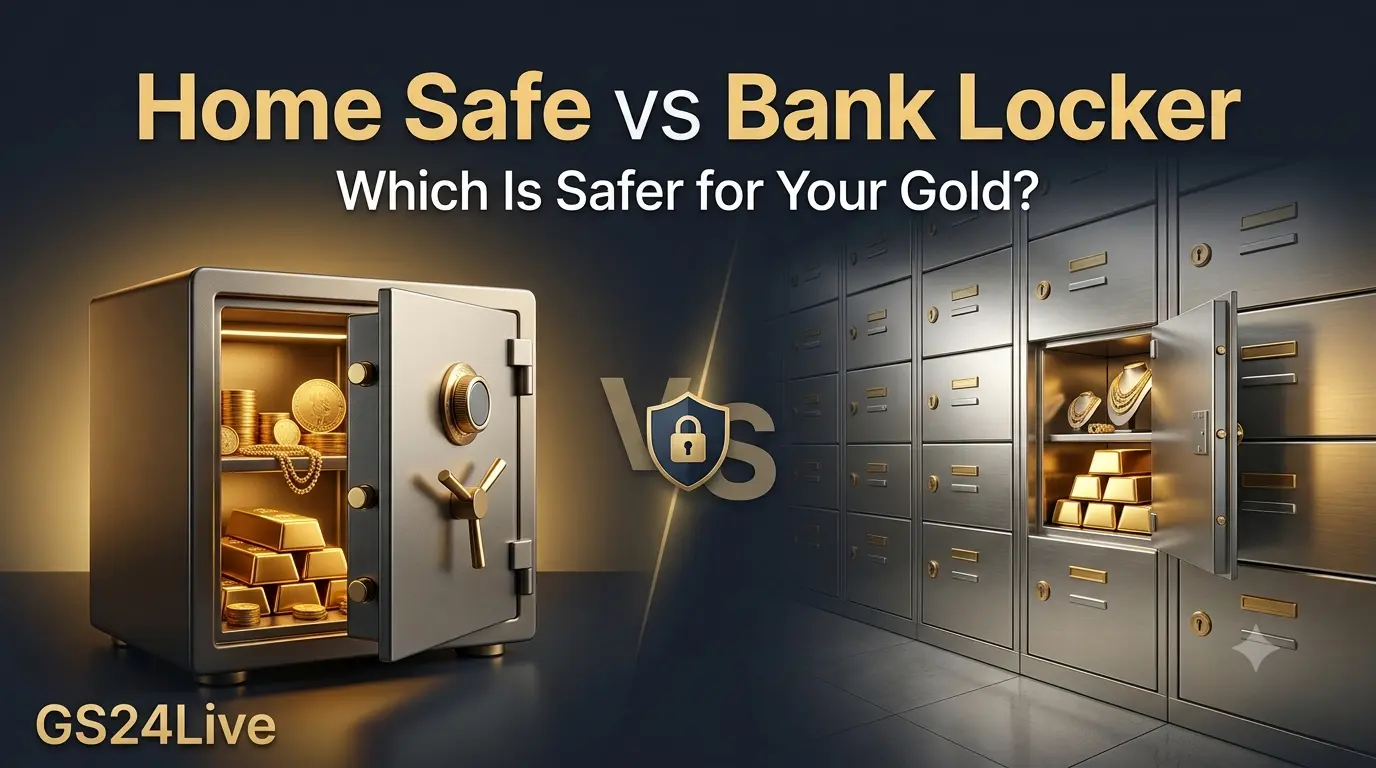
Buying gold is only half the job. The other half is keeping it recoverable — after a theft attempt, a monsoon leak, a family dispute, or a forgotten locker visit years later. Indian households still hold a large share of personal wealth in physical metal, yet many families treat storage as an afterthought: a kitchen drawer for coins, a Godrej almirah for bridal sets, and a vague plan to “get a locker someday.” Learning how to store gold safely India style means matching each holding to the right container, documentation, and access rules — not chasing the loudest safe brand advertisement.
This guide covers threat types, home-safe standards, bank locker mechanics, what to store where, inventory habits, and Gujarat-specific practical tips. Product choices such as Sovereign Gold Bonds vs physical gold and the Gold Monetisation Scheme are linked only where storage cost or idle-metal decisions intersect — those articles own product mechanics. Check live metal levels on GS24LIVE’s gold price today page when you value holdings for insurance or locker allocation.
Key Takeaways
- Safe storage is a system: container + access control + inventory + insurance thinking — not a single steel box.
- Bank lockers reduce home-theft risk but introduce branch hours, waitlists, rent, and nomination paperwork.
- Bridal jewellery you wear often needs a different plan than 24K coins you will not touch for a decade.
- Undocumented gold is harder to reclaim, insure, or prove ownership after loss — invoices matter as much as locks.
- Ahmedabad families often split holdings: daily-wear pieces at home under control, bulk coins and heirlooms in lockers.
What You Are Actually Protecting Against
Storage failures rarely look like movie heists. More often they are opportunistic theft after a social-media travel post, domestic staff turnover without inventory control, children finding “shiny boxes,” fire or water damage to paper certificates, or relatives disputing who holds the keys after a death. Flood floors in low-lying Ahmedabad pockets and terrace seepage can ruin velvet pouches and cardboard coin boxes even when metal itself survives.
Separate physical loss from paperwork loss. Metal that survives a fire but loses every invoice and hallmark photograph becomes harder to sell at a fair buy-back and harder to explain to an insurer. Treat documentation as part of storage, not an afterthought folder in a different cupboard.
Home Safe Standards That Matter More Than Brand Ads
A home safe helps only if it is bolted, fire-rated honestly, and placed where guests do not casually see it opened. Lightweight “hotel safes” screwed into particle board fail against determined thieves. Prefer a safe fixed to a structural wall or floor slab, with a combination or dual-control key policy so no single domestic helper can open it alone.
| Home option | Strength | Weakness | Best for |
|---|---|---|---|
| Bolted fire-rated safe | On-demand access; no branch hours | Still inside the home perimeter | Daily-wear sets, small coin float |
| Almirah / wardrobe hide | Convenient | First place thieves search | Avoid for high value |
| False-bottom furniture | Low visibility | No fire rating; family knowledge risk | Temporary only |
| Buried / outdoor hide | Off-home | Moisture, forgetfulness, legal disputes | Generally poor idea |
Never store loose stones, cash, and gold in the same unlocked drawer. Segregate coin certificates from jewellery pouches so a single spill or pest incident does not destroy every proof of purchase.
Bank Lockers: Rules, Access Limits, and Nomination
Safe-deposit lockers shift metal outside the residential footprint. Banks allot lockers subject to availability; many Ahmedabad branches run waitlists after festival buying seasons. You pay annual rent, follow KYC, and access only during banking hours — a real constraint if you need a wedding set on a Sunday evening.
Nomination and joint operation rules decide who can open the locker if the primary holder is unavailable. Update nominations after marriage, divorce, or death in the family. Photograph the locker agreement and keep a copy outside the locker itself — a classic mistake is locking the only agreement inside the box you cannot open.
| Year / period | Storage habit shift (illustrative India) | Household takeaway |
|---|---|---|
| Pre-2010 | Heavy reliance on home almirahs and informal village custody | Theft and dispute risk high; weak paperwork |
| 2010–2018 | Urban bank locker demand rises with apartment living | Waitlists appear in metro and Tier-1 branches |
| 2019–2022 | Digital gold and ETF awareness grows; physical still dominates weddings | Paper gold reduces some locker pressure — physical sets remain |
| 2023–2026 | High gram prices push families to split coins into lockers, keep wear pieces home | Hybrid storage becomes the practical default |
Locker contents are generally your responsibility under bank terms — do not assume the bank automatically reimburses jewellery theft at full market value. Read the agreement; consider separate jewellery insurance where available. For idle bars you never wear, compare locker rent against regulated alternatives such as SGB or GMS in the linked guides rather than re-learning those products here.
What Belongs at Home vs What Belongs in a Locker
- Home (controlled safe): Pieces worn weekly, lightweight daily chains, one emergency coin if culturally preferred — with inventory logged.
- Bank locker: Bulk 24K coins, heavy bridal sets between functions, heirloom polki not in active rotation, original invoices and assay cards in sealed sleeves.
- Neither alone: Extremely high-value holdings without insurance review or split-location thinking — concentration risk.
If you plan to sell scrap soon, storage is temporary — but still document weight and photographs before the trip to Manek Chowk. Resale process details live in our sell old gold Ahmedabad guide.
Inventory and Photo Documentation Checklist
- List each item: description, approximate weight, karat/HUID if marked, purchase date, invoice number.
- Photograph front, clasp, and hallmark area on a plain background; store copies in cloud and an offline drive.
- Note which pouch or locker box holds which items — scavenger hunts before weddings cause rushed mistakes.
- Update the list after every purchase, gift, or remake; stale inventories cause insurance and inheritance fights.
- Share the inventory location with one trusted adult — not the combination itself on the same message thread.
Ahmedabad Practical Habits: Lockers, Waitlists, and Festival Weeks
CG Road and Satellite Road families often face locker waitlists after Akshaya Tritiya and wedding-season spikes. Apply at two branches rather than one; keep rent auto-debit funded so the bank does not freeze access over a missed payment. During Rath Yatra or peak wedding weekends, avoid opening lockers the same morning you also negotiate a large showroom purchase — crowds and rushed paperwork invite skipped weighings.
- Carry a soft pouch and digital scale notes when retrieving sets for functions; re-weigh at home against your log.
- Do not announce locker visits on social media stories with branch landmarks in the background.
- If pledging metal for a gold loan, plan retrieval and re-storage dates before you pledge — loan articles own LTV math.
Risks of Undocumented or Single-Point Storage
Keeping everything in one home safe creates a single point of failure. Keeping everything in one locker creates access and succession friction. Keeping nothing documented creates reclaim and buy-back friction. Fraud patterns around undocumented purchases are covered in our gold jewellery scams guide — here the storage risk is simpler: if you cannot prove what you owned, recovery and insurance conversations stall.
Another quiet risk: multiple family members with partial knowledge and no written map. After a death, relatives may open the wrong box, miss a coin tin, or accuse each other of removal. A dated inventory signed by the primary holder reduces that conflict.
Practical Storage Strategy You Can Apply This Month
- Sort holdings into wear-often, wear-rarely, and never-wear (coins/bars).
- Move never-wear bulk to a locker or evaluate regulated paper alternatives for true idle metal.
- Bolt or upgrade the home safe for wear-often pieces; stop using the wardrobe default.
- Build the photo inventory in one weekend; back it up off-site.
- Review locker nomination and rent standing instructions before the next festival rush.
- Revisit the plan annually — gram prices and family composition change what “bulk” means.
Frequently Asked Questions
1. Is a bank locker safer than a home safe for gold in India?
For bulk holdings, lockers usually reduce residential theft risk, but they are not a full insurance policy and limit access hours. Many families use both.
2. Can jewellery stay in a bank locker for many years?
Yes, subject to rent and bank terms. Update nominations and visit periodically to check seals, moisture, and paperwork.
3. Should wedding gold and investment coins share one locker?
They can, but separate pouches and a written map help. Wear sets may need more frequent access than coins.
4. Does a bank locker cover burglary losses automatically?
Not automatically at full jewellery value in most retail agreements. Read your contract and consider separate cover where appropriate.
5. Is a home safe enough for a small coin collection?
A bolted, discreet safe can be enough for modest holdings if inventory and access control are strong. Scale up as value grows.
6. What documents should I store with gold?
Invoices, hallmark photos, locker agreements (copy outside the locker), and nomination proofs — not only the metal.
Data Sources and References
- Reserve Bank of India — banking and locker-related regulatory context for customers.
- World Gold Council — India household gold ownership and demand patterns.
- Bureau of Indian Standards (BIS) — hallmark identification useful for inventory photos.
- MCX India — reference pricing when valuing stored holdings.
- Reuters — reporting on household wealth and bullion market context.
Conclusion
Knowing how to store gold safely in India is less about buying the heaviest safe and more about splitting risk: home access for wear pieces, locker distance for bulk metal, and paperwork that survives accidents. Hybrid storage with a living inventory beats both “everything under the mattress” and “everything forgotten in a locker.”
Review nominations, bolt the home safe, and photograph what you own before the next wedding or festival rush. Metal you cannot find, prove, or calmly retrieve is metal that fails its job as family security.
Disclaimer: This article is for informational and educational purposes only. Precious metal investments are subject to market risks. Storage and insurance terms vary by bank and insurer; verify agreements and consult a qualified professional before acting.
Keywords: how to store gold safely India, bank locker for gold jewellery, home safe for gold India, gold storage tips Ahmedabad, safe deposit locker gold, protect gold from theft, gold inventory checklist.