
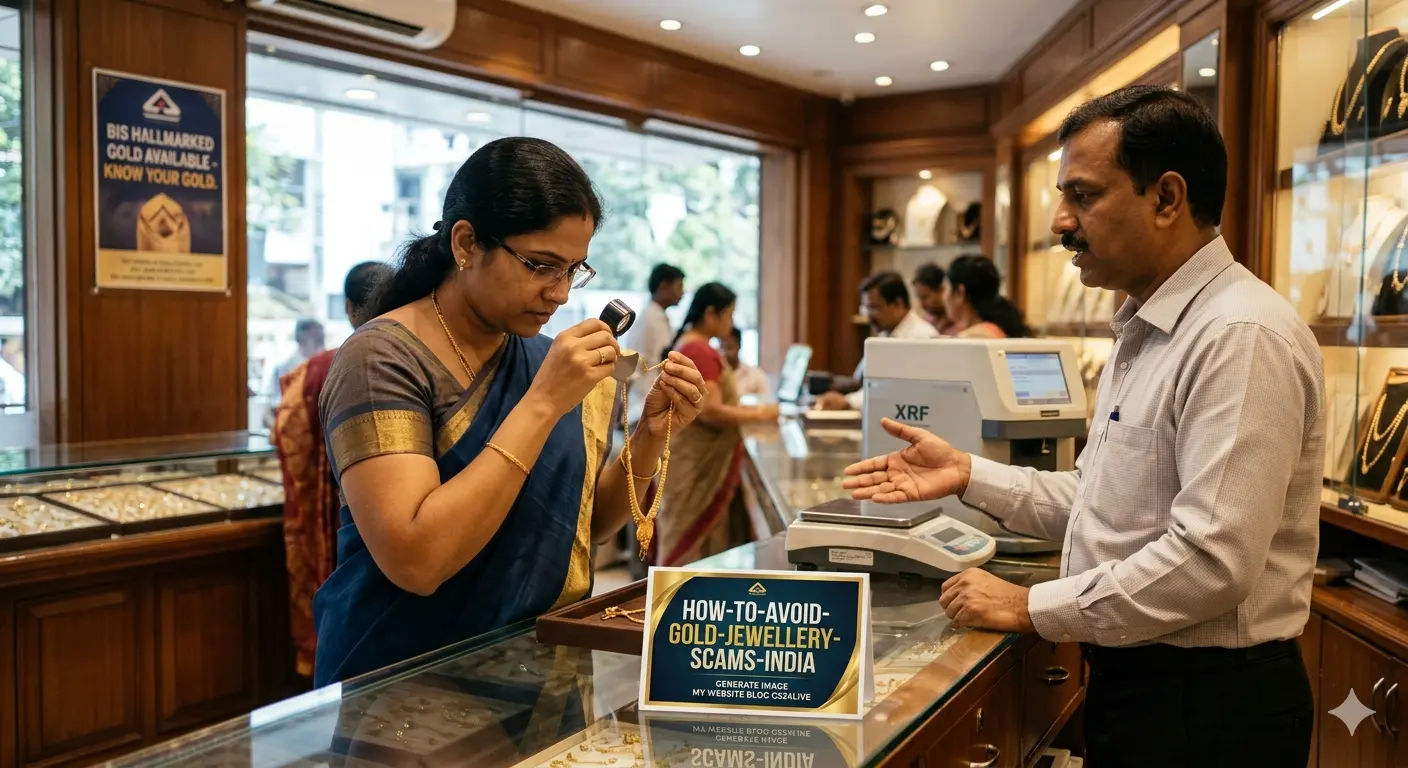
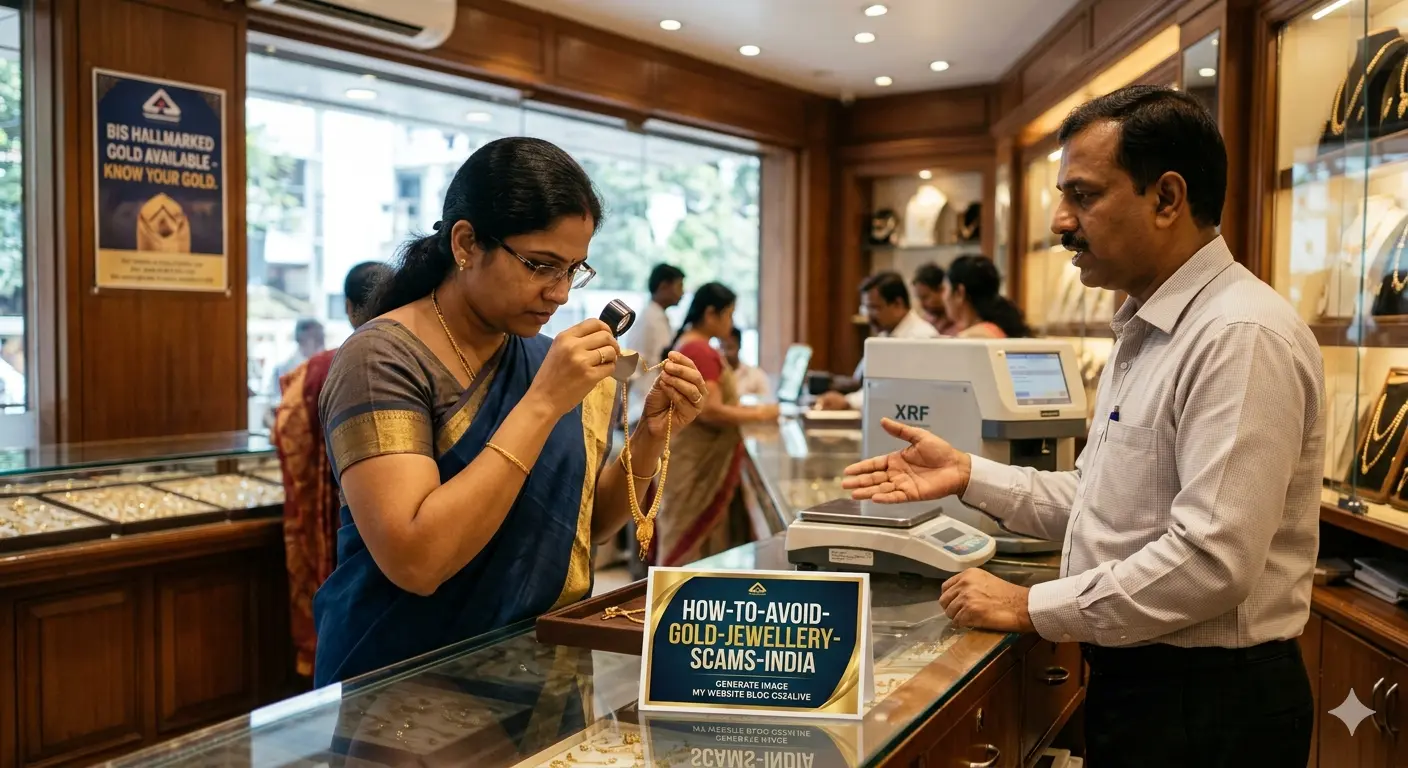
A showroom in Ahmedabad quotes ₹400 less per gram than every competitor on CG Road. The design is exactly what you wanted for the wedding, and the manager says the offer expires tonight. That urgency — not the discount — is often the first sign of a gold jewellery scam. Legitimate jewellers compete on service, hallmarking, and buy-back reputation; they rarely need pressure tactics to close a ₹3-lakh bridal set.
This guide explains the most common gold jewellery scams in India, how they show up in Ahmedabad and Gujarat markets, and the concrete checks you should complete before paying a single rupee. It is educational content, not legal advice. For karat and purity basics, see our 22K vs 24K gold guide. Confirm today's gold price today on GS24LIVE before comparing quotes.
Key Takeaways
- Gold jewellery scams in India usually exploit trust, urgency, and incomplete invoices — not sophisticated chemistry.
- Every hallmarked piece must carry BIS marks and a unique six-digit HUID that matches your invoice before you pay.
- Bait per-gram rates often hide inflated making charges, padded stone weight, or lower-than-claimed karat.
- Walk away from cash-only deals, missing GST invoices, and sellers who refuse written buy-back terms.
- Keep your invoice, HUID record, and weight slip for years — they are your only defence at resale or dispute.
Common Gold Jewellery Scams in India
Fraud patterns repeat because gold is emotional, expensive, and bought under time pressure before weddings and festivals. Scammers know buyers focus on the per-gram board rate and overlook everything else on the invoice. Understanding gold jewellery scams India buyers report most often helps you spot them before money changes hands.
| Scam type | How it works | What you lose |
|---|---|---|
| Fake or missing hallmark | Stamp looks genuine but HUID does not verify, or tag is swapped after you select the piece | Purity shortfall — you pay for 22K, receive 18K or lower |
| Bait per-gram pricing | Advertised rate is far below market; margin recovered via making charges | 15–30% extra on final invoice vs a transparent competitor |
| Stone weight padding | Semi-precious stones billed at gold weight or not deducted from gross weight | Metal value overstated on heavy bridal sets |
| Old gold exchange trick | Your old jewellery weighed wet, valued low, then applied as discount on overpriced new piece | Double loss on exchange and purchase |
| Online / WhatsApp wire fraud | Social media ads, fake branded sites, advance payment for "wholesale" gold that never arrives | Full payment with no delivery |
Fake Hallmark and HUID Fraud
Mandatory BIS hallmarking added the six-digit HUID — a unique ID per piece traceable through the Bureau of Indian Standards system. Scammers may attach tags from a genuine piece to lower-purity stock, reuse old tags, or press fake stamps that look correct to an untrained eye.
Before payment, scan or enter the HUID on the BIS Care app or portal and confirm the jeweller name, purity (916 for 22K), and weight line match the tag in your hand. If verification fails, stop — regardless of how convincing the showroom looks. Our 22K vs 24K guide explains fineness marks in detail; this article focuses on fraud patterns, not karat chemistry.
Bait Pricing and Making Charge Tricks
The oldest jewellery scam is arithmetic, not alchemy. A board showing ₹950 per gram when competitors quote ₹990 attracts footfall. The invoice then lists making charges of ₹1,200 per gram on a hand-work necklace, or bundles stones into the metal line without separation.
Always request a written break-up: gross weight, net gold weight, stone weight (if any), metal rate, making charge per gram or flat, GST on each component, and total. Compare final invoice totals across two or three Ahmedabad showrooms — not headline per-gram rates alone.
Stone Weight and Karat Mislabelling
Bridal sets with ruby, emerald, or polki inserts carry significant non-gold weight. Honest invoices show stone weight separately and charge stones on their own line. Dishonest sellers include stone mass in the gold weight column, so you pay 22K rates for glass or low-grade material.
Ask for the net gold weight after stone deduction in writing. For heavy sets, consider getting an independent weighing at a nearby shop if something feels off — reputable jewellers in Ahmedabad's established lanes rarely object to transparency.
Online, WhatsApp, and Social Media Gold Scams
Gold jewellery scams India-wide increasingly start on Instagram, WhatsApp groups, and fake e-commerce pages offering "direct import" or "factory outlet" prices. Red flags include payment only via UPI to a personal account, no physical address, no GST number on the invoice preview, and refusal to meet at a registered showroom.
Never wire an advance for gold you have not physically inspected and hallmarked. If the deal requires secrecy or bypasses standard GST billing, treat it as fraud regardless of the discount percentage.
Old Gold Exchange Manipulation
Exchange offers — "bring old jewellery, get ₹50,000 off" — can hide two scams at once. Your old gold may be valued below spot on a wet-weight scale or assessed at 18K when it is 22K. The new piece may then be priced above market so the "discount" is illusory.
Get your old gold valued independently at two shops, note the per-gram buy-back rate, then compare the net out-of-pocket cost of the new purchase. A genuine exchange benefit shows up in total rupees spent, not in marketing headlines.
Ahmedabad Bullion Market: Local Scam Patterns
Ahmedabad's jewellery corridors — CG Road, Ashram Road, and wholesale lanes near Manek Chowk — see scam pressure spike before Diwali, wedding season, and Akshaya Tritiya when counters are crowded and buyers skip steps. Local patterns include:
- Pop-up counters in malls offering "exhibition-only" rates with no permanent GST registration
- Intermediaries outside established showrooms promising "staff discounts" if you pay them instead of the billing desk
- Rushed HUID verification — staff discourage checking the tag because "the queue is long"
- Verbal promises of buy-back at "full rate" with nothing on the invoice
Established Ahmedabad families often buy from the same two or three jewellers for decades precisely because dispute resolution and buy-back depend on reputation, not a one-day discount. If you are new to the city, ask trusted neighbours which showroom handled their last wedding purchase — and whether buy-back matched expectations.
Investment Risks of Undocumented Purchases
Jewellery bought without proper hallmarking and invoices behaves like a speculative bet, not a store of value. At resale, unmarked pieces face re-assay delays, lower trust premiums, and sharper dealer spreads. You may discover purity issues only when you need liquidity — exactly when you cannot afford a loss.
If wealth preservation matters more than wear, hallmarked coins or bars with lower making charges suit the goal better than ornate pieces from unverified sellers. See our retail vs investment gold guide for format comparison.
Pre-Payment Checklist: Seven Steps Before You Pay
- Verify HUID on the BIS system — tag, piece, and invoice must match.
- Get full invoice break-up: metal, making, stones, GST — all separate lines.
- Confirm 916 (22K) or stated purity in writing, not verbally alone.
- Weigh the piece on a visible scale; note gross and net gold weight.
- Photograph the piece, tag, and invoice before leaving the counter.
- Pay by traceable method; insist on GST invoice with seller's registration number.
- Ask for buy-back terms in writing — spread, timeline, and same-showroom policy.
Complete all seven before transferring payment. If any step is refused, leave — a legitimate Ahmedabad jeweller loses one sale; you avoid losing lakhs.
How Consumer Complaints and Regulation Have Evolved
| Period | Buyer protection shift | Scam impact |
|---|---|---|
| Pre-2000 | Trust-based buying; verbal purity claims common | High — few verification tools for ordinary buyers |
| 2000–2015 | Voluntary hallmarking expands; more assay labs | Moderate — counterfeits still possible without HUID |
| 2015–present | Mandatory hallmarking phases; HUID per piece | Lower for documented purchases — if buyer verifies before paying |
| 2020–present | Digital BIS verification; online fraud rises in parallel | Split — showroom fraud down, remote wire scams up |
Regulation improved traceability for in-store purchases, but it cannot protect buyers who skip verification or send money to unregistered online sellers. Your checklist matters more than any rule on paper.
Frequently Asked Questions
1. How can I verify a gold HUID number before buying?
Use the BIS Care app or official BIS portal to enter the six-digit HUID on the tag. Confirm jeweller name, purity fineness, and that the details match the piece and invoice in front of you. If verification fails, do not pay.
2. What should I do if a jeweller refuses to give a proper GST invoice?
Treat refusal as a scam indicator. Walk away and report the seller to GST authorities if you already have evidence. A legitimate Ahmedabad showroom always issues a tax invoice for traceable purchases.
3. Are online gold deals at huge discounts usually scams?
Deep discounts with advance payment to personal UPI accounts, no physical showroom, or no hallmark preview are high-risk. Legitimate online gold sellers provide GST billing, insured delivery, and hallmark documentation.
4. Can I test gold purity accurately at home?
Home acid kits and magnets are unreliable for final purchase decisions. Use BIS hallmark and HUID verification instead. Independent assay at a certified lab is an option for high-value disputes, not routine shopping.
5. How does stone-weight fraud work on bridal jewellery?
Sellers include decorative stone weight in the gold weight column, so you pay 22K metal rates for non-gold mass. Insist on separate stone and net gold weight lines on the invoice before payment.
6. What records should I keep after buying gold jewellery?
Keep the GST invoice, HUID photograph, weight slip, payment receipt, and buy-back terms for the full ownership period. These documents are essential for resale, insurance claims, and consumer complaints.
Data Sources and References
- Bureau of Indian Standards (BIS) — hallmarking standards, HUID verification, and consumer guidance for gold jewellery in India.
- Multi Commodity Exchange of India (MCX) — benchmark gold pricing context for comparing fair market rates against quoted shop prices.
- World Gold Council — global gold market standards and consumer education on gold products.
- Reserve Bank of India (RBI) — macro and consumer finance context for precious metal purchases in India.
- Reuters — news on gold markets, consumer fraud trends, and regulatory updates affecting Indian buyers.
Conclusion
Gold jewellery scams in India rarely involve mysterious chemistry — they exploit rushed buyers, incomplete invoices, and trust in a discount headline. The protection stack is simple: verify HUID, demand a full break-up, compare final totals across showrooms, and keep every document. Staying alert to gold jewellery scams India regulators warn about — especially around festivals — saves more money than chasing the lowest per-gram quote.
Before your next Ahmedabad purchase, run the seven-step checklist even if the shop is recommended by family. Reputation matters, but paperwork is what protects your rupees when something goes wrong years later at buy-back or resale.
Disclaimer: This article is for informational and educational purposes only. It does not constitute legal or financial advice. Report suspected fraud to local authorities and BIS/GST consumer channels. Charts use illustrative data; verify live prices and consult qualified professionals before large purchases.