
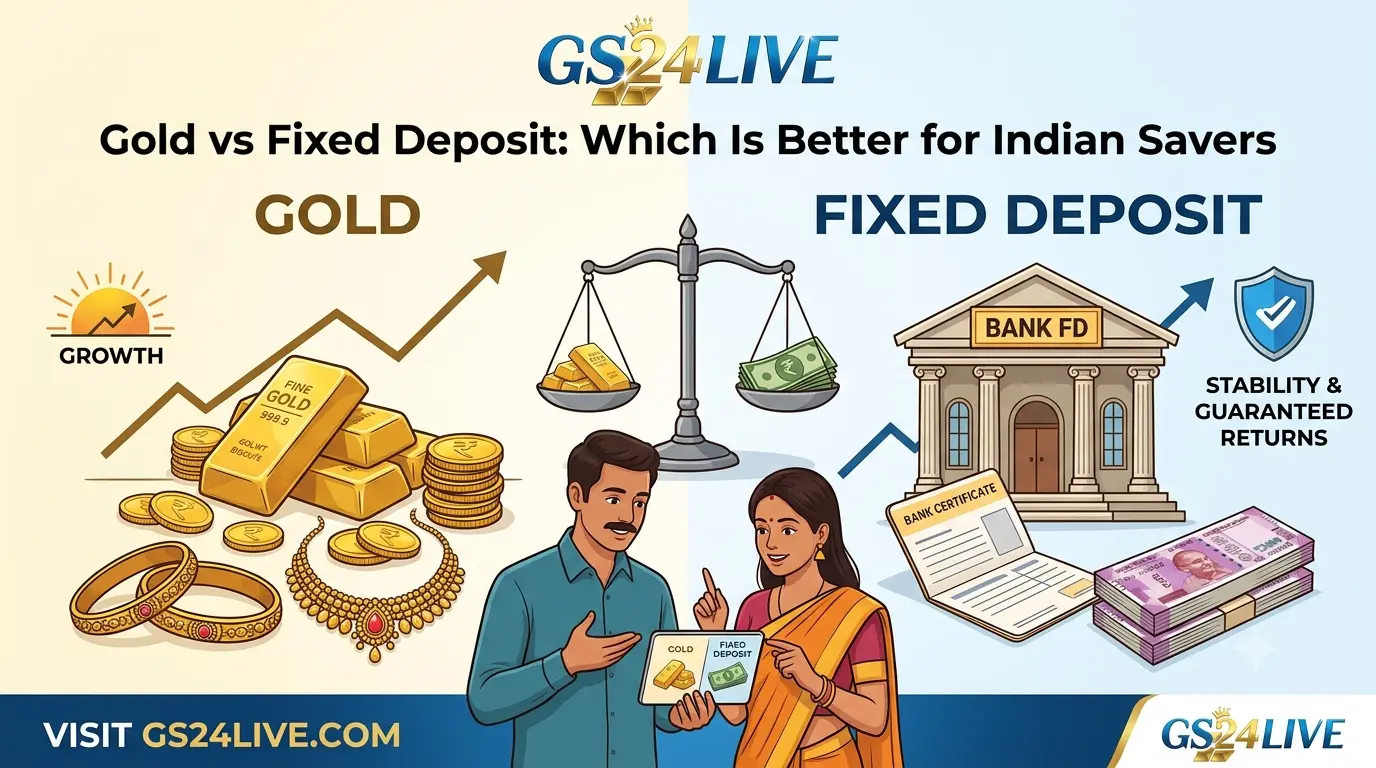
Ask any Ahmedabad household how they split their savings, and you will usually hear some version of "some FD, some gold, some in the business." Few families sit down and actually compare the two side by side, because they feel like different categories — one a bank promise, the other a physical asset. But both compete for the same rupee out of your monthly savings, so the comparison matters. This guide sets gold vs fixed deposit against each other on guarantees, liquidity, tax, and goal fit, without turning either into an ideology.
Gold's investment-versus-jewellery framing is covered separately in our retail vs investment Ahmedabad guide, and a full comparison of mutual funds vs digital gold exists if you want a paper-gold angle instead of a bank deposit angle. This article stays focused on the FD-versus-metal decision itself.
Key Takeaways
- A fixed deposit guarantees a stated interest rate on your principal; gold guarantees nothing except the metal weight you already own.
- Gold's return depends entirely on price movement between your buy and sell dates — there is no coupon or interest ticking in the background.
- FDs are easier to break for emergencies at a predictable, published penalty; jewellery and coins involve valuation and sometimes making-charge loss at resale.
- Tax treatment differs by holding period and product — this article summarises the comparison and links to the full tax breakdown rather than repeating it.
- Most stable Ahmedabad household budgets hold both — FD for near-term certainty, gold for a long-horizon, low-correlation cushion.
Guaranteed Interest vs an Uncertain Metal Price
A fixed deposit is a contract: you lend the bank money for a fixed term, and it promises a fixed rate, published upfront and locked at booking. Barring a bank failure — which deposit insurance partially covers up to a limit — you know almost exactly what you will receive at maturity. Gold offers no such promise. If you buy today and the price falls over your holding period, your rupee value falls with it, regardless of how patiently you held the metal.
This difference is the core of the debate. FD investors are paid for lending capital; gold holders are betting on demand, central bank behaviour, and currency movements pushing the price of the same physical asset higher over time. Neither is "wrong" — they solve different problems, and mixing them is common practice, not indecision.
| Factor | Fixed Deposit | Gold |
|---|---|---|
| Return certainty | Fixed and known at booking | Unknown; depends on price at sale |
| Principal protection | High, within deposit insurance limits | Metal weight protected; rupee value floats |
| Liquidity | Premature withdrawal with penalty | Sell anytime at prevailing market rate |
| Storage/handling | None — held electronically | Physical storage, security, insurance needed |
| Best fit | Short- to medium-term goals, emergency buffer | Long-horizon wealth cushion, crisis hedge |
Liquidity: Breaking an FD vs Selling Gold in a Hurry
Both are liquid in theory, but the mechanics differ. Breaking an FD before maturity usually means a small published interest penalty and a same-day or next-day credit to your account — predictable and boring, which is exactly the point of an emergency instrument. Selling gold jewellery or coins means finding a buyer, agreeing on a valuation, and often accepting a deduction against pure metal weight for stones, wastage, or making charges depending on the item's format.
Coins and bars sell closer to melt value than ornate jewellery does, which is one reason serious gold savers separate "wear" jewellery from "investment" coins in their own minds, even if both sit in the same locker. If you frequently need quick cash against gold without selling it outright, a gold loan is a separate route worth knowing about, though this article will not repeat that mechanism here.
Real Returns After Inflation and Tax: A Brief Framing
Comparing headline FD interest to gold's price appreciation without adjusting for inflation is misleading — a 7% FD in a high-inflation year can lose real purchasing power just as easily as gold can underperform in a low-inflation year. We cover the full inflation-and-gold relationship, including CPI mechanics and RBI's role, in our dedicated global inflation impact guide — here the point is simply that both instruments must be judged after inflation, not on the headline number alone.
Taxation also differs meaningfully. FD interest is added to your taxable income every year it accrues, at your slab rate, regardless of whether you withdraw it. Physical gold is taxed on sale, with short-term or long-term capital gains treatment depending on your holding period, plus GST paid at purchase. The full breakdown — including TDS rules and product-specific treatment for SGBs and ETFs — lives in our gold taxation guide; this article summarises only the comparison angle below.
| Aspect | Fixed Deposit | Physical Gold |
|---|---|---|
| When taxed | Annually, on accrued interest, at slab rate | At sale, as capital gains (short or long term) |
| TDS | Deducted by bank above threshold interest | Not applicable in the same way; GST at purchase instead |
| Documentation need | Bank statement, Form 16A | Purchase invoice for cost basis and holding period proof |
Matching Each Instrument to a Financial Goal
The better question is rarely "gold or FD" in isolation — it is "which goal is this money for." A wedding fund needed in eighteen months has a very different risk tolerance than a decade-long wealth cushion. Mapping goals to instruments avoids the common mistake of locking wedding-season cash into gold right when prices happen to be high, or leaving multi-decade savings entirely in low-yield deposits that inflation quietly erodes.
- 0–2 years (emergency fund, near-term expenses): FD or liquid instruments — you cannot afford metal price swings on money you need by a fixed date.
- 2–5 years (planned purchase, education, small wedding fund): A blended approach; short-tenor FDs for the bulk, small gold accumulation if the purchase itself will be gold-linked (like a wedding set).
- 5+ years (long-term wealth building): Room for a meaningful gold allocation alongside equity and debt, since gold's low correlation with other assets helps smooth portfolio swings over a full market cycle.
Ahmedabad Household Patterns: Why Families Rarely Pick Just One
Talk to families along Satellite Road or in older Manek Chowk-linked business households and a pattern repeats: FDs fund known near-term obligations — a child's next school fee cycle, a planned renovation — while gold accumulates quietly through the year for weddings, festivals, and a general sense of family security that a bank passbook does not provide emotionally, even if it performs identically on paper. Business-owning households in Ahmedabad also sometimes prefer gold's portability during periods of banking-sector uncertainty, treating it as a parallel reserve rather than a replacement for deposits.
A practical Gujarat-specific habit worth adopting: review your FD maturity calendar and your gold accumulation pace together once a year, ideally around Diwali when both bank offers and coin premiums get renewed attention anyway, rather than treating them as two completely separate financial conversations.
Risks of Over-Concentrating in Either Instrument
An all-FD household faces slow, quiet erosion: safe on paper, but real purchasing power can lag if inflation runs consistently above post-tax FD returns for several years in a row. An all-gold household faces the opposite risk — genuine short-term volatility, no income stream while holding, and difficulty accessing exact amounts of cash quickly without either breaking a larger piece or accepting resale deductions on jewellery. Concentration risk is rarely about which asset is "better" — it is about being unable to meet a specific need because too much sits in the wrong instrument for that timeframe.
A subtler risk is behavioural: households who buy gold reactively during a price rally often buy at worse average prices than those who accumulate steadily regardless of the headline price that week. FDs remove that emotional timing decision almost entirely, which is itself a reason many households keep a baseline FD habit even while also buying gold.
A Practical Hybrid Allocation Strategy
- List your goals by timeframe first — do not start with "how much gold should I buy" as the first question.
- Fully fund a 3–6 month emergency buffer in FD or equivalent liquid instruments before allocating meaningfully to gold.
- Set a fixed monthly or festival-linked gold accumulation habit rather than lump-sum buying only when prices feel "cheap."
- Ladder FDs across different maturities so you are not forced to break a large deposit for a small near-term need.
- Revisit the split annually — rising incomes, upcoming weddings, or new goals should shift the ratio deliberately, not by default.
- Keep FD and gold documentation together in one household financial file so decisions are made with the full picture, not from memory.
Frequently Asked Questions
1. Is gold a better long-term investment than a fixed deposit?
Over long, multi-decade periods gold has often outpaced average FD rates before tax, but it does so with real volatility along the way; FDs never carry that price risk but rarely beat inflation by much after tax.
2. Which is more liquid, gold or a fixed deposit?
An FD is more predictably liquid — a fixed penalty and quick bank credit. Gold is sellable anytime but valuation and format (coin vs jewellery) affect how close you get to fair metal value.
3. Should I break my FD to buy gold during a price dip?
Generally no, unless the FD was already earmarked for discretionary investment rather than a near-term goal; breaking planned savings to chase a price dip introduces two risks instead of managing one.
4. How much of my savings should be in gold versus FD?
There is no universal ratio; it depends on your goal timeline, existing emergency buffer, and comfort with price swings — the goal-mapping section above is a better starting framework than a fixed percentage rule.
5. Do Sovereign Gold Bonds solve the "no interest on gold" problem?
SGBs add a small annual coupon on top of gold-linked returns, which narrows but does not eliminate the FD-versus-gold guarantee gap; full SGB mechanics are covered in our dedicated SGB guide.
6. Does inflation hurt FDs more than gold?
Historically gold has tracked or outpaced inflation better over long horizons than post-tax FD interest, though this varies by period; our inflation-impact guide covers this relationship in depth.
Data Sources and References
- Reserve Bank of India — deposit rate trends and household savings data.
- World Gold Council — long-term gold return and demand research.
- IMF — global inflation and savings context.
- LBMA — international gold price benchmarking.
- Reuters — market commentary on rate cycles and bullion demand.
Conclusion
Gold vs fixed deposit is not a contest with one universal winner — it is a mismatch question. FDs win on certainty and predictable liquidity; gold wins on long-horizon resilience and portability without any counterparty promise attached. Most Ahmedabad households already sense this instinctively by holding both, even without formally mapping goals to instruments.
The practical upgrade is deliberate allocation: fund near-term goals in FD, build a steady long-horizon gold habit, and review the split at least once a year against your actual life goals rather than the news headline of the week.
Disclaimer: This article is for informational and educational purposes only. Precious metal and deposit returns are subject to market and interest-rate risk. Compare current bank rates and live gold prices, and consult a qualified financial professional before allocating savings.
Keywords: gold vs fixed deposit, FD vs gold investment India, gold or fixed deposit which is better, safe investment options India, gold returns vs bank FD, hybrid savings allocation India.