

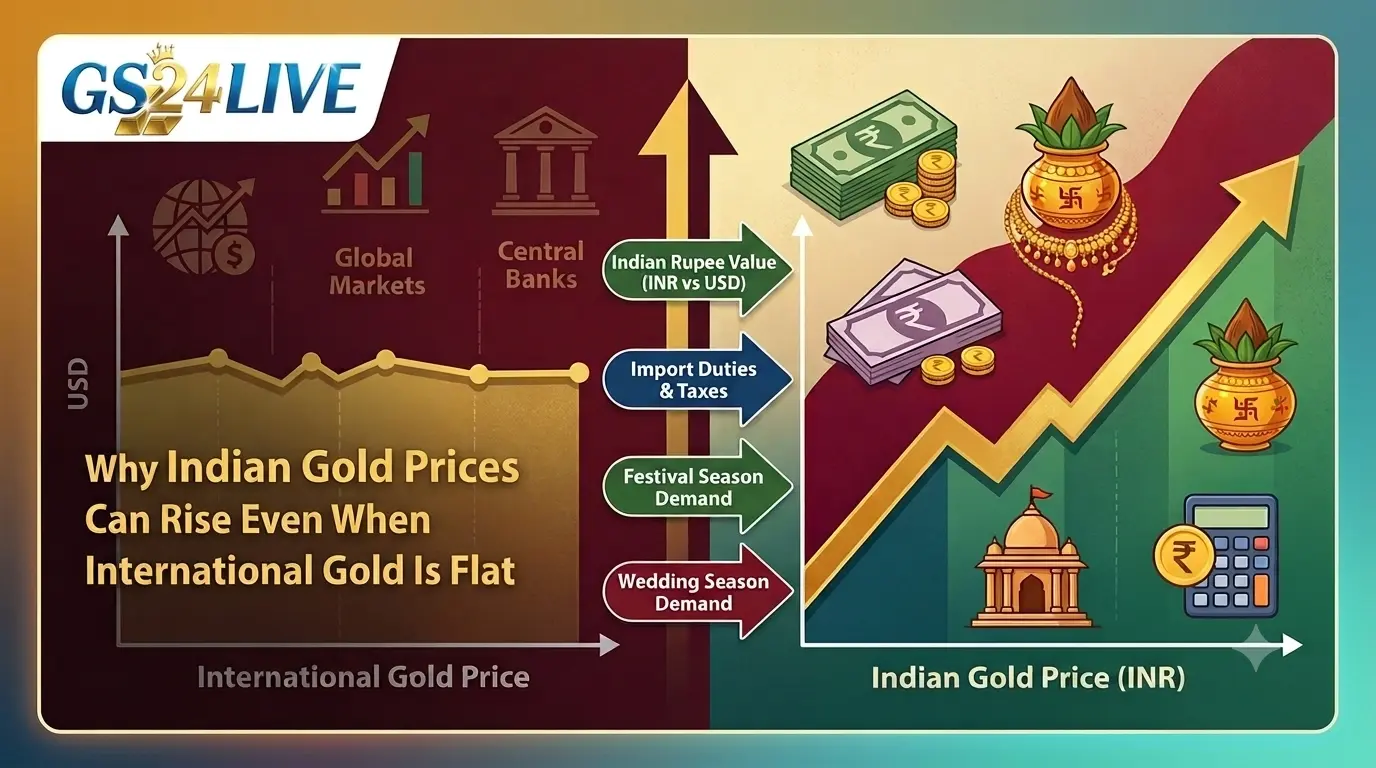
Many Indian readers see dollar gold barely moved overnight, then find the local showroom board higher than yesterday. That gap is how Indian retail pricing is built. This article explains Indian gold vs international spot as a conversion stack so you can read headlines without mistaking London quiet for Ahmedabad calm. Check GS24LIVE's gold price today page for the live Ahmedabad reference before comparing any overseas print.
Key Takeaways
- International spot is usually quoted in US dollars per ounce; Indian retail boards quote rupees per 10 grams for a stated karat.
- A flat dollar price can still produce a higher Indian board when the rupee weakens, duties or taxes change, or local premiums widen.
- MCX futures can move on currency and domestic cues even when overseas spot looks sleepy.
- Ahmedabad retail can sit above or below a simple import-parity estimate depending on inventory, scrap flows, and festive demand.
- Treat global headlines as one input — never as the invoice you will pay on CG Road or Manek Chowk.
What Global Headlines Usually Mean by "Gold Price"
Most international news cites a dollar-per-ounce benchmark linked to London or New York trading. That answers "what did dollar gold do?" — not "what will 22K jewellery cost in Gujarat this morning?" Indian retail rebuilds a rupee price through exchange rate, import costs, wholesale margins, and local boards. Keeping those questions separate is the first step to reading Indian gold vs international news without confusion.
The Rupee Layer: Same Ounce, Different Rupee Total
Gold is priced globally in dollars. Indian importers and bullion traders convert that value using the rupee-dollar rate. If dollar gold is unchanged but the rupee weakens, each ounce costs more rupees; if the rupee strengthens, domestic boards may rise less than overseas headlines suggest. That FX translation alone can move Indian prices on a flat dollar day. Broader drivers are indexed in our daily gold price factors guide.
| Overnight dollar gold | USD/INR move (illustrative) | Typical Indian board direction |
|---|---|---|
| Unchanged | Rupee weakens | Often higher in INR |
| Unchanged | Rupee strengthens | Often softer or capped INR rise |
| Slightly lower | Rupee weakens enough | Indian board can still rise |
| Slightly higher | Rupee strengthens enough | Indian board can look muted |
Numbers in the table are directional teaching cases, not forecasts. Always verify the live exchange rate and local board together.
Duty, Taxes and Import Parity — Still Not the Shop Invoice
After currency conversion, Indian landed economics add customs duty and related charges. Import parity is a rough "rebuild through official import channels" estimate — useful for wholesalers, incomplete for retail shoppers. A duty change or tight import week can reprice domestic boards even when dollar spot is quiet. Policy depth belongs in our Budget 2026 import duty guide; here, duty simply sits inside the Indian stack, not the overseas ounce print.
The illustrative stack above shows why readers who stare only at dollar spot miss most of what builds the rupee board.
Premiums, Discounts and Local Supply Conditions
Domestic gold can trade at a premium or discount to a simple import-parity sketch. Soft demand and plentiful scrap can cushion boards; festive restocking or thin inventory can widen premiums even without a dollar rally. Indian retail buys through authorised channels, wholesalers, and city boards — not LBMA bars off a London screen. Pipeline context is in our journey of gold guide.
| Local condition | Effect on Indian board vs "flat" dollar spot |
|---|---|
| Rupee weaker overnight | Supports higher INR quotes |
| Import duty or cess higher | Raises landed cost even if spot unchanged |
| Scrap supply tight / festive restocking | Can widen domestic premium |
| Heavy scrap / soft retail demand | Can cushion or reverse board rises |
Why MCX Can Move When Overseas Spot Looks Flat
MCX gold futures price Indian rupee contracts. They react to overseas spot, but also to USD/INR and domestic hedging demand — so an Indian futures screen can tick higher while a dollar chart looks sideways. MCX is still not your jewellery invoice. Full futures-versus-shop math is in our MCX vs local gold rate guide.
The illustrative delta chart compares a quiet dollar series with a more active Indian series — teaching the divergence idea, not predicting tomorrow's close.
Ahmedabad Boards vs Global Headlines
Ahmedabad association and showroom boards typically refresh after overnight overseas cues, rupee prints, and local wholesale phones. On a morning when dollar gold is flat but the rupee slipped, CG Road and Manek Chowk boards can still open firmer. Making charges and GST then sit on top of that metal rate — which is why apps and counters can disagree even after you understand the conversion stack. Use our Ahmedabad gold price board guide for board lines and why bullion apps show different prices for feed mismatches.
Practical habit: before reacting to a "gold flat" TV crawl, open the live local rate, note USD/INR, and ask whether today's board already priced a weaker rupee.
Illustrative Morning Walkthrough
Suppose dollar gold finishes almost unchanged, but overnight USD/INR makes each ounce cost more rupees. Wholesalers update landed economics, MCX opens firmer in INR, and Ahmedabad boards follow. A buyer who only saw "gold flat overseas" feels confused; a buyer who checked currency and the local board understands the rise. This walkthrough is illustrative — replace it with live screens before any purchase.
How Indian Readers Should Interpret International Gold News
- Translate, don't copy: Check dollar spot and USD/INR together.
- Separate metal rate from invoice: Making charges and GST are local layers.
- Watch premiums: Festive weeks can lift boards beyond a quiet overseas session.
- Confirm units: Global ounce headlines vs Indian per-10g 22K/24K boards are different measures.
Treat Indian gold vs international pricing as a stack and global news becomes background, not a single invoice number.
Risks of Mixing Global Headlines With Local Invoices
- Arguing a showroom down using only a dollar chart while ignoring rupee and duty layers.
- Comparing LBMA ounce moves with a 22K per-gram board without converting units.
- Assuming every domestic rise means "premium gouging" when currency moved first.
- Buying or delaying solely on overseas TV crawls without checking Ahmedabad's live board.
Practical Checklist for Gujarat Buyers
- Note overnight dollar gold and USD/INR direction before you leave home.
- Read the Ahmedabad board for the same karat you will buy.
- Ask whether today's quote already embeds a currency move.
- Separate metal rate, making, and GST on the written estimate.
- If futures and retail diverge sharply, wait for a second local confirmation.
Frequently Asked Questions
1. Can Indian gold prices rise if dollar gold is completely unchanged?
Yes — via a weaker rupee, higher duty burden, or wider domestic premium.
2. Does a stronger rupee always make Indian gold cheaper the same day?
Not always. Earlier inventory costs, premiums, and board timing can delay the pass-through.
3. Is MCX the same as the international gold price?
No. MCX quotes INR futures influenced by overseas spot plus domestic currency and liquidity.
4. Why does my Ahmedabad board differ from a global gold app?
Different currency, purity basis, update timing, and retail margins.
5. Should I wait for international gold to fall before buying jewellery in India?
Not as a standalone rule. Currency or premiums can offset a mild overseas dip — decide on need, budget, and the local quote.
6. Where should I verify the Indian side of the story?
Use the live Ahmedabad rate on GS24LIVE, then confirm the showroom board and written breakup.
Data Sources and References
- LBMA — international gold pricing benchmarks.
- Reserve Bank of India — rupee and domestic market context.
- MCX India — Indian gold futures reference.
- World Gold Council — India demand and market updates.
- Reuters — international bullion and currency reporting.
Conclusion
Indian retail gold is a converted, duty-aware, locally adjusted price — not a photocopy of the overnight dollar ounce. When you compare Indian gold vs international headlines, check currency, import economics, and local premiums before deciding the board "should" match global TV crawls. That habit turns confusing mornings on CG Road into readable pricing.
Disclaimer: This article is for informational and educational purposes only. Precious metal investments are subject to market risks. Charts and worked examples use illustrative data; verify live prices, exchange rates, and duties, and consult a qualified financial professional before investing.
Keywords: Indian gold vs international, Indian gold price conversion, USD INR gold impact, gold import parity India, domestic gold premium India, MCX vs international gold, Ahmedabad gold board vs global.