
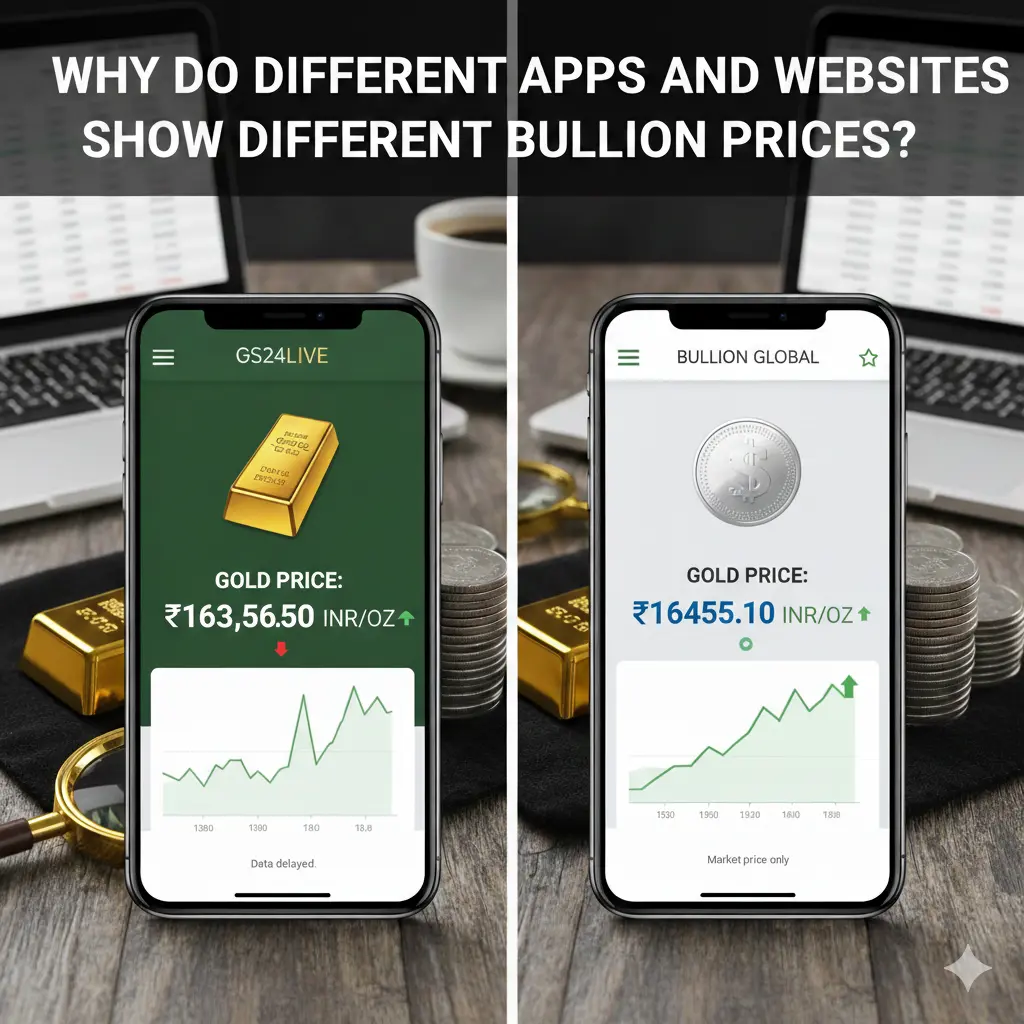
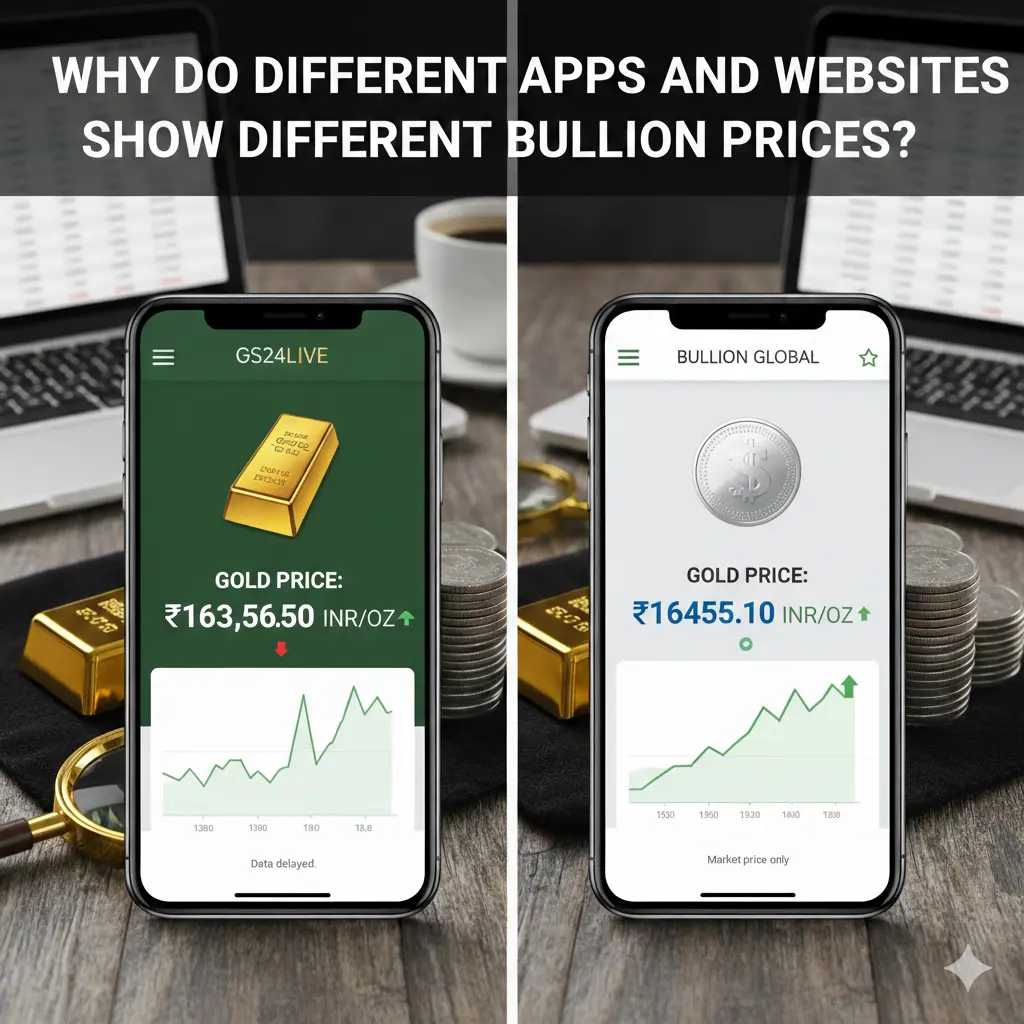
Many investors notice that gold and silver prices shown on different apps or financial websites are not always exactly the same. One platform might show a slightly higher price while another displays a lower value for the same metal.
This situation can confuse buyers, traders, and investors who follow bullion markets regularly. However, these differences are usually normal and are caused by how global precious metals markets operate.
Gold and silver prices depend on several factors including international benchmark prices, currency exchange rates, taxes, trading platforms, and supply-demand conditions. Understanding these factors can help investors interpret bullion prices more accurately.
Key Takeaways
- Apps disagree because they quote different layers: international spot, MCX futures, or retail board snapshots.
- Update frequency matters — hourly snapshots look "wrong" next to streaming MCX during volatile evenings.
- Jewellery prices include making charges and GST that no futures feed will show.
- For landed-cost math from MCX to shop rate, see the MCX vs local market guide — not repeated here.
- Compare two apps plus one physical quote the same hour before assuming fraud.
Global Benchmark Prices vs Domestic Prices
Gold and silver are traded globally in major markets such as the London Bullion Market Association (LBMA) and COMEX in the United States. These international markets determine the benchmark price for precious metals worldwide.
However, the price displayed in India is calculated by converting global prices into Indian rupees and adding additional costs such as import duty, logistics costs, and taxes. Because of this calculation process, domestic prices can vary slightly from international market prices.
Spot Prices vs Futures Prices
Another reason prices may differ across platforms is the difference between spot prices and futures prices.
The spot price represents the price of gold or silver for immediate delivery in the physical market. In contrast, commodity exchanges such as the Multi Commodity Exchange (MCX) trade futures contracts that represent an agreement to buy or sell metals at a future date. Our guide on how MCX gold price works breaks this conversion down in detail.
Because futures prices include factors like storage costs and market expectations, they may be slightly different from spot prices.
Why One Feed Can Look “Smoother” Than Another
Some apps snapshot a headline figure once an hour; others stream near-continuous futures prints during MCX evening overlap with London and New York. That alone can create the illusion of disagreement even when everyone is watching the same underlying contract family. The line below is a simplified intraday teaching example, not a replay of a specific session.
Currency Exchange Rate Impact
Gold and silver are priced internationally in US dollars. This means that currency fluctuations can influence domestic bullion prices.
If the Indian rupee strengthens against the US dollar, importing precious metals becomes slightly cheaper and domestic prices may decline. On the other hand, if the rupee weakens, domestic bullion prices may rise even if global prices remain unchanged.
Import Duties and Taxes
India imports a large portion of its gold and silver supply. As a result, import duties and taxes play an important role in determining domestic prices.
Government policy changes related to import duties can directly affect bullion prices in the Indian market.
How Layers Stack Before You See a Shop Quote
Even if two apps start from a similar international print, the path to a retail number passes through import charges, GST, logistics, and dealer margin—each rounded or updated on a different schedule. The bar chart is a rounded teaching breakdown; your city, purity, and contract month will change the arithmetic.
Regional Demand and Supply
Local demand also influences bullion prices. During festivals, wedding seasons, or periods of high jewellery demand, local bullion prices may increase slightly due to stronger buying activity.
Similarly, temporary shortages of physical metal in certain markets can create a premium over global prices.
Data Source Differences
Different apps and websites may use different data sources to display bullion prices. Some platforms track international spot prices, while others display MCX futures prices or bullion dealer quotes.
Because these sources update at different speeds, price differences may appear temporarily between platforms.
Key Factors Behind Bullion Price Differences
The following chart illustrates the major factors that cause price variations across bullion platforms.
Physical Gold vs Digital Gold Pricing
Another factor influencing price differences is the distinction between physical gold and digital gold. Physical gold purchases usually include additional costs such as making charges, dealer margins, and logistics expenses.
Digital gold or bullion trading platforms generally reflect the base metal price without these additional charges.
Which Price Should Investors Follow?
Investors should focus on the price relevant to their investment method.
- Commodity traders typically track MCX futures prices — see how to time buying or selling with the MCX live price.
- Jewellery buyers follow local bullion dealer prices, where making charges add to the base rate.
- Long-term investors often monitor international spot prices and our live gold price today and silver price today pages.
Although prices may vary slightly across platforms, the overall market trend usually remains consistent.
App vs MCX vs Showroom: Three Feeds on the Same Morning
| Source | What it usually shows | Typical lag |
|---|---|---|
| International spot app | LBMA/COMEX reference in USD | Seconds to minutes |
| MCX futures app | Active gold contract in INR | Near real-time in session |
| Jewellery board | 22K landed metal + shop margin | Manual refresh 1–3× daily |
None is "wrong" if you know the layer. For the full MCX-to-retail stack, see our MCX vs local gold rate guide.
Gujarat Buyers: Verifying App Quotes on CG Road
Before Akshaya Tritiya or a wedding muhurat, screenshot your app rate and ask the showroom which feed it uses. If the app shows MCX 24K but the board is 22K, convert with the purity factor from the MCX vs local guide — do not compare unmatched karats.
Risks When You Trade on a Stale App Number
Buying digital gold or placing a large coin order on a delayed feed can fill far from the MCX print you thought you saw. Sellers advertising "below MCX" without specifying contract month or karat often hide making charges in the headline rate.
App vs MCX vs Showroom: Three Feeds on the Same Morning
| Source | What it usually shows | Typical lag |
|---|---|---|
| International spot app | LBMA/COMEX reference in USD | Seconds to minutes |
| MCX futures app | Active gold contract in INR | Near real-time in session |
| Jewellery board | 22K landed metal + shop margin | Manual refresh 1–3× daily |
None is "wrong" if you know the layer. For the full MCX-to-retail stack, see our MCX vs local gold rate guide.
Contract Roll and Purity Assumptions Apps Hide
Some feeds silently roll from near-month MCX to the next contract; others stay on spot USD and convert with a static rupee assumption. A 22K jewellery app may apply purity conversion while a 24K futures widget does not — comparing them without reading footnotes creates false "arbitrage" that no counter will honour.
Before festival week, note each app's stated source in writing: spot USD, MCX active month, or dealer board snapshot. That single habit prevents most cross-app arguments at the kitchen table.
Gujarat Buyers: Verifying App Quotes on CG Road
Before Akshaya Tritiya or a wedding muhurat, screenshot your app rate and ask the showroom which feed it uses. If the app shows MCX 24K but the board is 22K, convert with the purity factor from the MCX vs local guide — do not compare unmatched karats.
Risks When You Trade on a Stale App Number
Buying digital gold or placing a large coin order on a delayed feed can fill far from the MCX print you thought you saw. Sellers advertising "below MCX" without specifying contract month or karat often hide making charges in the headline rate.
Frequently Asked Questions1. Why do different apps show different gold prices?
Different platforms use different data sources such as spot prices, futures prices, or dealer quotes.
2. Which price should I use — MCX, spot, or my jeweller's quote?
MCX for trading direction; international spot for global context; your jeweller's quote for the actual purchase cost including making charges.
3. Why does the same app show different prices at different times of day?
Update intervals, session gaps, and contract roll dates cause visible shifts even when the underlying trend is unchanged.
Data Sources and References
- Multi Commodity Exchange of India (MCX) – live gold and silver futures source for the different bullion app prices comparisons discussed above.
- World Gold Council – global gold research desk referenced for the different bullion app prices long-horizon context.
- London Bullion Market Association (LBMA) – precious-metals standards source used where different bullion app prices meets international pricing.
- Reserve Bank of India (RBI) – domestic policy source linked wherever different bullion app prices meets rupee or liquidity conditions.
- International Monetary Fund (IMF) – world economic outlook source supporting the different bullion app prices scenario discussion.
Conclusion
Price differences across bullion apps and websites are a natural result of how global commodity markets operate. Variations can occur due to currency movements, taxes, supply conditions, and different data sources.
Understanding these factors helps investors interpret bullion prices more effectively and make informed decisions when tracking gold and silver markets.
Disclaimer: Precious metals markets are subject to price fluctuations and global economic conditions. The information provided in this article is for educational purposes only and should not be considered financial advice.
Keywords: different bullion app prices, why gold prices differ apps, MCX vs spot price app, bullion price feed lag, gold app vs jeweller rate