
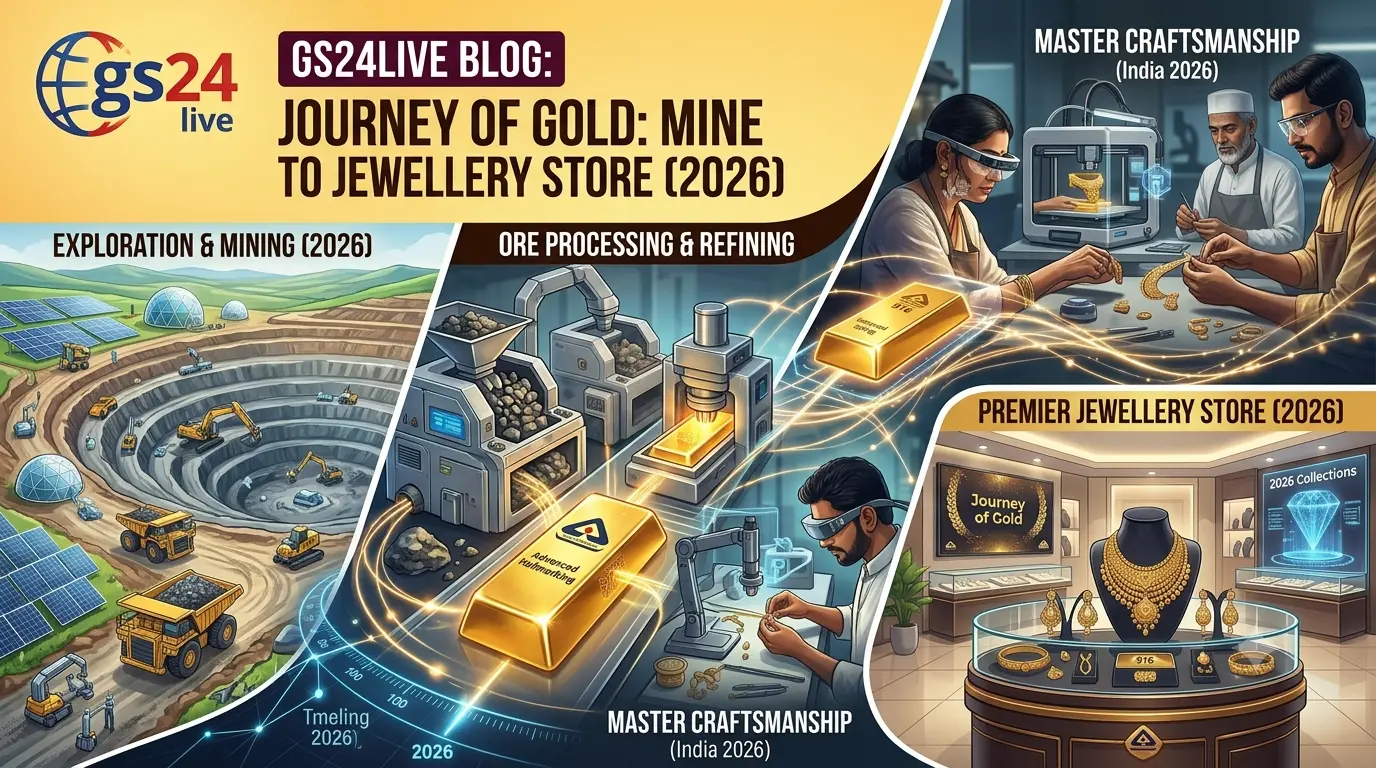
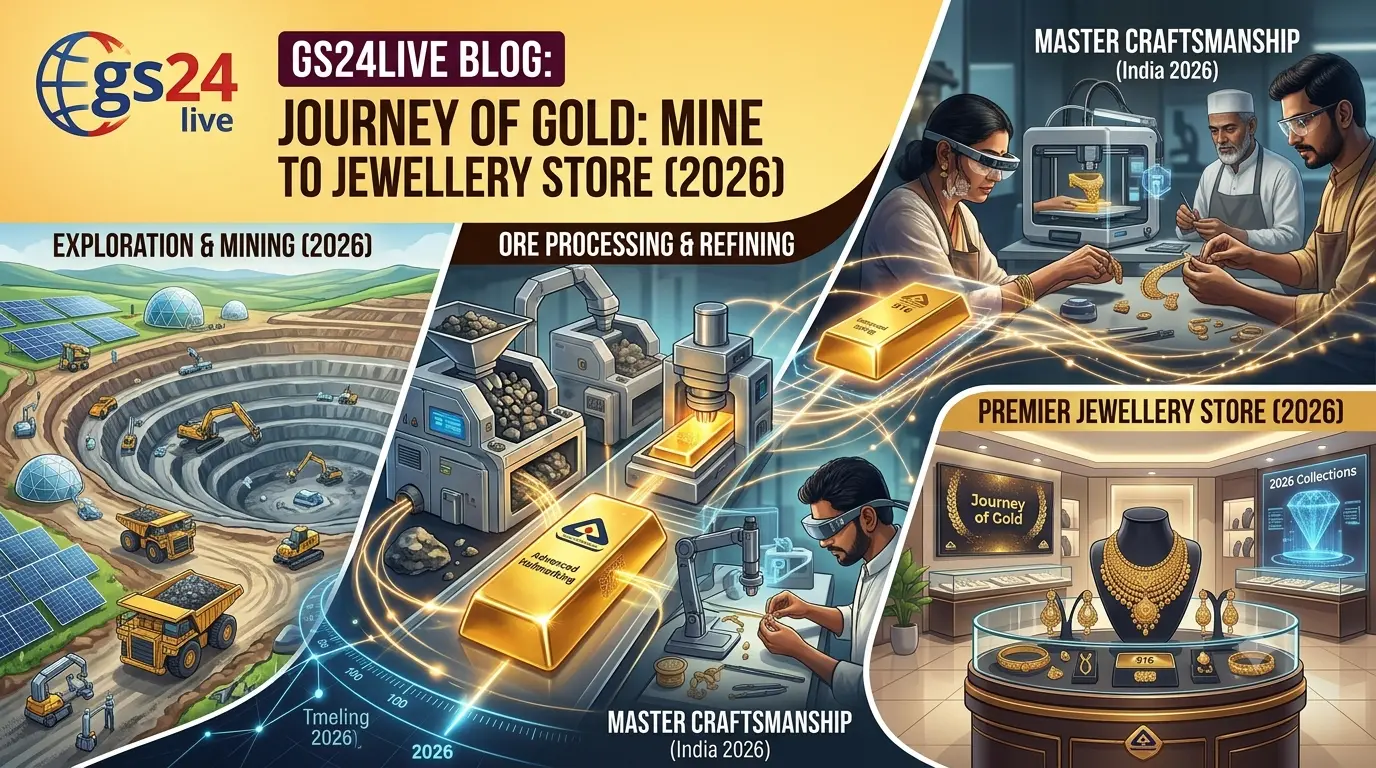
The bangle on your wrist began as rock buried kilometres underground — or as scrap melted in a refinery furnace thousands of kilometres away. By the time it reaches a CG Road showroom, that metal has passed through mining or recycling yards, assay labs, import customs, bullion dealers, casting workshops, hallmarking centres, wholesale sarafs, and a retail counter that adds making charges on top of the morning board rate. Most buyers see only the final price tag. Understanding the journey of gold from mine to jewellery store explains why shop rates differ from app quotes, why hallmarking matters, and where rupees accumulate along the chain.
This guide walks the full supply path in plain language for Indian readers — from ore and doré bars to the necklace in your hand. For how MCX futures translate into local board numbers, see our MCX vs local market gold rate guide in one sentence only. For BIS fineness marks at purchase, see our 22K vs 24K gold guide. Track live rates on GS24LIVE's gold price today page before comparing showroom quotes.
Key Takeaways
- Global gold mining produces ore with tiny gold concentrations; extraction and refining concentrate that metal into 99.9% bullion bars.
- India imports most of its gold bullion — domestic mining supplies only a small fraction of national demand.
- Refiners, banks, and MCX-linked dealers distribute 24K-equivalent metal to jewellers who alloy it to 916 (22K) for manufacturing.
- Hallmarking with HUID is the retail buyer's proof that the finished piece matches declared purity.
- Each supply-chain stage adds cost — duty, refining margin, wholesale spread, making charges — before the final showroom invoice.
The Gold Supply Chain at a Glance
Think of the gold supply chain as a pipeline with checkpoints. The diagram below is a simplified process map — real routes vary by mine, refiner, and importer, but the sequence is consistent for bullion that becomes Indian jewellery.
| Stage | What happens | Output form | Typical location |
|---|---|---|---|
| 1. Mining | Ore blasted, hauled, crushed | Rock with grams per tonne gold | South Africa, Australia, China, etc. |
| 2. Extraction | Gold separated from ore (flotation, leaching) | Concentrate / doré (rough gold-silver mix) | On-site processing plant |
| 3. Refining | Purification to investment grade | 999 fine gold bars | LBMA-accredited refiners globally |
| 4. Bullion trade | Good-delivery bars shipped, banked, hedged | Kilobars, contracts on COMEX/LBMA | London, Zurich, Dubai hubs |
| 5. India import | Customs clearance, duty, GST at entry | Bullion in nominated warehouses | Mumbai, Ahmedabad trade lanes |
| 6. Wholesale | Sarafs, banks, dealers sell to manufacturers | 24K feedstock, wire, grain | Zaveri Bazaar, bullion street |
| 7. Manufacturing | Alloy to 916, cast, set stones, polish | Unhallmarked or pre-assay jewellery | Surat, Jaipur, Ahmedabad clusters |
| 8. Hallmarking | BIS assay centre stamps 916 + HUID | Certified finished piece | BIS recognised centres |
| 9. Retail | Showroom display, invoice, sale | Tagged necklace, bangle, coin | CG Road, local chains |
Stage 1: Gold Mining — Where the Metal Starts
Gold occurs in quartz veins and alluvial deposits at concentrations measured in grams per tonne of ore — not kilograms. Open-pit mines remove vast surface rock; underground mines follow narrow high-grade veins deep below. Major producing countries include China, Australia, Russia, Canada, and several African nations. Operating a mine takes years of exploration drilling, environmental permits, and capital before the first pour.
India has domestic gold mining — notably in Karnataka and Jharkhand — but output is modest compared with national jewellery demand measured in hundreds of tonnes annually. That imbalance means the supply path for most Indian retail pieces begins abroad, even when the final karigar works in Surat or Ahmedabad.
The chart illustrates India's approximate demand mix — imported bullion dominates; recycled old gold and domestic mine output fill the remainder. Exact ratios shift with price, festival demand, and import policy.
Stage 2: Gold Extraction — From Rock to Concentrate
Raw ore is crushed and milled to powder, then processed to concentrate gold particles. Common methods include flotation (separating sulphide minerals) and cyanide leaching (dissolving gold from ore into solution, then recovering it on carbon or zinc). The result is often a doré bar — a rough alloy of gold and silver around 80–90% purity — still far from the 999 bars investors recognise.
Extraction efficiency determines mine economics. A gram recovered per tonne may be profitable at today's prices but unviable if spot collapses. Environmental regulation around tailings ponds and cyanide use shapes where new mines open and how existing sites operate.
Stage 3: Refining — Purifying to 999 Fineness
Doré and scrap feedstock enter refineries that remove silver, copper, and other metals until gold reaches 99.9% purity (999 fineness). Electrolytic refining and chlorination are standard industrial methods. Output is cast into kilobars or smaller units meeting LBMA good delivery specifications — weight, dimensions, and assay certificates that global banks accept as settlement metal.
Indian consumers rarely touch refinery output directly. Instead, nominated importers and banks bring certified bullion into the country, where it enters the wholesale stack that eventually alloys down to 22K for jewellery. Recycled old gold also flows back into refineries — a growing channel as families melt heirlooms during high-price years.
Stage 4: Bullion Production and Global Trading
Once refined, gold trades on international benchmarks — LBMA spot, COMEX futures, and Shanghai contracts set the reference prices MCX mirrors in Indian rupees. Bullion banks vault bars in London, Zurich, and Dubai; shipments move under armed logistics with assay documents chained to each bar serial number.
Futures markets let jewellers and dealers hedge months ahead. For how manufacturers use MCX before converting metal to 916 shop rates, see our MCX gold price guide for goldsmiths — one link only; this article covers physical flow, not contract mechanics.
Stage 5: India Import — Customs, Duty, and Landed Cost
India's physical gold demand is met largely through imports cleared at customs with applicable duty and taxes. Policy changes — such as budget adjustments to import duty — pass through to wholesale rates within days. For duty expectations and landed-cost framing, see our Budget 2026 gold duty guide in one sentence only.
| Cost layer (illustrative) | Where it applies | Buyer visibility |
|---|---|---|
| International spot + premium | Exporter to Indian importer | Embedded in wholesale quote |
| Import duty | Customs clearance | Moves morning bullion board |
| Importer margin | Bank / nominated agency | Wholesale spread |
| GST at import stage | Tax compliance | Part of landed stack |
| Transport and insurance | Vault to dealer | Minor per-gram add-on |
By the time bullion reaches a Mumbai or Ahmedabad dealer, the "raw" metal price already reflects global spot, rupee exchange rate, and policy — before any karigar touches the metal.
Stage 6: Wholesalers and Bullion Dealers
Wholesale sarafs and bullion banks sell 24K-equivalent feedstock — bars, wire, grain — to jewellery manufacturers and large retail chains. Zaveri Bazaar in Mumbai and dedicated bullion lanes in Ahmedabad move tonnes during festival season. Quotes reference the morning board, often derived from MCX close plus physical premium.
Manufacturers buy grain for casting trees; chains shops buy wire on spools; coin minters buy small bars. Credit terms, assaying on delivery, and trust relationships built over decades define wholesale trade — price alone does not win volume at this layer.
Stage 7: Jewellery Manufacturing — Alloy, Cast, Finish
Workshops receive 999 feedstock and alloy it to 916 (22K) before casting — the grade Indian bridal inventory expects. Why workshops default to 916 rather than 18K or 24K is covered in our why 916 gold is popular guide; this stage only notes that manufacturing converts refinery bullion into wearable alloy.
Production moves from CAD design through wax-tree casting, stone setting, and final polish before pieces ship to hallmarking centres. Surat plants run machine chains at volume; Jaipur and Ahmedabad job workers handle bridal sets and custom orders. Metal lost in filing and sprues becomes part of the making charges you see at retail — see our gold making charges guide for that invoice line, not the chemistry here.
Stage 8: BIS Hallmarking — Retail Proof of Purity
Before a piece reaches a showroom tag, it typically passes through a BIS-recognised assaying and hallmarking centre that verifies fineness and assigns HUID. Full mark explanation lives in our 22K vs 24K guide; fraud patterns are in the gold jewellery scams guide.
Stage 9: Retail Showrooms — Where You Enter the Chain
Retailers source inventory from manufacturers or wholesale job workers, add brand margin and making charges, and display pieces under lights on CG Road or in mall chains. The morning board lists 22K and 24K rates; your invoice stacks metal value, labour, GST, and stones separately. Making charge mechanics are covered in our gold making charges guide — this stage only notes that retail is where those labour lines appear.
Large chains centralise buying and hedge on MCX; independent showrooms may buy daily from local sarafs. Either way, the pipeline ends at your invoice — and restarts if you sell scrap back into the recycling loop years later.
Quality Checks Across the Pipeline
| Stage | Check performed | Who benefits |
|---|---|---|
| Mine / refinery | Fire assay, LBMA certificate | Banks, importers |
| Import | Customs documentation, weight verify | Government, dealer |
| Wholesale | Counter-assay on large lots | Manufacturer |
| Manufacturing | Batch alloy test, visual cast QC | Job worker, retailer |
| Hallmarking | BIS fineness test, HUID issuance | Retail buyer |
| Retail sale | Weigh on sale, invoice purity line | You at purchase |
Interesting Facts About Gold's Journey
| Fact | Detail |
|---|---|
| Concentration in ore | Profitable mines may yield 1–5 grams per tonne of rock moved |
| All gold mined | Historically extracted gold would fit in a modest cube — supply is scarce |
| India recycling | Old jewellery scrap returns significant metal during price rallies |
| Same atoms, new form | Your ring may contain gold mined decades ago, refined multiple times |
| Export reverse path | Surat-made 916 sets are exported, then re-imported as finished goods in some channels |
| Time from mine to counter | Bullion can move in weeks; bespoke bridal sets take months of design |
Ahmedabad and Gujarat: How Bullion Reaches CG Road
Gujarat's retail boards track Mumbai import parity adjusted for local wholesale premium and rupee moves. Ahmedabad dealers often receive metal via Mumbai vault transfers or direct import clearances through Gujarat ports for authorised agencies. On a busy pre-wedding morning, CG Road showrooms reprice when the overnight dollar gold move gaps up — bullion has already cleared customs and sarafs; retail only reflects the latest landed cost plus margin.
- Compare the showroom 22K board with MCX-linked apps the same hour — wide gaps may mean stale boards or bundled making assumptions.
- Ask whether a heavy chain was hallmarked locally or shipped pre-stamped from a Surat plant — both are valid if HUID verifies.
- Manek Chowk scrap buyers close the loop: sold old gold re-enters refining, skipping mining but rejoining the wholesale stack.
Risks When the Chain Breaks Down
Skipped hallmarking, unverified wholesale lots, and bait-and-switch at retail are where the pipeline fails consumers. Unmarked "916" sold below board without HUID may never have passed a BIS centre. Importers without proper documentation undercut honest dealers briefly but create assay risk for buyers downstream. At retail, inflated making charges disguise weak metal rates — see our making charges guide rather than re-learning that math here.
What Smart Buyers Should Notice at Purchase
- Understand that shop rate = global bullion journey + duty + spreads + making — not mine cost alone.
- Insist on BIS hallmark and HUID on finished jewellery; verify before paying.
- Read invoice lines for metal weight, purity, making charge, and GST separately.
- For investment metal, buy coins or bars closer to refinery output — fewer manufacturing layers.
- When selling old pieces, you re-enter the chain at scrap — our sell old gold guide covers buy-back in one link.
Frequently Asked Questions
1. What is the journey of gold from mine to jewellery store?
Gold is mined as ore, extracted into doré, refined to 999 bullion, traded globally, imported into India, sold through wholesalers to manufacturers who alloy to 916, hallmark at BIS centres, and retail at showrooms with making charges added.
2. Does Indian jewellery gold come from Indian mines?
Only a small share. Most bullion is imported; recycled scrap and domestic mining supplement demand. Your piece likely contains metal refined from global sources.
3. What happens during gold refining?
Refineries remove base metals until gold reaches 99.9% purity, then cast LBMA-standard bars with assay certificates. Jewellery workshops later alloy 999 down to 916 for durability.
4. Why is my showroom gold price higher than MCX?
Physical jewellery sits several cost layers past the futures screen. See our MCX vs local market gold rate guide for landed-cost math; this article shows where those layers attach in the supply chain.
5. When does hallmarking happen in the supply chain?
After manufacturing — BIS centres assay and assign HUID before retail sale. Verification steps are in our 22K vs 24K guide; do not pay for finished jewellery without hallmark proof.
6. Can old gold skip mining and rejoin the chain?
Yes. Scrap sold at sarafs returns to refiners, is purified, and re-enters wholesale as grain or bar — one reason India recycles heavily during price peaks.
Data Sources and References
- World Gold Council — global mine production, recycling, and India demand statistics.
- London Bullion Market Association (LBMA) — good delivery standards and refining benchmarks.
- Bureau of Indian Standards (BIS) — hallmarking and HUID framework for finished jewellery.
- Multi Commodity Exchange of India (MCX) — domestic gold futures pricing reference.
- Reserve Bank of India (RBI) — import policy and macro context for bullion flows.
- Reuters — mining, trade, and market news along the gold supply chain.
Conclusion
This path from mine to jewellery store spans continents and checkpoints — extraction, refining, import, wholesale trade, alloying, hallmarking, and retail markup. Indian buyers interact only with the last step, but the board rate on CG Road carries the weight of every earlier layer. Recognising that chain helps you judge quotes fairly, insist on BIS proof at the right stage, and separate efficient bullion purchases from craftsmanship-heavy bridal invoices.
Next time a showroom updates its morning rate, you are seeing not just market sentiment — you are seeing the end of a supply path that began as ore, doré, or scrap long before the necklace reached the glass case.
Disclaimer: This article is for informational and educational purposes only. Supply-chain descriptions are simplified; refinery and import procedures vary. Verify live prices locally and consult qualified professionals for large transactions.
Keywords: journey of gold, gold mining to jewellery, gold refining India, bullion supply chain, gold hallmarking process, gold wholesale India, Ahmedabad gold market.