
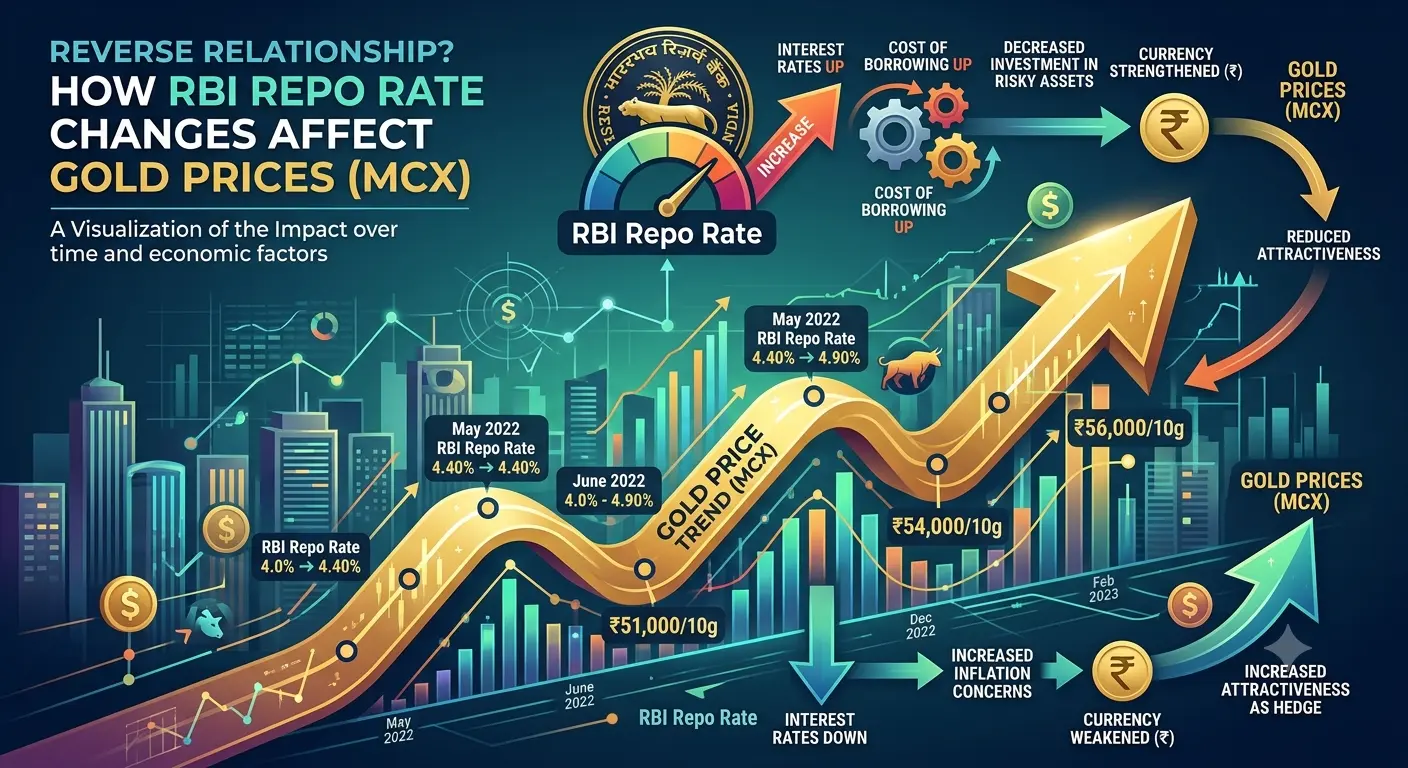
On RBI policy day, MCX gold often moves within minutes of the Monetary Policy Committee statement — sometimes up, sometimes down, and sometimes both in the same afternoon. Traders watch the repo rate line first; jewellers in Ahmedabad watch whether the rupee firms and whether their morning board rate still makes sense after lunch. The connection is real, but it is not a simple rule that every rate cut lifts gold or every hike kills it.
This guide explains how RBI repo rate gold prices transmit through bond yields, currency, liquidity, and sentiment into MCX contracts and retail counters. It is written for Indian investors, MCX participants, and jewellery buyers who want to read MPC headlines with context — not panic. For broader inflation mechanics, see our global inflation and bullion guide; for the full list of daily drivers, see top factors affecting gold prices daily. Confirm live levels on the gold price today page before acting.
Key Takeaways
- The repo rate is RBI's main policy lever; MPC decisions shift yield, rupee, and liquidity expectations that reach MCX gold in rupee terms.
- A repo cut can support bullion via a softer rupee and easier financial conditions — but global dollar gold and US yields may override the move the same session.
- A repo hike often lifts bond yields, raising the opportunity cost of holding non-yielding gold — though safe-haven demand can still bid prices on risk-off days.
- Retail Ahmedabad counters may reprice the same evening or next morning; they rarely match MCX tick-for-tick on announcement hour.
- Policy-day volatility is common; most household buyers benefit from a written quote and invoice plan rather than chasing the first MCX spike.
What Is the RBI Repo Rate?
The repo rate is the interest rate at which the Reserve Bank of India lends short-term funds to commercial banks against government securities. When RBI raises the repo rate, borrowing costs for banks typically rise; when it cuts, funding becomes cheaper. The Monetary Policy Committee (MPC) meets on a published calendar — usually six times a year — to vote on the policy rate and release a statement explaining the growth-inflation balance.
For bullion markets, the repo rate matters less as a single number and more as a signal about future liquidity, rupee stability, and domestic bond yields. Indian gold is priced in rupees per gram or per 10 grams on MCX, built from international spot converted through USD/INR plus local adjustments. Any policy move that shifts the rupee or rate expectations can change that conversion layer even when dollar gold is flat.
How MPC Decisions Reach MCX Gold
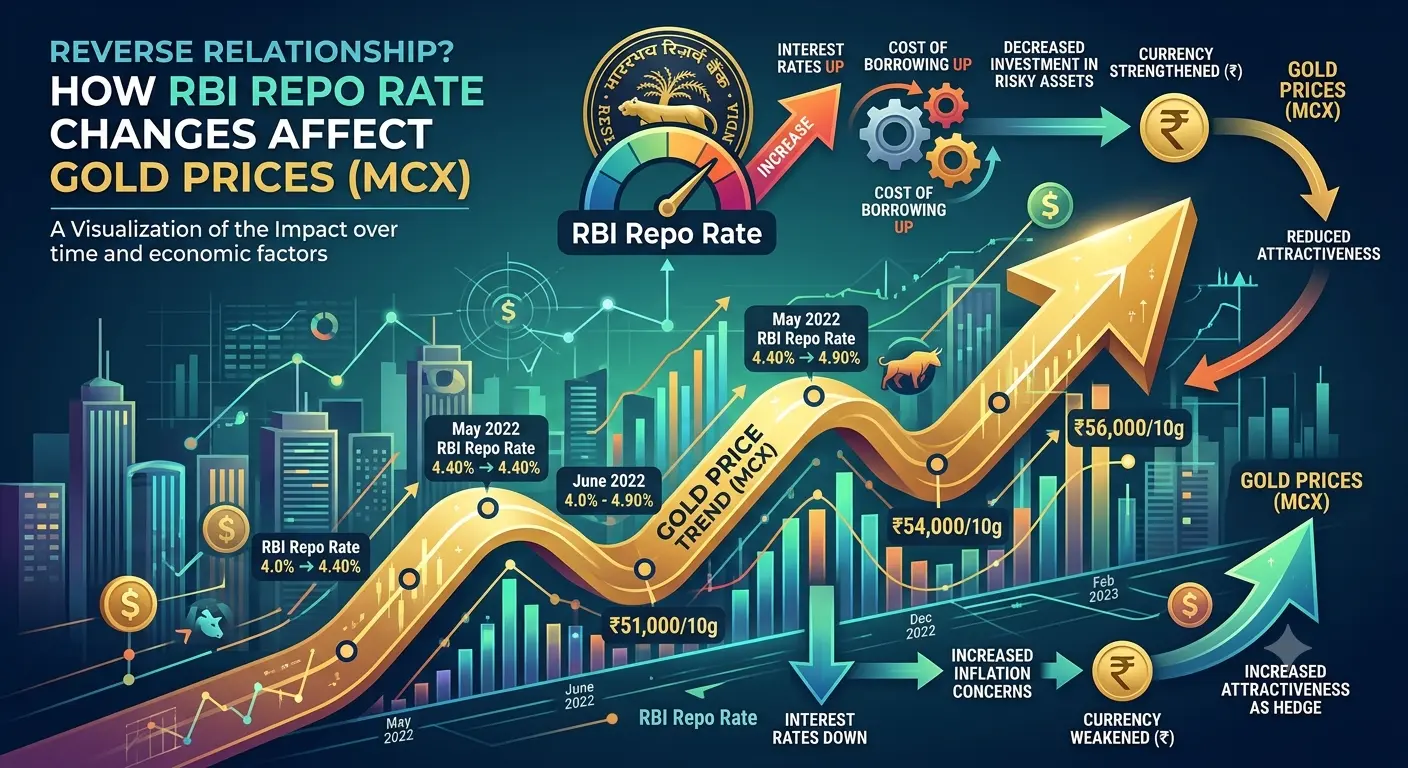
Think of the transmission chain as a sequence of market reactions rather than one switch. When the MPC announces a decision, banks and bond desks reprice government securities within seconds. Yield moves influence the rupee through capital flows and risk appetite. Importers and bullion banks adjust hedging. MCX gold futures reflect the combined effect — often amplified by algorithmic trading around the headline.
The bar chart below ranks illustrative channel strength from repo policy to domestic gold — educational only, not a trading formula. In practice, global spot and US real yields can dominate on the same day RBI speaks.
| Transmission step | What typically moves | MCX gold link |
|---|---|---|
| MPC repo decision | Policy rate and forward guidance | Sets tone for domestic financial conditions |
| Government bond yields | 10-year G-sec and money-market rates | Higher yields can weigh on non-yielding gold short term |
| USD/INR | Rupee vs dollar | Weaker rupee lifts rupee gold even if dollar spot is unchanged |
| Bank liquidity | Credit growth, import finance | Affects bullion import timing and dealer inventory |
| MCX session | Futures open interest, intraday volume | Concentrated reaction often in first 30–90 minutes post-statement |
Repo Rate Cut vs Hike: How Gold Often Behaves
Markets usually price a portion of the decision before announcement day. That means MCX gold may not move in the "obvious" direction after the headline if the outcome was already expected. Surprises — a hold when a cut was priced, or a hawkish statement despite an unchanged rate — frequently produce larger swings than the numeric change itself.
| Scenario | Typical domestic channel | Common MCX gold pattern (not guaranteed) |
|---|---|---|
| Repo rate cut | Easier liquidity, softer yields, potential rupee pressure | Supportive for rupee gold if global spot steady; may fade if dollar gold falls on US data |
| Repo rate hike | Tighter conditions, higher yields | Headwind for gold if yields rise sharply; offset if hike signals inflation fight lagging |
| Hold with dovish tone | Future cuts priced in | Gradual support over days rather than one vertical candle |
| Hold with hawkish tone | Delayed easing expectations | Short-term pressure possible even without a rate change |
Silver on MCX can move in the same direction but with wider percentage swings because industrial sentiment and margin requirements differ. This article focuses on gold; silver traders should still watch the same policy clock but expect higher beta.
Historical MPC Cycles and Gold: Illustrative Pattern
History does not repeat mechanically, but reviewing past MPC cycles helps calibrate expectations. During extended pause phases, gold sometimes trends on global factors while domestic policy sits in the background. When RBI pivots from hikes to holds or cuts, bullion often re-prices the rupee and yield story over several sessions — not only on announcement day.
| Illustrative phase | Repo backdrop | Sample domestic gold behaviour |
|---|---|---|
| Tightening cycle start | Successive hikes to contain inflation | Choppy MCX sessions; rallies often sold into yield spikes |
| Long pause at peak | Rate held for multiple MPCs | Gold increasingly driven by global spot and US Fed path |
| First cut after pause | Easing cycle begins | Often positive rupee-gold impulse if cut was partly surprise |
| Cut + cautious guidance | Rate down but inflation warning | Initial rally may reverse within the week |
The dual-axis chart uses rounded sample data to show how repo levels and indexed MCX gold can diverge around an MPC — verify every live print on official exchange feeds.
Policy Day vs the Week After: Timing MCX and Retail Buys
MCX participants often see the sharpest volume in the window immediately after the MPC press conference. Gaps between expectation and outcome trigger stop-loss clusters. By the second or third session, attention usually rotates back to US economic releases, geopolitical headlines, and physical demand — unless RBI's statement opened a new multi-month easing or tightening narrative.
Retail buyers planning a wedding purchase or coin allocation rarely need to trade that first hour. A more practical approach: note the policy outcome, compare your jeweller's next-morning board rate to MCX-implied levels, and execute when invoice terms — not adrenaline — align with your budget. For session-level timing frameworks, see our MCX buy and sell timing guide.
Ahmedabad Bullion Market: How Jewellers Reprice After RBI
Ahmedabad's established corridors — CG Road, Ashram Road, and wholesale lanes near Manek Chowk — typically source day rates from MCX benchmarks and importer quotes. On MPC days, large chains may update digital boards twice: once after the futures reaction and again at next-day opening when overnight global spot and rupee levels settle.
- Smaller counters sometimes keep the morning rate until evening if the MPC move was minor and expected — ask whether the quote is "opening" or "post-policy."
- Wholesale sarafs often adjust faster than retail showrooms because their inventory is hedged on MCX or import forwards.
- Festival-week MPC dates see wider spreads between shops as footfall reduces the time staff spend on repricing.
- Always request a timestamp on written quotes during policy week — an Ahmedabad buyer who confirms the rate reference at 11 a.m. avoids paying a stale morning number after a sharp afternoon move.
That timestamp habit costs nothing and prevents the most common policy-week dispute: "the board still showed yesterday's level when I paid."
Investment Risks Around Policy Announcements
Using RBI meetings as a sole buy or sell trigger is risky. Domestic policy is one layer in a stack that includes US Federal Reserve guidance, dollar index moves, central bank gold purchases, and seasonal jewellery demand. A repo cut does not insure against a simultaneous crash in global spot; a hike does not guarantee a multi-week decline if geopolitical risk spikes.
Leveraged MCX positions face margin calls on volatile policy days — a 1% futures move can require additional collateral faster than retail buyers expect. Physical holders face a different risk: overpaying making charges into a short-term policy rally that reverses within days. Paper products such as ETFs track NAV mechanics that may not match the exact minute of an MPC spike.
Practical Strategy for Indian Bullion Participants
- Mark the RBI MPC calendar at the start of each quarter — link it to your purchase plan, not to social-media rumours.
- Before policy week, decide your maximum all-in rupee budget including GST and making charges; do not expand it because MCX moved 0.5% on headline day.
- Compare three Ahmedabad quotes on the morning after a major surprise, not only the announcement hour.
- If you hedge on MCX, define exit levels before the statement; do not add size into the first volatile candle without a margin buffer.
- Hold a core physical or paper allocation through cycles; use policy clarity to adjust timing, not to flip the entire portfolio on one vote.
Discipline on invoice break-ups and HUID verification matters more for jewellery buyers than guessing the MPC outcome. Policy moves inform the environment; your documented purchase terms protect the rupees.
Frequently Asked Questions
1. Does an RBI repo rate cut always increase gold prices on MCX?
No. A cut can support rupee-denominated gold through yields and currency, but global dollar gold, US real yields, and risk sentiment can push MCX lower the same day. Treat cuts as one input, not a guaranteed buy signal.
2. How quickly does MCX gold react after an MPC announcement?
Liquidity often concentrates in the first 30–90 minutes if the outcome surprises markets. Expected decisions may produce little move at the headline, with drift over following sessions as traders read the full statement.
3. Should I buy gold before or after the RBI policy meeting?
Household buyers with a fixed wedding or festival date should prioritise verified purity, invoice break-up, and budget — not the exact MPC hour. If policy week volatility worries you, compare quotes the morning after the decision when global and domestic levels have had time to settle.
4. Why did gold fall on RBI policy day even after a rate cut?
Common reasons include a cut already priced in, a hawkish accompanying statement, a stronger US dollar, rising US yields, or profit-taking after a pre-MPC rally. Domestic policy and global bullion drivers often pull in opposite directions intraday.
5. How does the repo rate affect Ahmedabad jewellery shop rates?
Shops benchmark to MCX and import economics. A policy move that weakens the rupee can lift the per-gram board even when dollar gold is flat. Repricing speed varies — large chains may update faster than small counters. Ask whether your quote reflects post-policy levels.
6. Is MCX gold a reliable hedge against RBI rate hikes?
Gold can hold value over long horizons when real returns on cash and bonds are eroded, but short-term hike cycles often lift yields and pressure bullion. Hedge quality depends on holding period, allocation size, and what happens simultaneously in US markets — not on the hike alone.
Data Sources and References
- Reserve Bank of India (RBI) — MPC statements, repo rate history, monetary policy reports, and rupee market guidance.
- Multi Commodity Exchange of India (MCX) — gold futures contract specifications, trading hours, and official price dissemination.
- World Gold Council — global gold demand trends and investment behaviour around rate cycles.
- US Federal Reserve — US rate policy context that often moves dollar gold alongside RBI decisions.
- Reuters — live policy-day coverage, currency moves, and bullion market reaction reporting.
- International Monetary Fund (IMF) — global growth and inflation outlook framing central bank policy paths.
Conclusion
RBI repo rate decisions shape the domestic financial backdrop that MCX gold trades inside — through yields, the rupee, liquidity, and guidance — but they rarely dictate bullion alone. Indian investors who understand the transmission chain read policy day with less guesswork: separate the headline from the surprise, watch whether moves hold beyond the first session, and anchor retail purchases in documented quotes rather than tick-by-tick futures.
Before the next MPC, mark the calendar, set your budget, and plan Ahmedabad comparisons for the morning after if volatility runs high. That routine beats reacting to every flashing MCX candle when the repo rate changes.
Disclaimer: This article is for informational and educational purposes only. Precious metal investments are subject to market risks. Charts use illustrative data; verify live prices on MCX and consult a qualified financial professional before investing.
Keywords: RBI repo rate gold prices, RBI MPC gold impact, MCX gold policy reaction, repo rate cut gold India, Ahmedabad gold rate after RBI, monetary policy bullion India, gold price today MCX.