
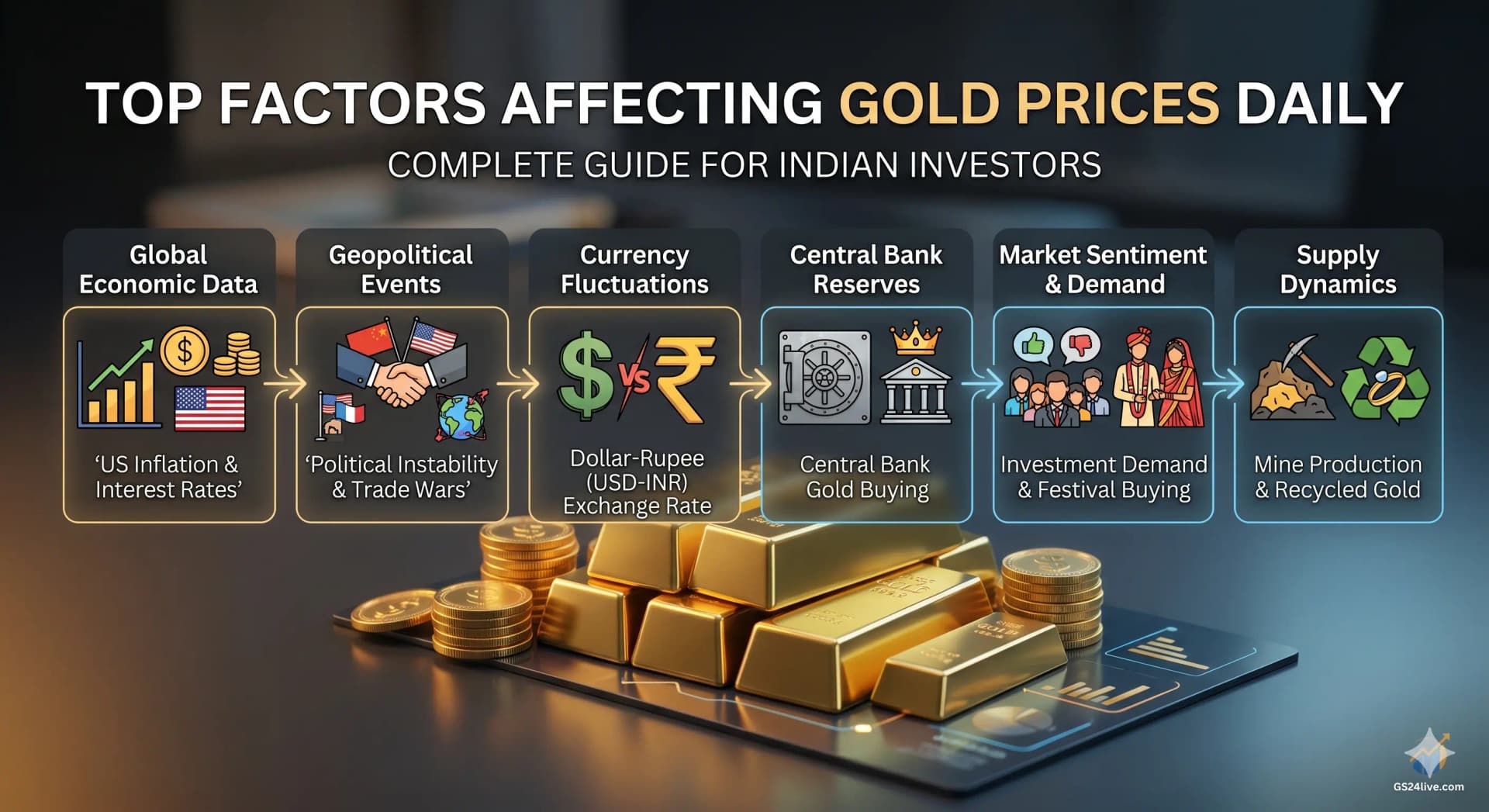
Every morning, jewellers in Ahmedabad check their screens, MCX traders scan the opening print, and households wonder whether today is a good day to buy gold. The quote you see is never random—it is the result of several forces pulling in different directions at once. Understanding those forces is one of the most practical skills an Indian bullion investor can build.
Unlike a fixed deposit rate that changes only when a bank announces it, gold reacts continuously to global markets, currency moves, policy headlines, and local demand. Some drivers matter for minutes; others shape the trend for months. This guide walks through the top factors affecting gold prices daily, with a focus on how they show up in MCX contracts, retail counters, and the Ahmedabad bullion market.
Whether you follow gold price today for a wedding purchase or track silver price today alongside industrial news, the framework below will help you read headlines without panic and compare prices with more context.
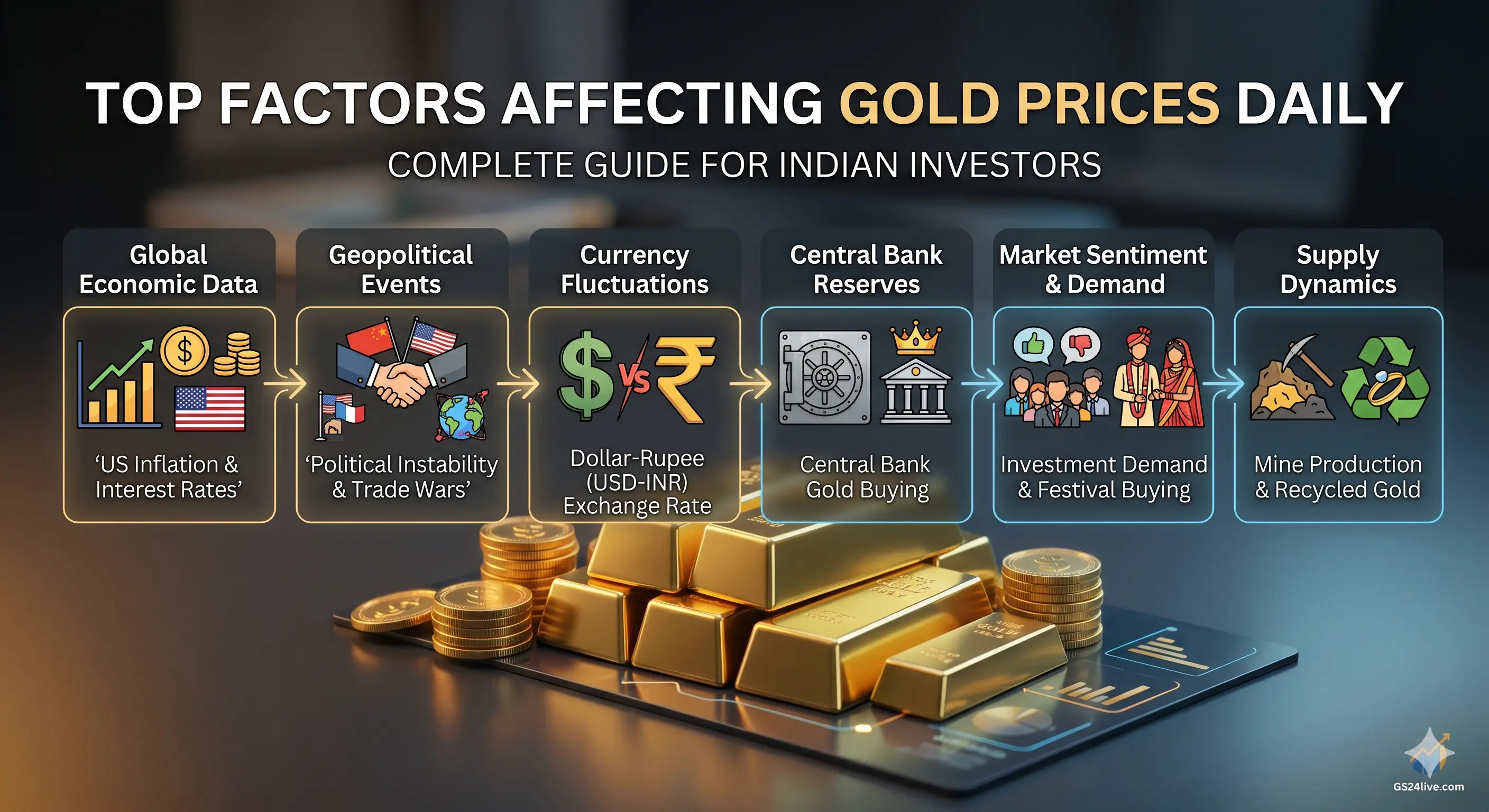
Key Takeaways
- Gold prices respond daily to a mix of global spot moves, rupee exchange rates, and local demand.
- Inflation expectations, US dollar strength, and interest-rate outlooks are among the most watched macro drivers.
- Crude oil and geopolitical headlines can shift sentiment quickly, especially in the Middle East supply chain.
- MCX gold futures translate international signals into rupee terms for Indian traders.
- Central bank buying and jewellery demand add structural support over longer horizons.
What Affects Gold Prices Daily
At a high level, domestic gold is priced from international bullion benchmarks, converted through the rupee, then adjusted for duties, taxes, and dealer margins. Within that chain, daily volatility usually comes from news flow: inflation prints, central bank speeches, currency gaps, or sudden geopolitical developments.
Indian participants often watch the same handful of themes each session. The doughnut chart below is an educational illustration of how analysts sometimes apportion attention across drivers—it is not a formula used by any single exchange to set the closing price.
Retail buyers in cities like Ahmedabad may not trade futures, but they still feel these drivers when the morning rate board changes between breakfast and lunch. Traders on MCX, meanwhile, may react within seconds to a firm dollar or a soft US inflation number.
| Factor | Typical daily influence | Who feels it first |
|---|---|---|
| International spot gold | Direct pass-through to MCX and imports | Futures desks, large importers |
| USD/INR exchange rate | Converts global price into rupees | Banks, bullion banks, jewellers |
| Domestic demand season | Premiums/discounts vs theoretical price | Retail chains, local saraf markets |
| Policy headlines | Sentiment spikes, sometimes fade quickly | News-driven traders, ETF flows |
Impact of Inflation on Gold
Gold is often discussed as a purchasing-power hedge. When households worry that future rupees will buy less, some allocate to physical gold, sovereign bonds, or ETFs. That narrative does not guarantee a rise every time CPI prints higher—other forces such as interest rates can offset the story—but inflation remains a core reason long-term holders own bullion.
In India, food and energy components still matter for sentiment. A sticky inflation report can keep rate-cut expectations at bay, which may pressure gold short term even while investors debate the long-term hedge case. The bar chart compares illustrative indexed paths for inflation pressures and domestic gold trends; always verify live data before acting.
For daily trading, inflation matters most when it surprises markets. A hotter-than-expected number can lift bond yields and the dollar, both of which may weigh on gold for a session or two, even if the multi-year thesis stays intact.
US Dollar and Gold Relationship
International gold is priced in US dollars. When the dollar strengthens against major currencies, gold can become more expensive for non-dollar buyers, sometimes easing demand. When the dollar weakens, the opposite dynamic appears. The relationship is well known but not mechanical—risk-off days can see both dollar and gold firm as investors seek liquidity and safety.
Indian investors should watch USD/INR as well as the Dollar Index (DXY). A stable global gold price can still produce a higher domestic quote if the rupee depreciates. That is why two people comparing gold price today on different apps may see different numbers even when London spot barely moved.
The line chart above uses indexed sample weeks to show how dollar strength and gold can move in opposite directions in many—but not all—sessions. Use it as a teaching aid, not a signal service.
Interest Rates Impact
Gold pays no coupon. When government bond yields rise because markets expect tighter policy for longer, some investors rotate toward interest-bearing assets. When rate-cut hopes return, bullion often finds incremental support. The Federal Reserve’s guidance still ripples through Asian sessions before Indian markets open.
Domestically, RBI policy shapes liquidity and rupee stability, which indirectly affects bullion. A surprise repo move may not target gold directly, yet jewellers and importers adjust working-capital and hedging decisions when funding costs shift.
How rate expectations show up in a typical day
- Pre-market: traders parse US futures and dollar moves after Fed speakers.
- Morning: MCX gold opens with rupee and spot adjustments.
- Afternoon: global data releases can reverse the morning trend.
- Evening: US session often sets the tone for the next Indian open.
Crude Oil and Gold Connection
Energy prices feed into transport, manufacturing, and consumer inflation. Sharp crude spikes—especially when linked to supply fears in the Middle East—can lift inflation expectations and safe-haven demand at the same time. Traders sometimes describe this as a push-pull: higher oil can hurt growth yet support gold as a hedge.
India’s import dependence makes oil headlines particularly relevant for household sentiment. When pump prices dominate news cycles, conversations in bullion markets often turn to whether gold will benefit as an inflation hedge, even before hard data confirms the trend.
Geopolitical Tensions Impact
Geopolitical shocks can move gold within minutes. Conflicts, sanctions, and diplomatic breakdowns raise uncertainty premiums. The effect may fade if tensions stabilize, but repeated headlines can keep volatility elevated for weeks—something MCX participants price through wider intraday ranges.
Indian markets also watch regional shipping routes and energy corridors because disruption risks can cascade into inflation and currency volatility. Investors should distinguish between a one-day headline spike and a sustained risk premium.
Central Bank Gold Buying
Official sector purchases provide a slower-moving but important backdrop. When central banks diversify reserves away from concentrated currency exposure, reported buying can support sentiment even on quiet days. World Gold Council publications are widely cited for tracking these flows.
Retail investors rarely trade on central bank data intraday, yet the knowledge that official demand exists can underpin long-term allocation decisions alongside jewellery and investment demand.
The polar chart illustrates illustrative global demand shares across jewellery, investment, central banks, and technology. Actual percentages vary by year and data provider.
Gold vs Silver Performance
Silver price today often moves faster than gold because industrial users and smaller speculative pools amplify swings. On days when gold drifts quietly, silver may still jump on solar or electronics headlines. Pairing both metals in research—not assuming identical drivers—leads to better decisions.
| Attribute | Gold | Silver |
|---|---|---|
| Primary daily drivers | Macro, FX, safe haven | Macro plus industrial cycle |
| Typical volatility | Moderate | Often higher |
| Indian retail use | Jewellery, weddings, savings | Jewellery, gifts, some investment |
| MCX liquidity | Very deep | Deep, can gap on news |
MCX Gold Market Analysis
MCX gold futures compress global signals into a rupee-denominated contract that jewellers, banks, and traders use for hedging. Daily volume and open interest reflect how aggressively the market is positioning around events. A calm international night can still produce an active MCX session if the rupee gaps.
Contract rolls, margin changes, and expiry weeks can add technical volatility unrelated to fundamentals. New participants should learn the difference between a macro-driven move and a positioning squeeze near expiry.
The chart shows an illustrative Monday–Friday path for a sample MCX gold quote. Live ticks will differ; use GS24LIVE or official exchange data for decisions.
Global Factors Impact Table
| Global factor | Direction if factor strengthens | Typical Indian market channel |
|---|---|---|
| US Dollar Index | Often headwind for dollar-priced gold | Spot conversion, importer costs |
| US real yields | Often headwind for non-yielding gold | ETF flows, macro funds |
| Geopolitical risk | Often supportive for safe havens | Spot spikes, MCX gap opens |
| Central bank buying | Supportive over quarters | Sentiment, long-term demand narrative |
Historical Trend Context
| Period | Sample domestic gold (₹/10g, illustrative) | Notable driver |
|---|---|---|
| 2020 | ~52,000 | Pandemic uncertainty, policy easing |
| 2022 | ~52,500 | Inflation shock, rate hikes begin |
| 2024 | ~72,000 | Record highs, strong central bank demand |
| 2026 YTD | ~98,000+ | Macro mix, rupee and spot combined |
Historical tables are for context only. Past ranges do not predict future returns.
Gold Price Outlook for 2026
Analysts surveyed for educational commentary—not as personalised advice—generally expect gold to remain sensitive to the policy calendar. Inflation releases, employment data, and central bank minutes will continue to set the rhythm for daily moves. Indian participants should pair global macro awareness with local demand calendars and rupee tracking.
For Ahmedabad and wider Gujarat markets, festive planning and import logistics often matter as much as a single US data point during certain weeks. Building a checklist of daily factors beats reacting to every headline push notification.
Frequently Asked Questions
1. What are the five biggest factors moving gold prices daily in India?
International spot gold, USD-INR, US macro data releases, crude and geopolitical headlines, and local demand premiums — often several acting on the same session.
2. Why does MCX gold change when I am sleeping?
MCX reacts to overnight global sessions, currency moves, and news before the Indian cash market opens. Gaps at open are common after major overseas events.
3. How does the US dollar index affect MCX gold prices?
Gold is dollar-denominated globally; a stronger dollar often pressures rupee gold even when international spot is flat.
4. Should I buy gold based on one daily factor?
Most experienced investors combine multiple signals and prefer gradual accumulation rather than betting on a single headline.
5. What is the relationship between interest rates and gold prices?
Rising real yields tend to pressure gold; falling yields or rate-cut expectations often support it — though the link is not one-to-one on every data print.
Data Sources and References
Research for this factors affecting gold prices piece draws on official market venues and widely cited global commodity institutions, with links listed below.
- Multi Commodity Exchange of India (MCX) – the exchange reference behind the factors affecting gold prices timing and board-gap examples in this guide.
- World Gold Council – industry demand statistics used to support the factors affecting gold prices jewellery vs investment framing.
- London Bullion Market Association (LBMA) – London benchmark context behind the factors affecting gold prices global spot discussion.
- Reserve Bank of India (RBI) – Indian macro reference for the factors affecting gold prices interest-rate and currency angles in this article.
- Reuters – international news service covering commodities, currencies, and macroeconomic developments.
- International Monetary Fund (IMF) – international macro research cited where factors affecting gold prices depends on growth and risk appetite.
These sources help provide reliable insights into global bullion markets, macroeconomic trends, and price movements affecting gold and silver trading in India.
Conclusion
Gold prices change daily because global macro, currency, energy, and policy channels all feed into a single rupee quote at the jeweller and on MCX. No single factor wins every session. Building a habit of checking spot, USD/INR, scheduled data, and local demand conditions leads to calmer decisions than chasing one viral headline.
For Indian readers—whether in Ahmedabad saraf lanes or metro ETF investors—the practical goal is context, not perfect timing. Keep a short checklist — dollar, yields, rupee, oil, and local premia — then decide whether today's move changes your plan or is just noise around an unchanged horizon.
Related Reading on GS24LIVE
- Live gold price today
- How inflation affects gold and silver
- MCX vs local gold rate guide
- Best time to buy or sell using MCX
- Crude oil and bullion linkage
Disclaimer: Daily driver map for learning how sessions move — not a trading system. Charts are illustrative; verify live prices before any purchase or hedge.