
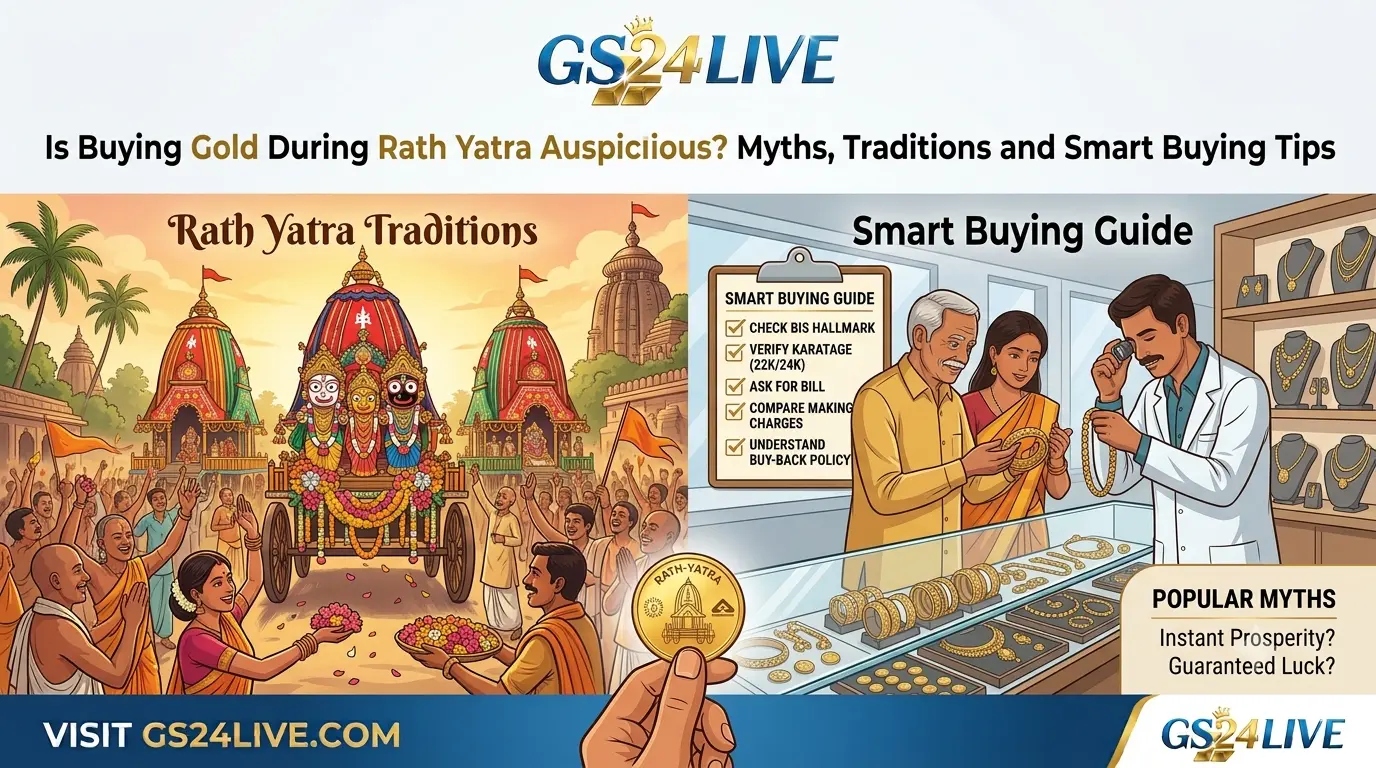
Every year as Lord Jagannath's chariots roll through Ahmedabad's old city and Puri's Grand Road, a quieter ritual plays out in showrooms nearby: families walk in to buy gold, convinced the day carries a blessing that makes the purchase luckier than an ordinary Tuesday. Whether buying gold during Rath Yatra is genuinely auspicious, or a tradition that grew alongside the festival's crowds and momentum, is a question worth separating from showroom marketing.
This is a cultural and traditions guide, not a price-timing article — for the broader festival and wedding buying calendar, see one sentence in our wedding season gold demand guide, which covers Akshaya Tritiya and Dhanteras in full; that ground is not repeated here. Check GS24LIVE's gold price today page before finalising any festival purchase.
Key Takeaways
- Rath Yatra is not one of the classical Hindu calendar dates (like Akshaya Tritiya or Dhanteras) traditionally linked to gold-buying scripture — its gold-shopping association is more regional and cultural than doctrinal.
- In Gujarat and Odisha, the festival's devotional energy and community gathering have organically extended into shopping, including jewellery, over generations.
- Many families treat any day during a major temple festival as spiritually favourable for a purchase, which is a belief, not a documented religious rule specific to gold.
- Showroom footfall genuinely rises around Rath Yatra in procession-route cities, which can mean less individual attention and more pressure-selling than a quiet weekday visit.
- Smart buying on any auspicious day means the same checks — hallmark, invoice, per-gram transparency — regardless of how meaningful the date feels.
What Rath Yatra Actually Celebrates
Rath Yatra marks the annual journey of Lord Jagannath, Balabhadra, and Subhadra from the temple to a symbolic outing, most famously in Puri, Odisha, and with a large, historic procession in Ahmedabad that draws lakhs of devotees along its route each year. The festival is about devotion, community participation, and the chariots themselves — not a scripture-based instruction to purchase precious metal, unlike Akshaya Tritiya's specific association with wealth and new beginnings in Hindu tradition.
That distinction matters because it explains why Rath Yatra's gold-buying culture feels different from Akshaya Tritiya's — it grew from festival atmosphere and crowd behaviour in specific regions rather than from an established religious calendar instruction.
Myth vs Fact: Common Rath Yatra Gold Beliefs
| Belief | Myth or Fact | Explanation |
|---|---|---|
| Rath Yatra is a classical "buy gold" scriptural date like Akshaya Tritiya | Myth | No widely documented scriptural instruction ties gold purchase specifically to Rath Yatra; the association is cultural and regional |
| Buying near a temple festival brings blessings on the purchase | Belief (personal faith) | This is a matter of personal devotion, not a verifiable market or religious fact — respected as belief, not treated as guaranteed outcome |
| Showrooms see genuinely higher footfall during Rath Yatra in procession cities | Fact | Observable pattern in cities like Ahmedabad and Puri around the festival dates |
| Gold bought on Rath Yatra day will always appreciate faster | Myth | Price movement depends on markets, not the calendar date of purchase |
| Many families historically combine the festival outing with a small symbolic purchase | Fact (tradition) | A real, generations-old regional habit, distinct from investment logic |
How Rath Yatra Retail Habits Have Shifted Over the Years
| Period | Observed retail pattern (illustrative, India-wide) | Likely driver |
|---|---|---|
| Before 2015 | Rath Yatra treated mainly as a temple-town devotional event, with limited retail gold tie-in outside Odisha | Regional custom largely confined to Puri and nearby belts |
| 2015–2019 | Gujarat jewellers begin folding Rath Yatra into festival marketing calendars alongside other symbolic dates | Retail competition seeks additional footfall occasions |
| 2020–2022 | Pandemic years bring subdued procession crowds and quieter adjacent showroom footfall | Public gathering restrictions and cautious household spending |
| 2023–2026 | Footfall recovers strongly; small coin and single-piece purchases rise faster than bridal-set buying on the day itself | Buyers prefer lower-ticket symbolic purchases over big-ticket festival buys |
Why Ahmedabad's Rath Yatra Has Its Own Gold-Shopping Character
Ahmedabad's Rath Yatra, centred around the Jagannath Mandir in the old city, is one of the largest processions of its kind outside Odisha and draws crowds from across Gujarat. Jewellery lanes near the procession route often see a visible uptick in walk-ins on and around the festival, partly devotional sentiment and partly simple opportunity — extended family gathered in the city for the occasion, shops open with festive displays, and a general mood of celebration that nudges discretionary spending, jewellery included, upward for a few days.
This is distinct from Ahmedabad's Dhanteras or Akshaya Tritiya rush, which draws more explicitly investment-minded buyers stocking coins and bars alongside jewellery; Rath Yatra buying leans more toward small symbolic pieces, gifting, and family outings than deliberate portfolio building.
What Kind of Purchases Are Typically Made
- Small symbolic pieces — rings, pendants, or coins bought as a modest festival gesture rather than a large-ticket investment.
- Gifting items — a common pattern for children or newly married family members present for the celebration.
- Coin purchases — some families prefer a clean, easily verified coin over jewellery for a festival-day purchase; our bank and mint gold coin guide explains how to buy those correctly.
- Deferred larger purchases — many households simply note the festival mood but complete bigger jewellery buying later when a wedding date or personal budget is firmer.
Regional Variations Across India
Rath Yatra's gold-shopping culture is not uniform across India — it concentrates in cities with a strong devotional and procession presence. In Puri and much of Odisha, the day centres almost entirely on temple ritual and pilgrimage, with jewellery buying playing a minor, incidental role compared with the scale of religious observance. In Ahmedabad and parts of Gujarat, where the procession draws enormous local crowds and doubles as a community festival day, the adjacent commercial districts see more visible retail spillover, jewellery included. In many other Indian cities, Rath Yatra passes as a smaller religious observance with little to no associated jewellery-shopping pattern at all.
This uneven spread is itself useful evidence that the practice is a regional cultural habit layered onto a devotional festival, rather than a nationwide calendar instruction the way Dhanteras or Akshaya Tritiya function across almost every Indian state and community.
Separating Devotion From Investment Decisions
A festival purchase made for sentiment is a different financial decision from a deliberate investment allocation, and conflating the two is where families sometimes overspend. If the goal is genuine investment exposure rather than a symbolic gesture, our retail vs investment Ahmedabad guide explains how jewellery, coins, and paper gold differ for that purpose — a Rath Yatra ring purchase should be budgeted as sentiment spending, not measured against MCX return expectations.
If you are also tracking whether the broader market session favours buying or selling around the festival window, our MCX timing guide covers that separately in one sentence — this article stays focused on tradition, not trading windows.
Risks of Festival-Crowd Buying Without Basic Checks
Higher footfall around any major festival, Rath Yatra included, means busier counters, less individualised attention from staff, and sometimes rushed billing where a buyer skips verifying the hallmark or reading the making-charge line closely because the shop is crowded and the mood is festive. This is exactly when fraud patterns described in our gold jewellery scams guide find easier ground — a distracted, sentimental buyer is a softer target than someone in a quiet showroom on an ordinary day.
Making charges on festival-day purchases are not automatically discounted just because the date feels special; our gold making charges guide explains how that line item works so a Rath Yatra ring purchase is evaluated on the same terms as any other day.
Smart Buying Tips for Rath Yatra (or Any Crowded Festival Day)
- Decide your budget and piece type before entering a crowded showroom — festival mood makes impulse upsizing easy.
- Insist on the same hallmark, HUID, and invoice checks you would run on a quiet weekday, regardless of crowd pressure.
- Ask for gross weight, per-gram rate, and making charge as separate lines even if the counter is busy and wants to bundle a quick total.
- If the shop is too crowded for proper verification, consider returning a day after the peak procession date rather than rushing.
- Treat the purchase as sentiment spending with its own small budget line, separate from any planned investment allocation.
Frequently Asked Questions
1. Is Rath Yatra officially considered an auspicious day for buying gold in Hindu tradition?
Unlike Akshaya Tritiya, Rath Yatra does not carry a widely documented scriptural instruction specifically tied to gold purchase — its gold-shopping association is regional and cultural rather than doctrinal.
2. Why do so many people still buy gold during Rath Yatra?
Festival atmosphere, family gatherings, and showroom footfall around the procession create a natural shopping moment, even without a specific religious mandate for gold.
3. Is gold cheaper or more expensive during Rath Yatra?
Prices follow normal market drivers on any given day; the festival date itself does not systematically move rates one way or another.
4. Should I buy jewellery or a coin during the festival?
For a small symbolic purchase, either works; coins are easier to verify and resell cleanly, while jewellery suits gifting. Choose based on purpose, not tradition alone.
5. Is it safe to shop during the crowded procession days?
Yes, with the same precautions as any busy shopping day — verify hallmark and invoice details carefully rather than rushing because the counter is crowded.
6. How is Rath Yatra buying different from Dhanteras or Akshaya Tritiya buying?
Those two dates carry specific scriptural and cultural instructions around wealth and new beginnings; Rath Yatra's gold-shopping habit is a regional, festival-adjacent tradition rather than a calendar mandate — see our wedding season guide for the Dhanteras and Akshaya Tritiya calendar in detail.
Data Sources and References
- World Gold Council — India festival and cultural gold demand context.
- BIS — hallmarking verification standards.
- Reuters — bullion and festival demand reporting.
- MCX India — bullion price reference.
Conclusion
Buying gold during Rath Yatra is best understood as a regional, faith-linked tradition rather than a documented scriptural instruction like Akshaya Tritiya or Dhanteras — the sentiment is real and worth honouring, but it does not change how carefully you should verify a purchase. Enjoy the procession, make a small symbolic buy if that feels meaningful to your family, and apply the same hallmark and invoice discipline you would on any ordinary Tuesday.
Separate devotion from investment planning, keep festival-day budgets modest and intentional, and let market timing and portfolio decisions live in their own separate conversation rather than being decided by the calendar of a chariot procession.
Disclaimer: This article is for informational and cultural-educational purposes only and does not constitute religious or financial advice. Precious metal purchases are subject to market risks; verify current prices and hallmark details and consult a qualified professional before investing.
Keywords: buying gold during Rath Yatra, Rath Yatra gold shopping tradition, is Rath Yatra auspicious for gold, Jagannath Rath Yatra gold buying, Ahmedabad Rath Yatra gold shopping, festival gold buying myths India.