
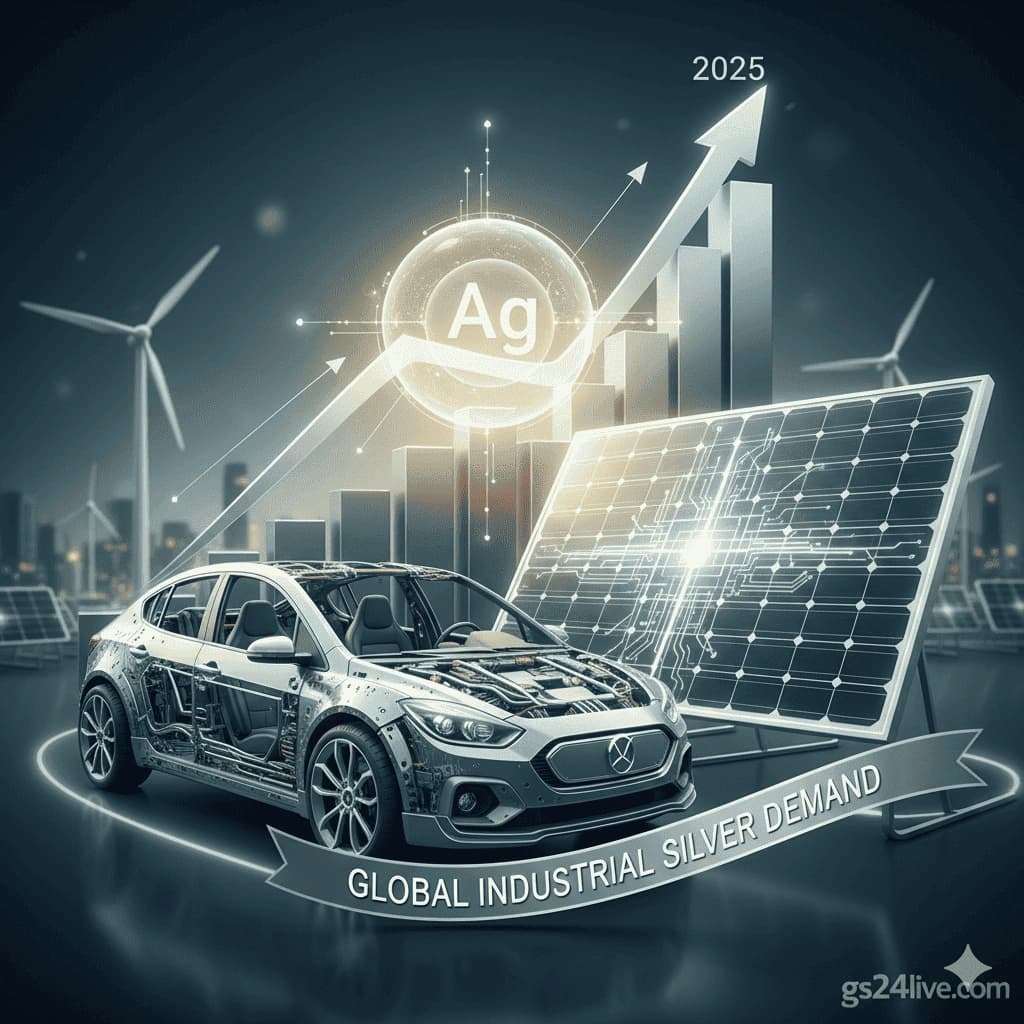
Silver has quietly become one of the most strategically important metals of the clean-energy era. While gold's story is largely about investment and jewellery, silver carries a second identity: it is an essential industrial raw material whose demand is now driven by technology adoption curves rather than festival calendars or central-bank buying alone.
This guide explains the engineering reason behind that shift — silver intensity in solar cells, electric vehicles, and electronics — and why a by-product supply model struggles to keep up. It is educational content, not personalised investment advice. For how this global demand transmits into Indian and Gujarat counter prices, see our companion piece on how industrial silver demand impacts local prices, and confirm the live silver price today before acting.
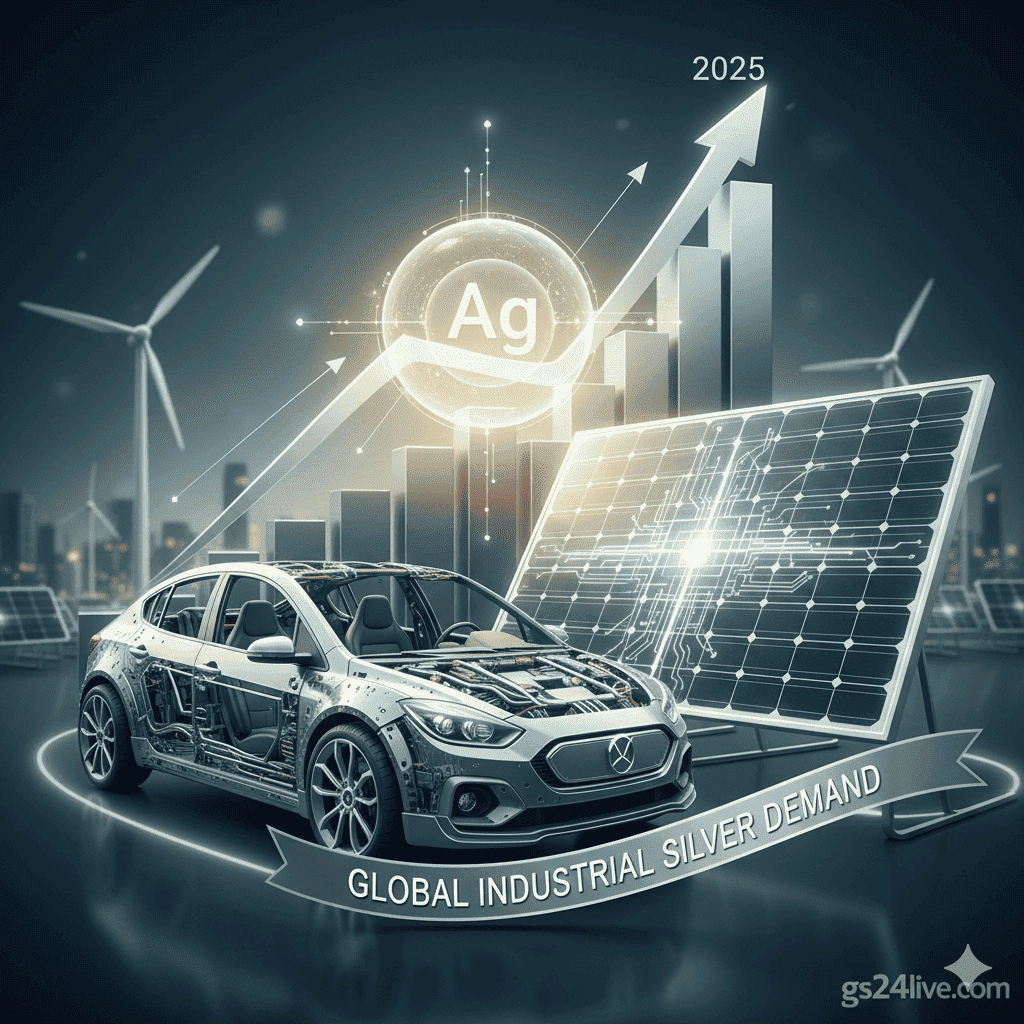
Key Takeaways
- Industrial applications now account for more than half of total global silver demand — a structural change from the jewellery-and-investment past.
- Silver intensity (grams of metal per unit) is the core concept: even small per-unit amounts compound into huge demand at global manufacturing scale.
- Solar photovoltaics and electric vehicles are the two fastest-growing demand engines, supported by electronics, 5G, and data-centre build-out.
- Supply is constrained because most silver is mined as a by-product of copper, lead, and zinc — output cannot scale quickly with price.
- The combination produces a persistent structural deficit that underpins silver's long-term demand case, separate from short-term price swings.
Silver Intensity: The Concept That Explains Everything
The single most useful idea for understanding industrial silver is silver intensity — the amount of metal embedded in each finished product. Silver has the highest electrical and thermal conductivity of any metal, plus excellent reflectivity, so engineers reach for it whenever performance matters more than cost. A device may contain only a fraction of a gram, but multiply that across hundreds of millions of units and the totals become market-moving.
The chart below compares illustrative silver content across common products to show how a conventional car, an electric vehicle, and a solar panel differ in metal intensity.
Solar Photovoltaics: The Largest Industrial Driver
Solar cells use silver paste printed into the fine conductive "fingers" that carry electricity off the cell. It is one of the few materials that delivers the conductivity solar manufacturers need at the temperatures involved in cell production. As global solar installation volumes have climbed year after year, total silver consumed by the sector has trended steadily higher.
There is a counter-force called thrifting — manufacturers continuously redesign cells to use less silver per watt to protect margins. Newer cell architectures such as TOPCon and heterojunction shift the per-cell amount up or down depending on design. The important point for readers is the net effect: despite thrifting, soaring installation volumes have kept aggregate solar silver demand rising rather than falling.
Electric Vehicles and Charging Infrastructure
An electric vehicle carries meaningfully more silver than a comparable petrol car. The metal appears in power electronics, battery management systems, onboard chargers, dense sensor networks, and the many switched electrical contacts a modern EV relies on. As production scales into the tens of millions of vehicles per year globally, even a modest per-vehicle figure compounds into a significant new demand layer.
Charging infrastructure adds a second, often overlooked, EV-linked demand source. Fast chargers, connectors, and grid-side power electronics all use silver for reliable high-current switching. Unlike jewellery demand, none of this is seasonal — it tracks the multi-year electrification of transport.
Electronics, 5G and Data Centres
Beyond clean energy, silver remains foundational to electronics: semiconductors, printed circuit boards, connectors, smartphones, and the server hardware behind cloud computing and artificial intelligence. The build-out of 5G networks and AI data centres has added a fresh, power-hungry demand stream that did not exist at scale a decade ago.
Medical and antimicrobial uses, brazing alloys, and specialty coatings round out a long tail of applications. The breadth is the point: silver demand is now diversified across dozens of industries, which makes it far less dependent on any single end-market than gold.
The Supply Problem: Silver Is a By-Product Metal
Here is the structural twist. The majority of mined silver is not produced by dedicated silver mines — it emerges as a by-product of copper, lead, and zinc mining. That means silver output is largely governed by decisions made for other metals. Even when silver prices rise sharply, miners cannot simply switch on more supply, because their economics are tied to the host metal.
Recycling helps at the margin, but a large share of industrial silver is used in tiny quantities that are difficult or uneconomic to reclaim. The result is a market that has run in deficit — demand exceeding fresh supply — for an extended stretch, drawing down above-ground inventories.
| Market Factor | Direction | Why It Matters |
|---|---|---|
| Industrial demand | Rising | Solar, EV, electronics structurally increase consumption |
| Mine supply | Constrained | By-product economics limit fast scaling |
| Recycling | Limited | Small per-unit amounts are hard to reclaim |
| Net balance | Deficit | Demand has exceeded supply, drawing down inventories |
What This Means for Investors
Structural demand is a long-term tailwind, not a guarantee of straight-line prices. Because silver is both an industrial input and an investment asset, it swings harder than gold in both directions: factory slowdowns can knock it back quickly, while demand surges can lift it faster. Position sizing and time horizon matter more here than with gold.
If you are weighing how much silver to hold against gold, our gold vs silver investment comparison covers volatility, allocation, and storage. To see how industrial cycles and gold corrections affect silver, read our silver volatility analysis.
Risks When Industrial Narratives Overshadow Position Size
Structural deficit stories support long-term cases but do not prevent 10% weekly corrections. Gujarat buyers should not skip purity checks or premium comparison because a technology headline sounded bullish.
EV and Solar: Where Tonnes Actually Leave the Market
Solar paste and EV contact materials consume silver in thin layers but at massive unit volumes — that is why industrial demand headlines can persist for years while jewellery cycles turn quarterly. This article owns that structural story; Gujarat pass-through pricing lives in the local industrial impact guide.
Electronics and Photography: The Third Industrial Leg
Beyond EV and solar, consumer electronics and legacy industrial films still pull measurable silver tonnage — enough to matter when mine supply disappoints. Indian investors feel that through MCX sentiment long before local fabrication quotes catch up.
Frequently Asked Questions1. What share of silver demand is industrial?
Industrial applications now make up more than half of total global silver demand, led by solar, electronics, and electric vehicles — a major change from earlier decades dominated by jewellery and investment.
2. Will thrifting in solar reduce silver demand?
Thrifting lowers the silver used per cell, but rising global installation volumes have so far outpaced those savings, keeping total solar silver consumption on an upward path.
3. How much more silver does an EV use than a petrol car?
An electric vehicle typically contains noticeably more silver due to power electronics, battery management, and charging contacts. Exact figures vary by model, but the direction is consistently higher than a comparable internal-combustion car.
4. Why can't miners just produce more silver?
Most silver is mined as a by-product of copper, lead, and zinc. Production is therefore tied to those metals' economics and cannot scale quickly in response to silver prices alone.
5. Does industrial demand make silver less volatile?
No — it can make silver more volatile, because prices respond to both industrial cycles and investment sentiment, producing sharper swings than gold.
6. Does India's solar push materially affect local silver demand?
Yes. Domestic module manufacturing and rooftop installations consume silver paste; growth adds a structural demand layer beyond investment flows alone.
Data Sources and References
The analysis in this article is based on publicly available financial data and reports from trusted global and Indian institutions.
- Multi Commodity Exchange of India (MCX) – live gold and silver futures source for the silver industrial demand EV comparisons discussed above.
- World Gold Council – global gold research desk referenced for the silver industrial demand EV long-horizon context.
- London Bullion Market Association (LBMA) – precious-metals standards source used where silver industrial demand EV meets international pricing.
- Reserve Bank of India (RBI) – domestic policy source linked wherever silver industrial demand EV meets rupee or liquidity conditions.
- International Monetary Fund (IMF) – world economic outlook source supporting the silver industrial demand EV scenario discussion.
These sources provide reliable insights into global bullion markets, industrial demand trends, and price movements.
Disclaimer: This article is for informational and educational purposes only and should not be considered financial advice. Chart figures use illustrative data; verify live prices and consult a qualified professional before investing.
Keywords: silver industrial demand EV solar, silver EV demand, solar panel silver, silver supply deficit