
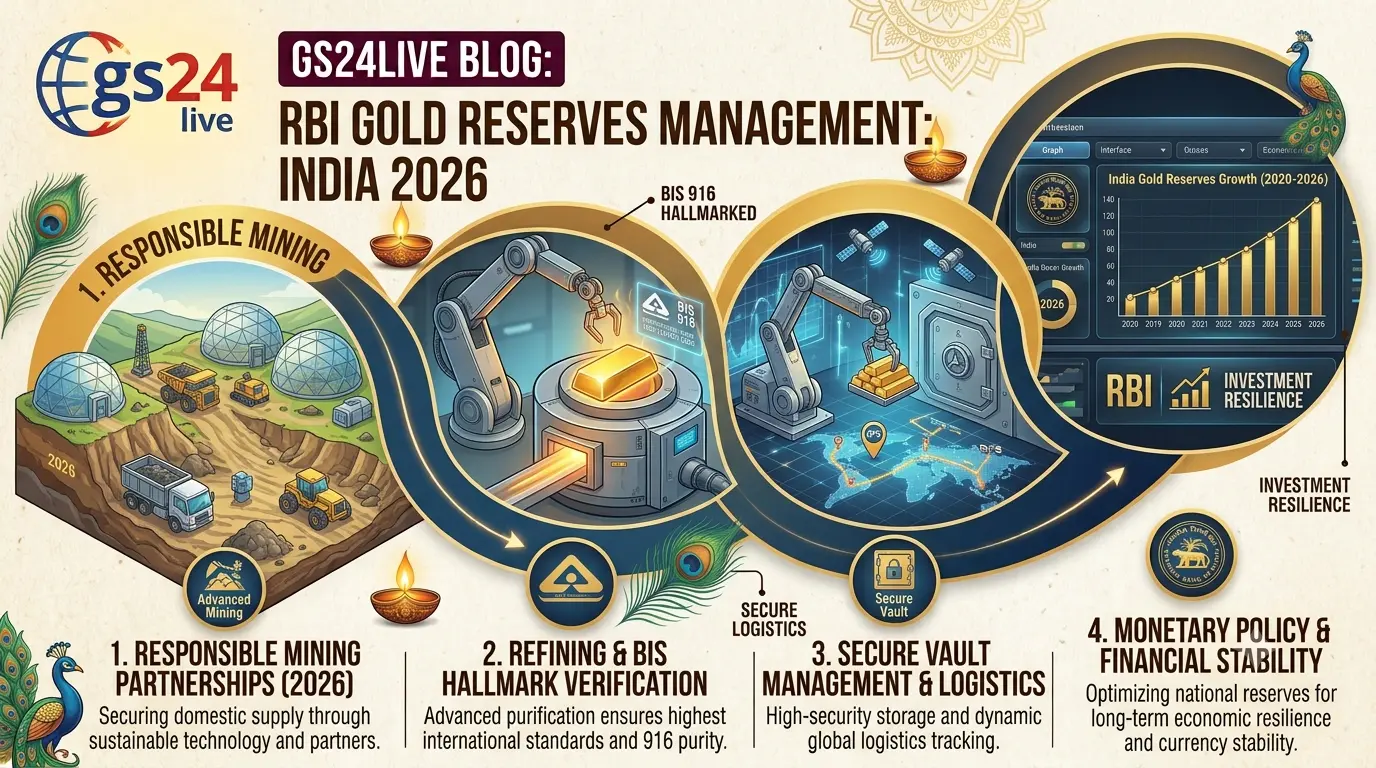
When the Reserve Bank of India publishes its weekly balance sheet, a line item under foreign currency assets quietly tracks tonnes of gold sitting in vaults — some in Mumbai, some under London stone. That stockpile is not jewellery, not ETF units, and not the gold in your locker. It is sovereign metal held as a reserve asset alongside dollars, euros, and bonds. Understanding RBI gold reserves means understanding how a central bank stores, values, acquires, and strategizes around bullion when rupee stability and import confidence matter as much as MCX session moves.
This guide explains RBI's gold reserve management — storage locations, foreign custodian arrangements, reporting mechanics, historical growth including the 1991 crisis chapter, and why the bank has been a steady buyer since 2018. For global country rankings and India's approximate 9th-place standing, see our gold reserves by country ranking guide in one link only. Track retail bullion on GS24LIVE's gold price today page when RBI purchase headlines hit wires.
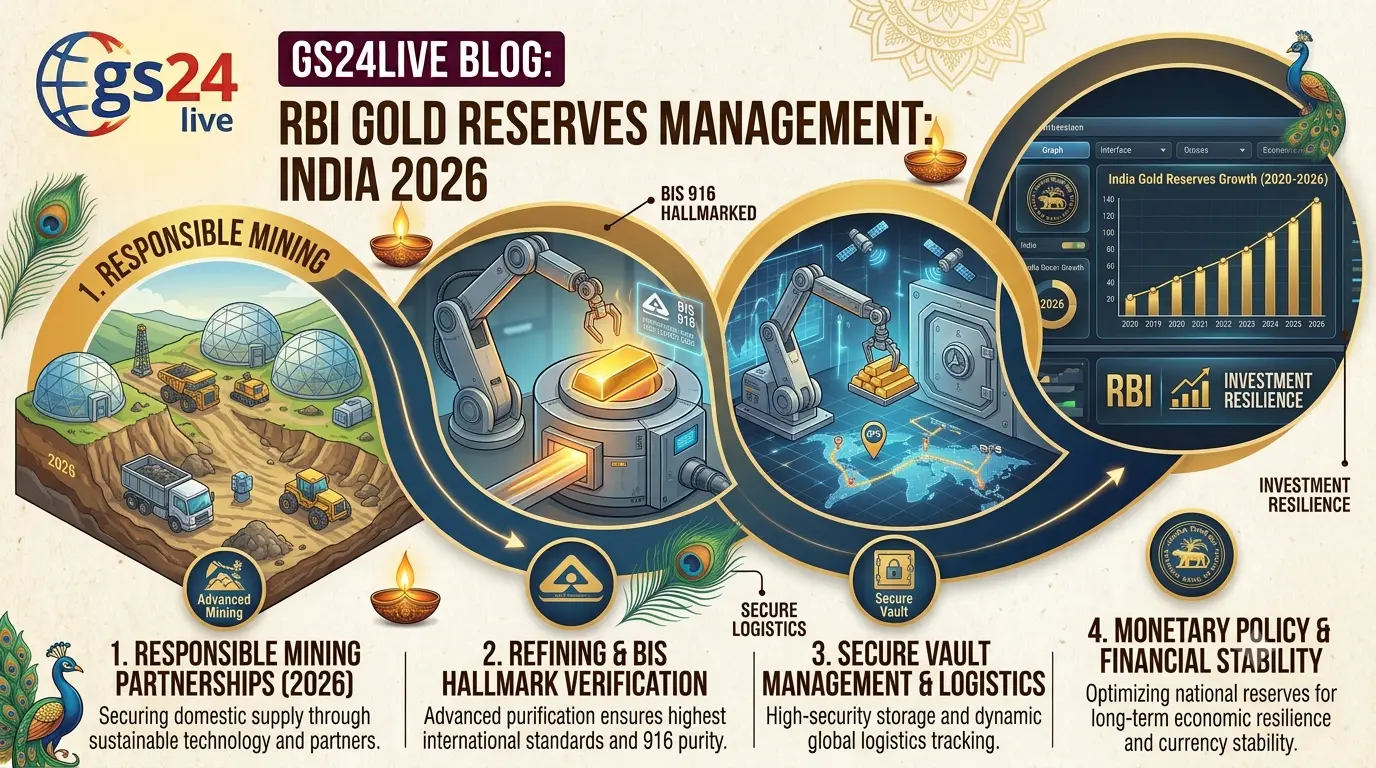
Key Takeaways
- RBI gold is part of India's official foreign exchange reserves — reported weekly in the statistical supplement with market-value conversion.
- Holdings are stored in domestic vaults and foreign custodian banks — historically including the Bank of England for settlement liquidity.
- RBI accelerated purchases after 2018, lifting holdings toward ~880+ tonnes — rank context in our country ranking guide, not repeated here.
- Gold diversifies reserves away from single-currency exposure — a strategic asset, not a trading book for profit.
- Retail jewellery prices follow import and duty mechanics — RBI buying supports sentiment but does not set CG Road board rates directly.
What Are RBI Gold Reserves?
Official RBI gold holdings are gold bullion bars owned by the Reserve Bank of India and counted as part of the nation's international reserve assets. The metal must be readily available to the monetary authority — unencumbered or clearly reported if under repurchase agreements. This differs from:
- Household gold — private jewellery and coins not on RBI's balance sheet.
- Sovereign Gold Bonds — paper liabilities of the government; RBI administers the scheme but SGB units are not vault bullion.
- Commercial bank gold — metal held for customers or trading desks, not official reserves.
RBI's mandate covers monetary stability and reserve management — gold sits in that framework as a long-duration asset denominated in troy ounces, revalued frequently at market prices for reporting.
How RBI Reports Gold Holdings
The primary public source is the Weekly Statistical Supplement (WSS) on RBI's website. Gold appears within foreign currency assets with rupee valuation based on international prices at the reporting date. Watch both:
| Metric | What it tells you | Common misread |
|---|---|---|
| Rupee value of gold | Market price × holdings converted to INR | Can rise without new purchases if spot rallies |
| Tonne equivalent (derived) | Physical stock estimate from WGC/RBI context | Round numbers lag weekly releases |
| Total forex reserves | Gold + currency + SDRs + IMF position | Gold is subset, not whole bar |
| Change week-on-week | Purchases, sales, or revaluation | Large rupee moves may be price-only |
Analysts cross-check RBI data with World Gold Council quarterly tables for tonne estimates. Discrepancies usually reflect reporting dates or swapped metal temporarily encumbered.
Storage: Domestic Vaults and Foreign Custodians
Central banks rarely store entire gold stocks in one basement. RBI uses a split model common among emerging markets:
Domestic storage
RBI maintains vault capacity in India for sovereign metal — reinforcing political confidence that national reserves physically exist on home soil. Domestic holdings support narrative independence and reduce sole reliance on foreign jurisdictions.
Foreign vaults (custodian banks)
A portion of India's gold has historically been held with custodians such as the Bank of England in London — the hub of global bullion settlement. Reasons include:
- Liquidity: London good-delivery bars settle international transactions quickly.
- Security infrastructure: Centuries-old vault systems and insurance pools.
- Settlement convenience: Purchases or swaps on international markets may settle in London first.
Exact domestic versus foreign splits are not always published in detail — chart shares are illustrative. The strategic trend in many countries, including India, has been increasing domestic share while maintaining some foreign custodian access for market operations.
How RBI Acquires and Manages Gold
Reserve management is conservative. RBI gold strategy emphasises:
| Activity | Typical approach | Market impact |
|---|---|---|
| Purchases | Gradual accumulation from international/domestic channels | Supports long-term bullion sentiment; size small vs daily jewellery flow |
| Sales | Rare; crisis or policy exception (1991 precedent) | Headline event if repeated |
| Swaps / deposits | Occasional liquidity operations; encumbered metal reported carefully | Temporary reduction in "free" gold |
| Revaluation | Mark-to-market on balance sheet | Affects reported rupee value, not physical tonnes |
| Accounting | Part of foreign currency assets presentation | Audited in RBI annual report |
RBI does not publish a "target tonnage" like inflation targets. Strategy is inferred from steady buying patterns post-2018 and public statements on reserve adequacy and diversification.
Historical Growth: From 1991 Crisis to Modern Accumulation
India's RBI gold story has two eras — defensive crisis and proactive accumulation.
1991: Pledged gold
During the balance-of-payments crisis, India shipped gold to the Bank of England and Bank of Japan as collateral for emergency financing. The episode remains a policy memory — why reserves matter, and why gold is both anchor and last-resort asset. Holdings fell sharply before rebuilding over the following decade.
2000s–2017: Stable but modest
RBI held roughly 350–560 tonnes for years — adequate by older metrics but small versus rising import dependence and external balance scale.
2018 onward: Active buyer
RBI joined global central banks as a net purchaser, adding tonnes steadily through market channels. Holdings approached ~880 tonnes by 2024–2026 — moving India up global rankings (see country ranking guide for table).
Economic Importance of RBI Gold Holdings
Why hold gold when bonds pay interest? RBI's economic rationale aligns with global central bank practice:
- Reserve diversification: Reduces concentration in any single fiat currency in the forex stack.
- Crisis liquidity: Gold settles internationally without counterparty chains — 1991 proved both need and cost of running low.
- Confidence signal: Rising holdings signal policy intent to maintain robust external buffers.
- Inflation hedge (long run): Gold purchasing power persists over decades — link macro inflation channels to our global inflation and bullion guide in one sentence only.
- Geopolitical insurance: Sanctions and asset-freeze risks post-2022 elevated gold's strategic value for many EM central banks.
Gold does not earn coupon income — the "cost" of holding it is foregone yield on US Treasuries. RBI accepts that trade-off for diversification benefits.
Gold Reserve Strategy in 2026: What RBI Is Optimising For
Inferred strategy from behaviour and public reserve-management principles:
- Gradual accumulation — avoid shocking bullion markets with single massive orders.
- Domestic + foreign balance — sovereignty plus settlement flexibility.
- Reserve adequacy framing — gold complements forex war chest covering imports and external obligations.
- No retail price targeting — RBI does not manage MCX for jewellers; see repo and macro guides for policy transmission, not repeated here.
- Transparency via WSS — weekly data reduces rumour-driven speculation.
RBI Gold vs Private Indian Gold: Two Different Worlds
| Dimension | Official RBI gold | Private household gold |
|---|---|---|
| Estimated scale | ~880 tonnes official | Thousands of tonnes culturally held |
| Form | Good-delivery bars | Jewellery, coins, artifacts |
| Policy role | External stability | Savings, weddings, collateral |
| Price sensitivity | Mark-to-market on balance sheet | Sentiment and liquidity preference |
| Public data | Weekly RBI release | Surveys and estimates only |
Ahmedabad Bullion Desks: Why RBI News Matters Locally
CG Road traders watch RBI headlines for sentiment — not for next morning's making charges. Confirmed central bank buying can firm MCX overnight, but retail boards still stack duty, spread, and labour. Practical habit: when RBI gold news breaks, compare MCX move with two showroom quotes before assuming your necklace invoice drops or spikes automatically.
- RBI buying ≠ cheaper jewellery — different market layers entirely.
- Weekly WSS release days sometimes coincide with intraday MCX commentary — verify tonnes changed, not just rupee revaluation.
- Long-term RBI accumulation supports structural bullion demand narrative alongside wedding season — see wedding season demand guide in one link.
Risks and Misconceptions About RBI Gold
"RBI can print gold like currency." No — physical acquisition requires market purchase or swap.
"All India's gold is abroad." Outdated — domestic share has increased; exact split partially undisclosed.
"RBI selling gold will crash wedding prices." Retail pricing follows import stack; RBI rarely sells.
"Higher RBI gold guarantees strong rupee tomorrow." Reserves support confidence; they do not eliminate currency volatility.
"RBI gold equals household gold counted twice." Only official vault metal is on RBI balance sheet.
Frequently Asked Questions
1. How much gold does the RBI hold?
Approximately 879+ tonnes as of 2024–2026 WGC/RBI-derived estimates — verify latest weekly supplement for rupee value and analyst tonne conversions.
2. Where does RBI store its gold?
In domestic vaults and foreign custodian facilities — historically including the Bank of England for part of the stock. Exact location splits are not fully public.
3. How often does RBI report gold reserves?
Weekly in the Statistical Supplement, with broader context in the Annual Report and balance sheet publications.
4. Why did RBI pledge gold in 1991?
To secure emergency external financing during a balance-of-payments crisis — collateral against international loans until conditions stabilised.
5. Does RBI gold buying affect local jewellery rates?
Indirectly through sentiment and MCX — not through a direct subsidy to showrooms. Landed cost math is in our MCX vs local guide.
6. Is RBI still buying gold in 2026?
Policy pattern since 2018 shows periodic net additions — confirm tonnage changes in weekly data rather than assuming every rupee value rise is a new purchase.
Data Sources and References
- Reserve Bank of India (RBI) — Weekly Statistical Supplement, annual report, reserve management publications.
- World Gold Council — central bank holdings tables and quarterly demand commentary.
- International Monetary Fund (IMF) — International Financial Statistics, monetary gold reporting standards.
- Bank of England — custodian gold market infrastructure context.
- Reuters — RBI reserve and bullion market news.
Conclusion
The Reserve Bank's official gold stockpile is managed as part of India's external stability toolkit — stored across domestic and foreign vaults, reported weekly, revalued at market prices, and accumulated gradually in the modern era after the hard lesson of 1991. The strategy prioritises diversification and crisis liquidity over trading profits.
For jewellers and investors in Ahmedabad, RBI gold matters as macro backdrop — confirming that official India takes bullion seriously — not as a shortcut to predicting tomorrow's making charges. Watch the weekly supplement for tonne changes, read rank context in the country ranking guide, and let sovereign accumulation inform long-term views without confusing vault bars with showroom chains.
Disclaimer: This article is for informational and educational purposes only. RBI holdings and storage splits change; verify official RBI and WGC releases. Not investment or policy advice.
Keywords: RBI gold reserves, RBI gold storage, Bank of England India gold, India central bank gold strategy, gold reserve management India, RBI weekly gold holdings, RBI foreign exchange gold assets.