
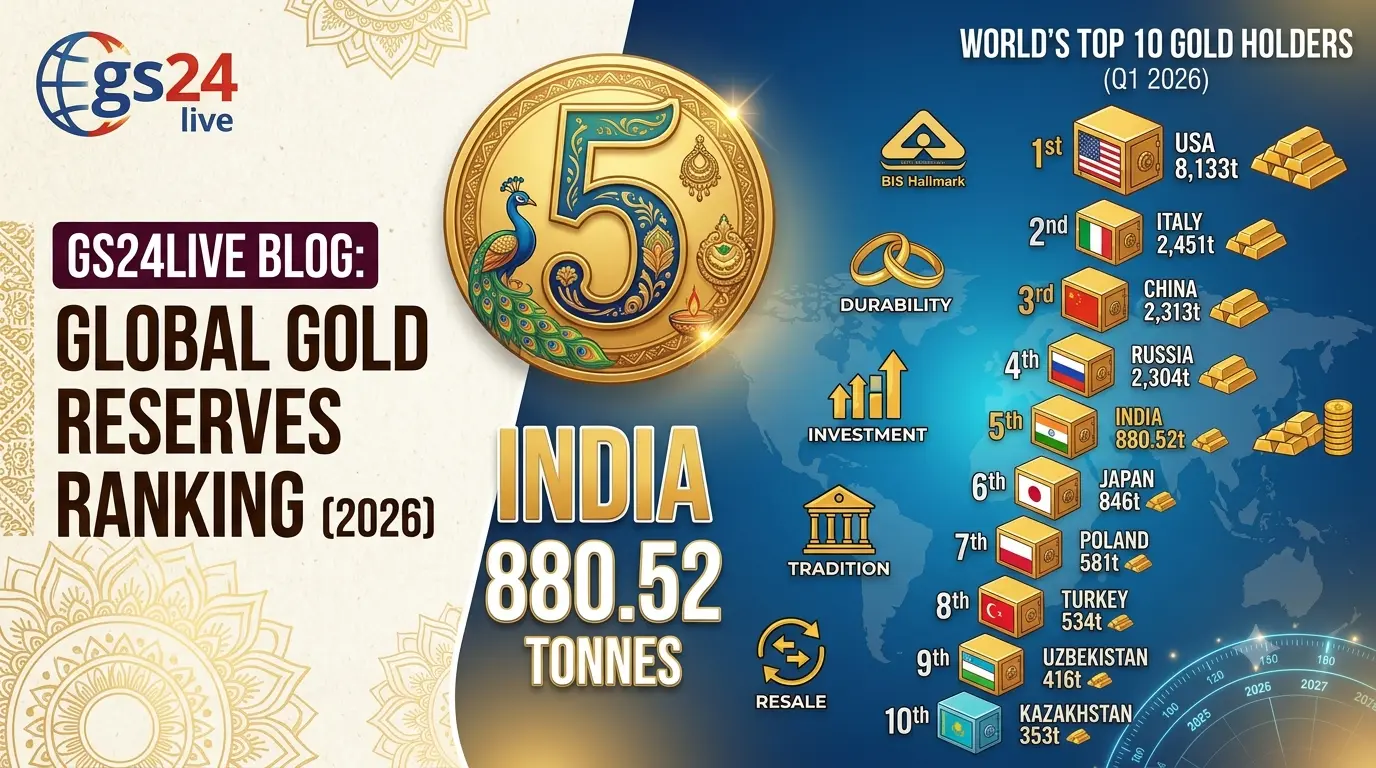
When finance ministers discuss national wealth, they cite foreign exchange, bonds, and a metal stored in vaults that never pays interest yet never defaults — gold. The list of countries with highest gold reserves reads like a map of economic history: the United States at the top with holdings from the Bretton Woods era, European nations that accumulated metal over centuries, and emerging powers that have been buying aggressively since the global financial crisis. India sits in that second group today — no longer a modest holder, but a top-ten sovereign accumulator whose Reserve Bank purchases make headlines from Mumbai to MCX trading desks.
This guide ranks the top 20 official gold holders, explains where India stands, how RBI reports its holdings, what IMF and World Gold Council data actually measure, and why central banks keep adding bars even when bond markets offer yield. For how central bank demand fits among daily MCX drivers, see our top factors affecting gold prices daily in one sentence only. Track live bullion levels on GS24LIVE's gold price today page when RBI purchase news hits the wires.
Key Takeaways
- The United States holds the world's largest official gold stockpile — roughly 8,100+ tonnes, far ahead of Germany and Italy in second and third place.
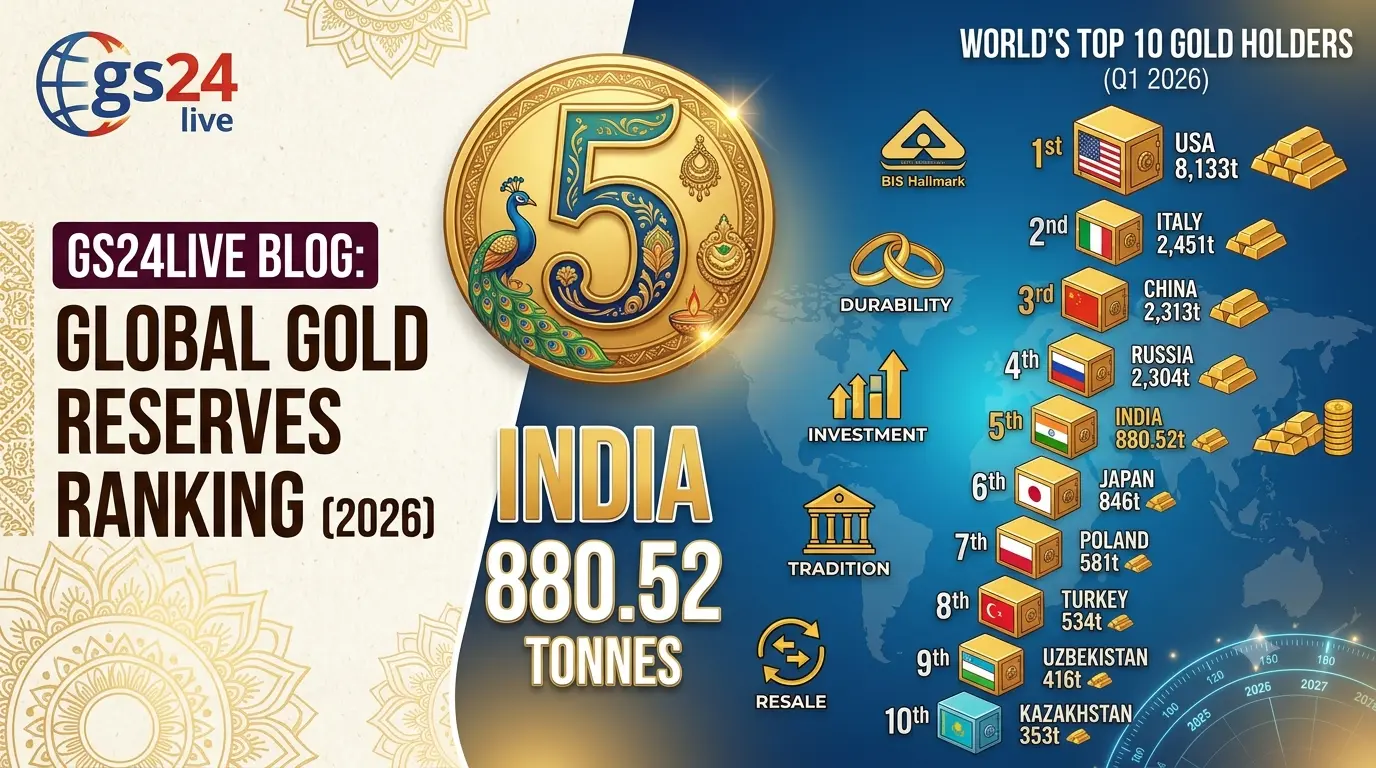
- India ranks approximately 9th globally with RBI holdings near 880 tonnes (figures update quarterly via RBI and WGC).
- IMF International Financial Statistics and World Gold Council databases are the standard public sources for cross-country reserve comparisons.
- RBI accelerated purchases after 2018, diversifying reserves away from concentrated dollar assets and supporting long-term bullion sentiment domestically.
- Central banks buy gold for sovereignty, diversification, and crisis liquidity — not for short-term trading returns.
What Counts as an Official Gold Reserve?
Official gold reserves are gold bullion owned by a nation's central bank or finance ministry and reported as part of international reserve assets. The metal must be readily available to the monetary authority — typically stored as good-delivery bars in domestic vaults or trusted foreign custodians such as the Bank of England. Gold held by private citizens, jewellery in households, or gold ETFs on stock exchanges does not count toward sovereign totals, even though India consumes hundreds of tonnes of jewellery annually.
Reserve gold differs from commercial bullion sitting in bank vaults for jewellery fabrication. When the Reserve Bank of India buys gold, it adds to the nation's balance sheet as a long-duration asset denominated in tonnes, revalued monthly at market prices for reporting purposes.
IMF Data vs World Gold Council: How Rankings Are Built
Two sources dominate public reserve comparisons. The International Monetary Fund (IMF) publishes International Financial Statistics (IFS) with line items for monetary gold reported by member countries. The World Gold Council (WGC) aggregates central bank holdings, often with timelier quarterly updates and commentary on net purchases.
| Source | What it shows | Update frequency | Best use |
|---|---|---|---|
| IMF IFS | Monetary gold in official reserves | Monthly (with lag) | Academic cross-country comparison |
| World Gold Council | Central bank holdings + purchase trends | Quarterly | Market commentary, ranking tables |
| RBI Weekly Statistical Supplement | India's foreign exchange and gold position | Weekly | Tracking RBI additions in near real time |
| Central bank press releases | Individual purchase announcements | Event-driven | Confirming large discrete buys |
Small discrepancies between IMF and WGC totals for the same country usually reflect reporting dates, gold swapped or lent under repurchase agreements, or metal in transit at month-end. Rankings should be read as approximate — not exact to the last kilogram — especially when multiple central banks sit close together, as India does with Japan and the Netherlands.
Top 20 Countries With the Highest Gold Reserves
The table below lists the leading official holders using illustrative tonnage aligned with World Gold Council and IMF publications in 2025–2026. Tonnes update when central banks buy or sell; verify latest figures before citing in research.
| Rank | Country / institution | Gold (tonnes, approx.) | Share of global official stocks (illustrative) |
|---|---|---|---|
| 1 | United States | 8,133 | ~23% |
| 2 | Germany | 3,352 | ~9% |
| 3 | Italy | 2,452 | ~7% |
| 4 | France | 2,437 | ~7% |
| 5 | Russia | 2,333 | ~7% |
| 6 | China (PBOC) | 2,264 | ~6% |
| 7 | Switzerland | 1,040 | ~3% |
| 8 | Japan | 846 | ~2% |
| 9 | India (RBI) | ~879 | ~2.5% |
| 10 | Netherlands | 612 | ~2% |
| 11 | Turkey | 578 | ~1.6% |
| 12 | Taiwan | 424 | ~1.2% |
| 13 | Uzbekistan | 391 | ~1.1% |
| 14 | Kazakhstan | 389 | ~1.1% |
| 15 | Portugal | 383 | ~1.1% |
| 16 | Saudi Arabia | 323 | ~0.9% |
| 17 | United Kingdom | 310 | ~0.9% |
| 18 | Lebanon | 287 | ~0.8% |
| 19 | Spain | 282 | ~0.8% |
| 20 | Austria | 280 | ~0.8% |
The chart highlights the steep drop from US holdings to mid-tier holders — and India's green bar among the top ten. The IMF also holds gold as an institution (~2,814 tonnes), separate from national rankings, supporting its balance sheet operations.
Where India Ranks — and How It Got There
India's climb into the top ten is recent by historical standards. For decades RBI held roughly 350–560 tonnes — respectable but not headline-grabbing. After the 1991 balance-of-payments crisis, India pledged gold to secure emergency financing, a moment still cited in macro textbooks. Rebuilding trust in reserve adequacy took years.
From 2018 onward, RBI joined the global central bank buying wave. Purchases came through a mix of domestic market absorption and imports, adding more than 300 tonnes within a few years. That pushed India past Switzerland in narrative importance (though Switzerland still holds more tonnes), then beyond Turkey and the Netherlands in ranking tables — landing near 9th place globally with holdings approaching 900 tonnes heading into 2026.
The trend chart shows the inflection after 2018 — flat legacy holdings, then steady accumulation. Exact monthly tonnage appears in RBI's weekly supplement; round numbers here are illustrative for education.
RBI Gold Reserves: Storage, Reporting, and Market Impact
The Reserve Bank of India reports gold as part of foreign currency assets in its weekly statistical supplement. Holdings are valued at end-of-period international prices converted to rupees, so the rupee value of RBI gold rises when both bullion and the exchange rate move — a double sensitivity investors sometimes overlook.
RBI stores gold domestically and with foreign custodians. A portion of India's stock has historically been held at the Bank of England, a common arrangement for emerging market central banks seeking secure, liquid vaulting in London's bullion market. Domestic storage capacity has expanded as holdings grew — sovereignty over physical metal matters politically, not only financially.
- Domestic purchases: RBI occasionally buys from local refiners or market participants, absorbing metal that might otherwise chase jewellery demand.
- Import channel: Additional bars enter through authorised bullion import routes, similar to commercial flows but destined for vaults, not showrooms.
- Revaluation effect: Rising spot prices inflate reported rupee values without any new tonnes purchased — distinguish price moves from quantity moves when reading headlines.
- MCX sentiment: Large RBI purchase rumours or confirmed additions often coincide with bullish domestic commentary, though retail board rates still follow landed import costs — see our MCX vs local gold rate guide for that stack in one link.
Why Central Banks Buy Gold in 2026
After the 2008 financial crisis and again after 2022 geopolitical realignments, official sector net buying turned structurally positive. Central banks purchased more than 1,000 tonnes in several recent years — among the highest annual totals since the 1960s. Reasons vary by country, but themes repeat.
| Motive | Explanation | Example holders |
|---|---|---|
| Reserve diversification | Reduce reliance on any single currency in foreign exchange stacks | China, India, Poland, Turkey |
| Sanctions and seizure risk | Physical gold in domestic vaults cannot be frozen by foreign payment systems | Russia, several EM banks post-2022 |
| Inflation and debasement hedge | Gold retains purchasing power over decades despite zero coupon | Global — link inflation mechanics to our global inflation and bullion guide only |
| Crisis liquidity | Good-delivery bars settle internationally without counterparty chains | India (1991 lesson), Argentina history |
| Geopolitical signalling | Large purchases communicate financial independence | China, Russia, Middle East buyers |
Central banks rarely chase intraday MCX ticks. They accumulate over quarters, smoothing price impact. Retail investors who copy the thesis — slow accumulation rather than panic buying — align more closely with official behaviour than with festival-week spikes.
Gold Reserve Comparison: India vs Selected Peers
| Metric | India (RBI) | China (PBOC) | United States | Germany |
|---|---|---|---|---|
| Approx. tonnes (2026) | ~879 | ~2,264 | ~8,133 | ~3,352 |
| Global rank | ~9th | ~6th | 1st | 2nd |
| Recent buying trend | Active buyer since 2018 | Steady accumulation | Stable (no sales) | Stable repatriation focus |
| Gold as % of total reserves (illustrative) | Rising but still modest vs FX | Rising | High legacy share | High legacy share |
| Typical storage note | Domestic + Bank of England custodian | Domestic focus | Fort Knox / Fed vaults narrative | Frankfurt repatriation |
India's absolute tonnage remains far below the United States and China, but the direction of change matters for markets. Percentage of total reserves still skews heavily toward foreign currency assets for RBI — gold is growing, not yet dominant.
Historical Milestones in India's Official Gold Story
| Period | Approx. RBI gold (tonnes) | Context |
|---|---|---|
| 1991 | ~240 (before crisis pledges) | Gold shipped to secure emergency IMF financing |
| 2000 | ~358 | Post-liberalisation rebuild phase |
| 2010 | ~558 | Stable holdings pre-global buying wave |
| 2018 | ~566 | Start of renewed accumulation cycle |
| 2022 | ~787 | Accelerated purchases amid global uncertainty |
| 2024–2026 | ~879+ | Top-ten ranking; ongoing additions |
Future Outlook: Will India Climb Higher?
Several structural forces suggest official sector gold demand remains supported through the late 2020s. Geopolitical fragmentation encourages reserve managers to hold assets outside traditional dollar-denominated settlement channels. Emerging market current account surpluses in some regions generate FX reserves that require diversification. Jewellery-heavy cultures like India's also produce political comfort with gold as a national asset — unlike nations that view metal as a legacy of older monetary systems.
India specifically could continue rising in the rankings if RBI maintains quarterly purchase pace and peers like Japan or the Netherlands remain static. Surpassing China or major European holders is a multi-decade proposition requiring sustained tonnage far beyond current levels. More realistic near-term narrative: consolidating top-ten status and closing ground on Switzerland and Japan if buying persists.
Headline risk cuts both ways. If global gold prices spike without corresponding FX inflows, the rupee cost of incremental ounces rises — RBI may slow purchases without abandoning the strategy. Conversely, sharp price corrections sometimes invite accelerated buying, as central banks treat dips as cheaper insurance premiums.
Ahmedabad and Gujarat: What Rankings Mean for Local Buyers
CG Road jewellers rarely quote RBI tonnage on showroom boards, but official buying shapes the mood around festival season. When press reports highlight another RBI purchase, sarafs on Manek Chowk often cite "government demand" as a reason boards firm — sometimes accurately, sometimes as sales rhetoric. A practical habit: compare the morning 22K rate with MCX and global spot the same hour rather than trading solely on reserve headlines.
- RBI buying supports long-term bullion sentiment but does not bypass import duty or making charges on your necklace invoice.
- Coin and bar buyers benefit psychologically from official accumulation — physical gold remains culturally aligned with national strategy.
- When ranking news breaks, check whether MCX moved on global spot or on rupee — our Ahmedabad gold price and uncertainty guide covers local board behaviour in one link.
Risks of Over-Reading Sovereign Gold Rankings
Country rankings measure official tonnes, not household wealth. India owns vast private gold in lockers and jewellery boxes that never appear in IMF tables — a cultural reserve that RBI statistics undercount. Conversely, a high sovereign ranking does not prevent currency volatility or short-term MCX drawdowns. Central banks can also lend or swap gold under repurchase agreements, temporarily reducing unencumbered totals below headline figures.
Retail investors who treat RBI purchase news as an automatic buy signal without position sizing or horizon planning may overpay during festival premiums. Rankings are macro context — not intraday trading alerts.
How Indian Investors Can Use Reserve Data Wisely
- Follow RBI weekly supplements for tonnage changes, not only rupee valuation headlines.
- Compare India's rank trajectory annually — steady climbing matters more than one quarter's noise.
- Pair sovereign demand data with personal allocation goals: jewellery, coins, ETFs, and SGB serve different roles — see our SGB vs physical gold guide for paper alternatives in one link.
- Do not assume US or European holdings will be sold into the market — legacy stocks rarely move.
- Watch WGC quarterly central bank surveys for global net purchase totals alongside India-specific RBI data.
Frequently Asked Questions
1. Which country has the highest gold reserves in the world?
The United States holds the largest official stockpile at roughly 8,133 tonnes — more than double Germany in second place. Figures come from IMF and World Gold Council reporting.
2. Where does India rank in world gold reserves?
India ranks approximately 9th globally with RBI holdings near 879 tonnes as of 2025–2026 data, behind the US, Germany, Italy, France, Russia, China, Switzerland, and Japan.
3. How much gold does the RBI hold?
RBI reports roughly 879 tonnes in official reserves, updated weekly in the statistical supplement with market-value conversions. Tonnes change when the central bank buys or sells — check the latest release for current numbers.
4. Where does IMF get gold reserve data?
Member countries report monetary gold holdings through IMF International Financial Statistics. The WGC complements this with quarterly central bank surveys and purchase estimates.
5. Why are central banks buying gold now?
Diversification away from single-currency reserves, geopolitical risk after sanctions episodes, and long-term inflation hedging drive official purchases — detailed daily price links sit in our top-factors guide, not repeated here.
6. Does RBI gold buying lower jewellery prices in India?
No direct mechanism. RBI bars enter vaults, not showroom chains. Retail prices still follow import duty, rupee, and making charges. Reserve news may affect sentiment on MCX, but your invoice math remains local.
Data Sources and References
- International Monetary Fund (IMF) — International Financial Statistics, official monetary gold reporting.
- World Gold Council — central bank holdings tables and quarterly demand trends.
- Reserve Bank of India (RBI) — weekly statistical supplement, foreign exchange and gold assets.
- London Bullion Market Association (LBMA) — good delivery standards for reserve bars.
- Reuters — central bank purchase news and macro context.
Conclusion
The league table of official gold holders tells a story of legacy wealth, geopolitical hedging, and emerging market ascent. The United States and Europe anchor the top ranks with metal accumulated over generations; China, Russia, and India represent the modern accumulation wave. India's approximate 9th-place standing reflects a deliberate RBI strategy to diversify national reserves — not a sudden accident.
For Ahmedabad buyers and MCX traders, rankings matter as backdrop: they explain why bullion retains official-sector demand even when bonds offer yield. They do not replace invoice math on CG Road. Watch RBI tonnage trends quarterly, place sovereign data beside your personal allocation plan, and let the world's vaults inform — not dictate — your next purchase.
Disclaimer: This article is for informational and educational purposes only. Reserve tonnage figures are approximate and change with central bank reporting. Charts use illustrative data; verify latest IMF, WGC, and RBI releases before citing. Consult a qualified professional for investment decisions.
Keywords: countries with highest gold reserves, India gold reserves ranking, RBI gold reserves, IMF gold data, central bank gold buying, official gold holdings comparison, World Gold Council reserves table.