
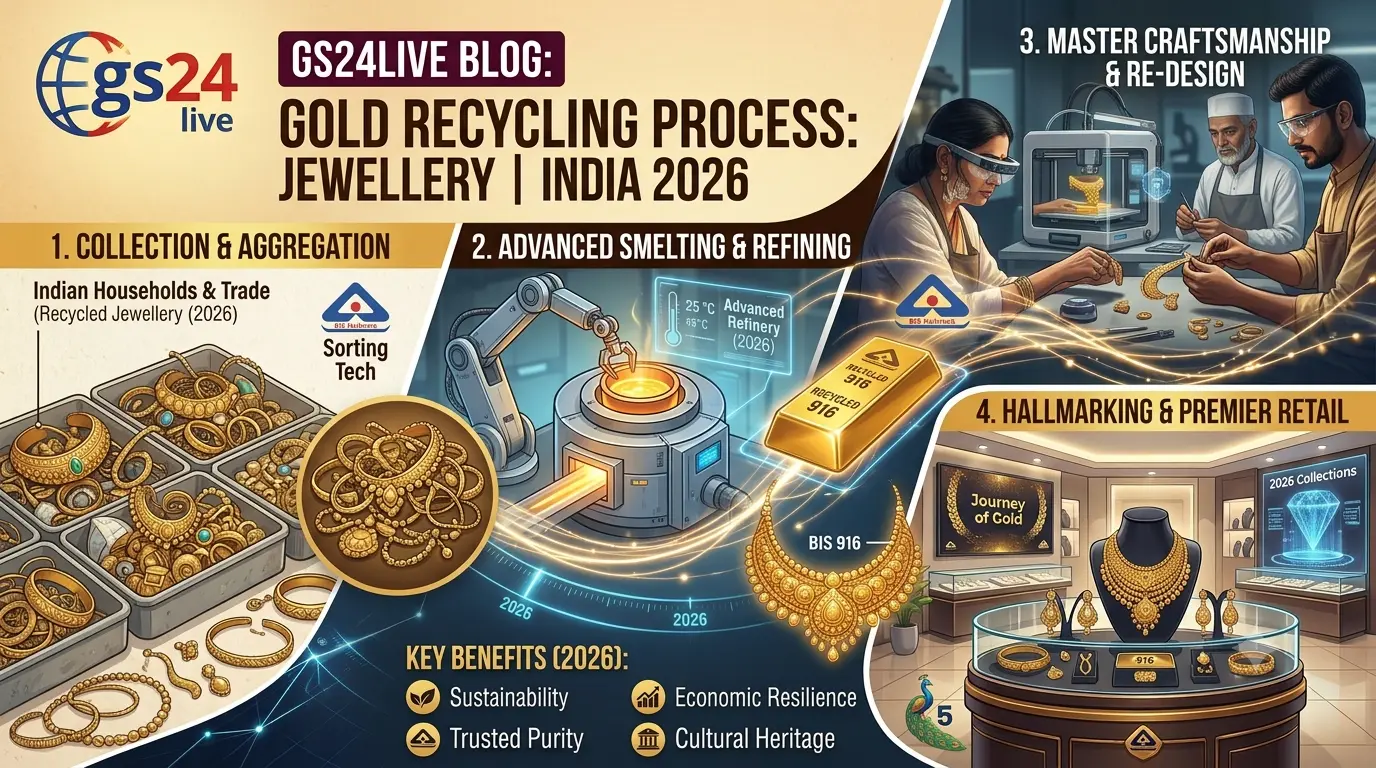
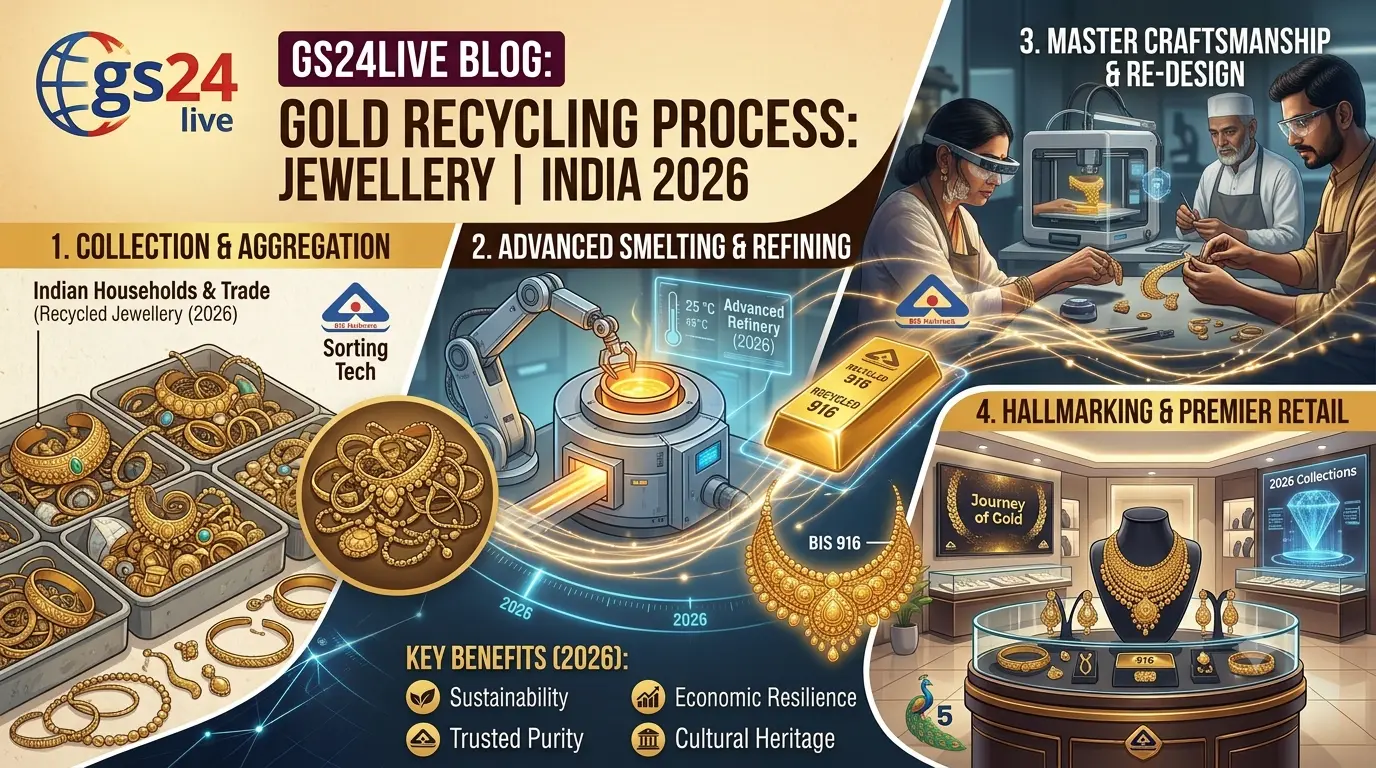
The necklace you exchange at a CG Road showroom this wedding season may contain gold that sat in someone else's locker twenty years ago — melted, refined, alloyed, cast, and hallmarked again as a new 916 set. India is one of the world's largest recyclers of gold jewellery by volume, not because of a green marketing campaign but because families constantly upgrade, resize, and convert old pieces into new designs. The gold recycling process closes the loop between Manek Chowk scrap lanes and Surat casting plants, reducing reliance on fresh mine output while keeping bridal demand supplied.
This guide walks each stage — collection, melting, refining, purity testing, and manufacturing — plus environmental benefits and what buyers should know when purchasing remade gold. For the full mine-to-retail pipeline including import, see our journey of gold guide in one sentence only. For selling scrap at the best counter, see our sell old gold guide. Check live bullion rates on GS24LIVE's gold price today page when exchange offers reference board rates.
Key Takeaways
- Old gold enters recycling through showroom exchanges, scrap dealers, refinery batches, and government schemes — not only through household sales.
- Melting consolidates mixed-karat scrap; refining separates gold from silver, copper, and solder until bullion-grade fineness is reached.
- Purity testing (fire assay, XRF) determines how much pure gold a batch yields — assay detail lives in our gold purity testing methods guide.
- Refined grain returns to jewellers who alloy to 916, cast new pieces, and send them for BIS hallmarking before retail sale.
- Recycled gold reduces environmental impact versus new mining — India’s recycled share rises during price peaks when families sell old jewellery.
Why India Recycles So Much Gold Jewellery
Indian households hold thousands of tonnes in private lockers — WGC estimates often cite recycled old gold supplying a double-digit share of annual jewellery demand. When prices rally, families melt grandmother's chains into contemporary sets. When designs age, showrooms offer exchange credit against new inventory. The cultural habit of never fully exiting gold — only transforming it — makes recycling structural, not optional.
The chart shows an illustrative supply split — import still dominates, but recycling fills meaningful volume without new mining.
Stage 1: Collection — Where Old Gold Enters the Loop
Collection channels run parallel across the economy:
| Channel | What arrives | Typical next step |
|---|---|---|
| Showroom exchange counters | Old chains, broken bangles, single earrings | Acid/XRF screen → credit against new purchase |
| Scrap dealers (Manek Chowk, Zaveri Bazaar) | Mixed karat bags, unmarked pieces | Sort, weigh, batch for refinery or melt pot |
| Wholesale refiners | Industrial scrap, filing dust, sweepings | Large furnace batches |
| Gold Monetisation Scheme (GMS) | Household deposits after assay | Refinery with government channel — see GMS guide link only |
| Job worker returns | Casting sprues, rejected castings | Internal melt back to grain |
Collection quality matters. A bag mixing 18K white gold, 22K yellow, and solder-heavy repairs yields unpredictable melt outcomes until sorted or assayed.
Stage 2: Melting — Turning Jewellery into Raw Metal
Melting uses high-temperature furnaces — induction or gas — to liquefy scrap into a bar or button shape. Stones must be removed first; enamel and lacquer burn off. Solder joints, copper alloy from 22K, and silver from old mixed pieces all enter the melt together at this stage — purity is not yet separated, only unified into one molten mass.
Small shop melting pots handle 100–500 gram lots for immediate exchange credit. Large refineries process tonnes per batch with crucibles designed for minimal gold loss to slag. "Melt loss" — gold trapped in slag or dust — is tracked professionally; informal melts may sacrifice more metal to waste unless skimmed carefully.
Stage 3: Refining — From Mixed Melt to 999 Bullion
Refining removes non-gold metals until the output approaches 999 fineness. Methods include:
- Fire assay / cupellation — reference accuracy for batch valuation.
- Electrolytic refining — common at accredited plants producing good-delivery bars.
- Chlorination / Miller process — industrial scale at major refiners.
Output forms grain, wire feedstock, or kilobars depending on customer — jewellers buy grain for casting; banks buy bars for vaults. Refining fees are priced per gram of fine gold recovered, not gross scrap weight — low-purity input costs more per fine ounce recovered.
Stage 4: Purity Testing — Proving Fineness Before Sale
Every batch gets tested before pricing. Touchstone and acid remain common at scrap counters for speed; XRF screens surface composition; fire assay settles disputes on large lots. BIS hallmarking centres test finished pieces again before stamping 916 on new jewellery — the recycled origin does not skip modern verification.
Buyers selling old gold should watch the test method used at credit time — not only the board rate applied. Testing mechanics are in our purity testing guide; this section only notes that recycling depends on accurate assay to price scrap fairly.
Stage 5: Manufacturing — From Grain to New 916 Jewellery
Refined gold is rarely worn as 999. Manufacturing steps:
- Alloying: Mix 999 with copper and silver to 916 (22K) or 750 (18K) per design.
- Casting / rolling: Wax-tree, machine chain, or hand forging in Surat, Jaipur, or Ahmedabad clusters.
- Finishing: Filing, stone setting, polish — why 916 dominates workshops is in our 916 popularity guide, not repeated here.
- Hallmarking: BIS centre assays finished piece, assigns HUID.
- Retail: Showroom tags the new necklace — physically new, chemically ancient gold atoms.
The Full Recycling Process at a Glance
| Step | Input | Output | Who performs it |
|---|---|---|---|
| 1. Collection | Old jewellery, scrap | Sorted scrap lots | Showrooms, sarafs, households |
| 2. Melting | Scrap lots | Doré button / bar | Scrap dealer or refinery |
| 3. Refining | Doré / mixed melt | 999 grain or bar | Accredited refinery |
| 4. Purity test | Refined metal | Assay certificate | Lab / BIS centre |
| 5. Alloying | 999 grain | 916 feedstock | Jewellery manufacturer |
| 6. Production | 916 feedstock | Unhallmarked jewellery | Karigar / plant |
| 7. Hallmark + retail | Finished piece | Tagged new jewellery | BIS centre + showroom |
Environmental Benefits of Gold Recycling
Mining moves mountains, consumes energy, and generates tailings. Recycling reuses already-extracted metal — avoiding new ore processing for the same gram sold at retail. Studies cited by industry groups often estimate recycled gold's carbon footprint at a fraction of mined gold per ounce, though exact figures vary by refinery energy source and logistics.
- Lower land disruption: No new open pits for recycled grams.
- Reduced chemical tailings: Refining still uses chemicals, but avoids cumulative mine waste.
- Energy savings: Melting existing metal typically demands less energy than full mine-to-doré path.
- Circular economy fit: Aligns with India's cultural gold loop — economic and environmental logic overlap.
Recycling is not zero-impact — furnaces burn fuel, acids require disposal — but it shifts burden away from extraction.
Recycled Gold vs Fresh Import: Does the Buyer Notice?
| Factor | Recycled gold path | Fresh import path |
|---|---|---|
| Atom purity at retail | Same 916 if hallmarked | Same 916 if hallmarked |
| Buyer-visible difference | None if BIS verified | None if BIS verified |
| Price on tag | Board rate + making — not labelled "recycled" | Same pricing mechanics |
| Traceability | HUID on new piece; scrap origin untraced | Import chain documentation upstream |
| Supply timing | Spikes when families sell into rallies | Follows import duty and rupee |
Ethically, some buyers prefer knowing metal is recycled; practically, BIS hallmark is the consumer-facing guarantee regardless of origin.
Ahmedabad: Manek Chowk to CG Road Exchange Loop
Gujarat's scrap ecosystem feeds both local remanufacturing and refinery shipments to Mumbai. Manek Chowk sarafs melt daily lots; CG Road showrooms credit exchange against bridal purchases during wedding season. A typical loop: sell 40 grams old chain at scrap, buy 60 grams new set — 40 grams recycled metal re-enters Surat plants within weeks as grain.
- Weigh scrap dry on a visible scale before acid test — wet-scale fraud is in our scams guide.
- Ask if exchange gold is credited at 22K assay or a discounted karat — affects rupee credit.
- New pieces still need HUID — recycled feedstock does not excuse missing hallmark on finished jewellery.
Risks and Misconceptions in the Recycling Chain
"Recycled gold is impure." False if BIS hallmarked — origin does not determine fineness; assay does.
"Melt always loses one gram per 100." Exaggerated in professional refineries; sloppy melts lose more.
"Showrooms secretly swap your gold." Fraud risk exists — mitigate with weight logs and reputable counters, not by avoiding recycling.
"Environmental claim means cheaper gold." Recycling saves extraction cost indirectly but retail prices follow board rates, not moral premium discounts.
Practical Tips for Buyers Using Exchange Gold
- Photograph scrap weight and purity estimate before melt at exchange counters.
- Separate stones — they are not gold credit unless priced separately.
- Compare exchange credit at two showrooms; board rates may match, scrap spreads differ.
- Insist on new jewellery with fresh HUID, not pre-stock with unclear origin.
- Keep tax invoices for both scrap sale leg and new purchase leg where applicable — see tax guide link only.
Frequently Asked Questions
1. What is the gold recycling process in India?
Old jewellery is collected, melted into unified metal, refined to high purity, tested by assay, alloyed back to 916, manufactured into new designs, and hallmarked before retail sale.
2. Does recycled gold jewellery have the same purity as new gold?
Yes — if BIS hallmarked at 916 or 750, fineness standards are identical regardless of whether metal came from a mine or a melted chain.
3. Where does old gold go when I sell it at a shop?
To melt pots, refinery batches, or wholesale grain stock — eventually returning as feedstock for new pieces or bullion bars. Resale channel detail is in our sell old gold guide.
4. Is melting gold at home safe or legal?
Domestic melting is impractical and risks purity loss; professional refineries handle chemistry and emissions. Sell to licensed channels instead.
5. How is purity tested during recycling?
Acid, XRF, and fire assay at various stages — full method comparison in our gold purity testing methods guide.
6. Is buying recycled gold better for the environment?
Recycled gold avoids new mining for the same gram — lower extraction impact. Retail pieces are rarely labelled "recycled," but India's exchange loop makes a large share of jewellery effectively circular.
Data Sources and References
- World Gold Council — gold recycling statistics, India demand and supply reports.
- Bureau of Indian Standards (BIS) — hallmarking on remanufactured jewellery.
- London Bullion Market Association (LBMA) — good delivery refining standards.
- Reserve Bank of India (RBI) — bullion import and macro context.
- Reuters — metals recycling and India jewellery industry news.
Conclusion
The gold recycling process turns yesterday's scrap into tomorrow's bridal set — collection, melt, refine, test, alloy, cast, hallmark, sell. India runs this loop at scale because culture treats gold as transformable wealth, not disposable fashion. Environmentally, recycled metal eases pressure on mines; economically, it keeps supply flowing when imports are costly.
As a buyer, you rarely see a "recycled" label — you see BIS 916 and a new design. Knowing the loop behind the counter helps you exchange old gold confidently, verify assay fairly, and recognise that the atoms in your new necklace may have already celebrated someone else's wedding decades ago.
Disclaimer: This article is for informational and educational purposes only. Recycling processes vary by refinery and region. Verify assay and hallmark on purchases. Consult qualified professionals for large transactions.
Keywords: gold recycling process, old gold jewellery recycling, gold melting refining India, scrap gold collection, recycled gold jewellery, gold remanufacturing India, environmental gold recycling.