
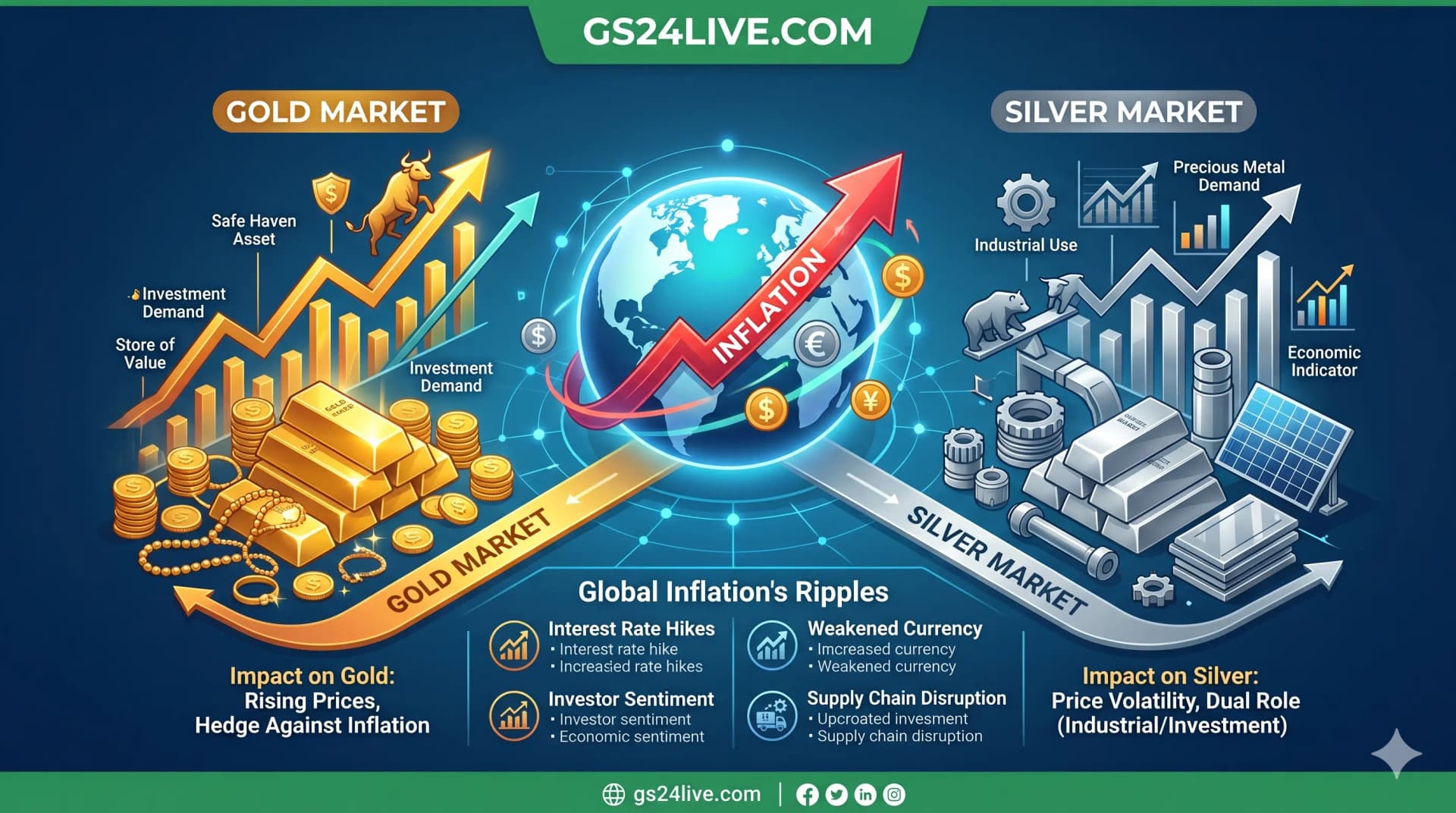
When grocery bills climb and headlines talk about rising prices, Indian investors often look toward bullion. Gold price today and silver price today are not just numbers on a screen—they reflect how markets price uncertainty, currency strength, and long-run purchasing power. Understanding how global inflation impacts gold and silver markets can help you read MCX moves and retail quotes with more context and less guesswork.
Inflation is not a single switch that pushes metals higher every day. Sometimes hotter inflation lifts bond yields and the US dollar, which can pressure gold in the short run even while the long-term hedge story remains popular. Silver adds another layer because industrial demand can pull it in different directions than pure safe-haven flows. This guide explains those links for readers who follow Ahmedabad bullion boards, MCX futures, or paper products such as ETFs and sovereign bonds.
The discussion below is educational. It draws on public macro data and market structure—not personalised advice. Always verify live levels on GS24LIVE or official exchange feeds before trading or buying.
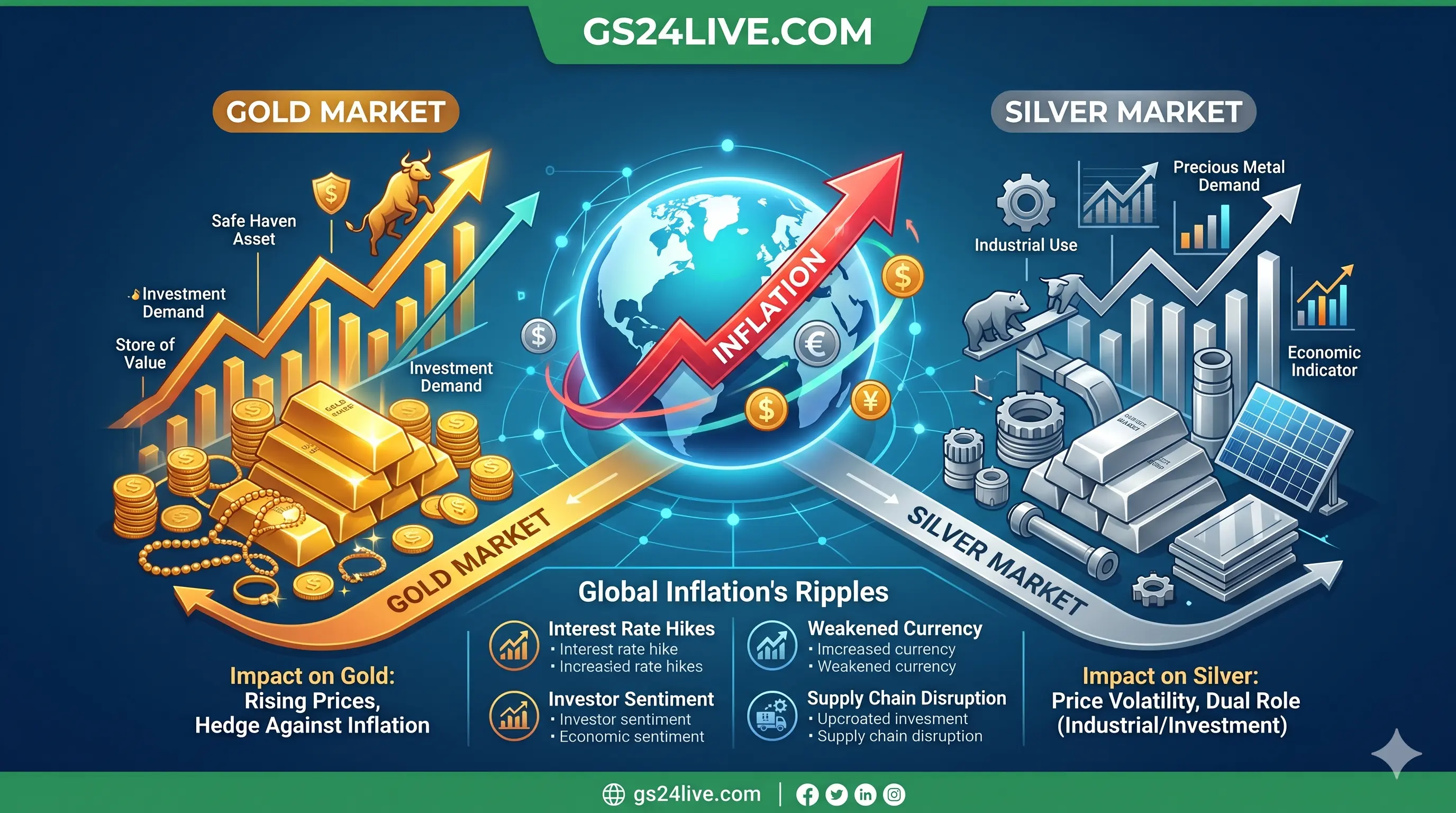
Key Takeaways
- Inflation shapes expectations for interest rates, currencies, and real returns—each channel touches bullion.
- Gold is widely treated as a long-term purchasing-power hedge, but daily prices can still fall on hawkish policy days.
- Silver may amplify moves because of industrial use alongside investment demand.
- Indian prices combine global spot, rupee moves, duties, and local premia—MCX reflects that stack in futures form.
- Disciplined allocation beats reactive buying after every CPI headline.
What Is Inflation?
Inflation measures how fast the general level of prices for goods and services is rising. Central banks track consumer price indices, producer prices, and broader measures of cost pressure. When inflation runs above target for long stretches, households feel it in food, fuel, rent, and services. Businesses face higher input costs and may pass them through to customers.
Global inflation matters for India because we import energy, technology, and a large share of gold supply. A surge in worldwide prices can lift domestic inflation even when local harvests are good. RBI responds with policy tools that influence liquidity, the rupee, and rate expectations—variables that eventually reach bullion counters in Ahmedabad and on MCX.
Core versus headline inflation also matters for markets. Headline CPI includes volatile food and fuel items that households feel immediately. Core measures strip some of that noise and guide policy expectations. Bullion traders sometimes react more to core prints when judging whether rate cuts are still months away or becoming realistic.
Why Inflation Impacts Precious Metals
Precious metals do not earn interest. That fact is central to how they behave when inflation and rate expectations shift. If investors believe cash or bonds will lose purchasing power, some rotate toward gold. If they believe central banks will raise rates aggressively, non-yielding assets can face headwinds even while the inflation story remains in the background.
Silver participates in both narratives. It can attract safe-haven flows similar to gold, yet it also depends on industrial cycles that may weaken when high inflation squeezes manufacturing margins. That dual personality is why inflation and precious metals headlines sometimes produce different daily results for each metal.
Gold as an Inflation Hedge
The gold inflation hedge idea rests on history: over multi-year horizons, gold has often preserved value when fiat currencies depreciate. Indian families experience this through jewellery wealth and gold savings passed across generations. Institutional investors express the same view via bars, ETFs, and central-bank reserves.
The hedge is imperfect at the daily frequency. A strong US jobs report that pushes real yields higher can drag gold lower even on the same week inflation data surprises to the upside. Long-term holders usually focus on allocation size and holding period rather than whether one CPI print moved the needle.
World Gold Council demand reports and LBMA liquidity surveys are useful complements to price charts when studying gold prices and inflation together. They show who is buying—central banks, ETFs, or jewellery—and help explain moves that spot alone cannot narrate.
Silver Market Reaction During Inflation
Silver market during inflation episodes can be volatile in both directions. When industrial demand is robust—think solar build-out or electronics output—silver may outperform gold on percentage terms. When factories slow and margins compress, silver can underperform despite inflation fears. Investors comparing silver investment India opportunities should weigh that industrial beta explicitly.
Retail demand for silver coins and gift articles remains culturally important, but the investment case often hinges on whether macro fears or industrial optimism dominates the narrative on a given month.
Inflation vs Interest Rates
Central banks usually respond to persistent inflation by tightening monetary policy. Higher policy rates can lift government bond yields, increasing the opportunity cost of holding gold. Markets sometimes sell bullion first and ask questions later when rate hikes are priced aggressively.
Yet inflation can also eventually force pauses or cuts if growth slows. Those pivots often revive bullion interest. Indian investors watching MCX gold analysis screens should track both inflation prints and rate guidance—not one in isolation.
How the policy loop can reach bullion
- Hot inflation data → hawkish expectations → stronger dollar or higher yields → short-term gold pressure possible.
- Inflation remains high but growth softens → cut expectations → bullion support may return.
- Rupee weakness on imported inflation → higher domestic gold in rupees even if dollar gold is flat.
US Dollar and Inflation Relationship
Many commodities are priced in US dollars. When US inflation surprises markets, the dollar’s reaction depends on whether traders think the Fed will out-hawk peers or whether real yields are rising. A firmer dollar can offset part of gold’s inflation-hedge bid for non-US buyers.
Indian participants feel the combination of dollar gold and USD/INR. That is why inflation impact on gold in Mumbai or Ahmedabad can differ from headlines about COMEX alone.
MCX Gold and Silver Analysis
MCX contracts translate global developments into rupee terms for hedgers and traders. On inflation-heavy weeks, volume often rises as jewellers adjust exposure and funds rebalance. Gold contracts typically see steady participation; silver can show sharper intraday ranges.
Margin requirements and limit rules still apply—leveraged traders can face calls even when the long-term inflation story supports bullion. Use exchange circulars for contract specs and risk parameters.
Gold vs Silver During High Inflation
| Feature | Gold | Silver |
|---|---|---|
| Typical hedge narrative | Strong cultural and central-bank support | Partial hedge plus industrial exposure |
| Volatility when CPI surprises | Moderate intraday swings | Often larger percentage moves |
| Industrial sensitivity | Lower | Higher |
| Retail familiarity in India | Very high | Moderate |
The bar chart below compares illustrative calendar-year returns during inflation-sensitive periods. Figures are rounded teaching samples, not forecasts.
Historical Examples of Inflation and Gold Prices
| Year | Inflation Rate (illustrative CPI) | Gold Return % | Silver Return % |
|---|---|---|---|
| 2020 | Elevated | +28 | +48 |
| 2021 | Rising | -4 | -12 |
| 2022 | High | +12 | +6 |
| 2023 | Cooling slowly | +15 | +8 |
| 2024 | Sticky services | +22 | +26 |
Historical Inflation Crisis Table
| Episode | Macro backdrop | Bullion behaviour (general) |
|---|---|---|
| 1970s oil shocks | High CPI, weak confidence in fiat | Gold rallied over time; volatility high |
| 2008 financial stress | Deflation fear then stimulus | Initial liquidity squeeze, then support |
| 2020–2022 pandemic era | Massive stimulus then tightening | Gold new highs; silver swung widely |
History rhymes rather than repeats. Use episodes to understand mechanisms, not to predict the next quarter verbatim.
| Metric (sample inflation week) | MCX gold | MCX silver |
|---|---|---|
| Typical intraday range | Narrower | Often wider |
| Gap risk on data | Present | Frequently larger |
| Open interest response | Steady hedging flows | Speculative spikes possible |
Best Investment Strategies During Inflation
Strategies that survive inflation cycles tend to be boring in a good way: decide target allocation, use systematic purchases, and rebalance yearly. Pair bullion with equities, debt, and emergency cash. If you use MCX, define risk per trade and avoid doubling down after losses.
Some households increase gold weighting gradually when real rates turn negative; others keep a fixed band regardless of headlines. Both can work if documented and followed.
Beginners should start by defining a rupee amount they can invest without distress, then choose a format—physical, ETF, or sovereign bond for gold; physical or carefully selected paper routes for silver. Review holdings after major policy events, not after every social-media rumour about inflation spirals.
Inflation Outlook for 2026
Analysts entering 2026 continue to debate whether inflation will settle near central-bank targets or prove sticky in services and wages. Gold may benefit from diversification flows if geopolitical and fiscal risks persist. Silver could outperform when industrial demand is strong yet may correct harder if manufacturing PMIs weaken.
For India, RBI communication, monsoon-food dynamics, and import economics remain critical local overlays on global inflation narratives. Track scheduled US and domestic data releases with a calendar rather than reacting to unverified social posts.
Bullion market trends in 2026 will likely stay headline-sensitive, but portfolios built on rules rather than fear tend to experience smoother outcomes. Keep position sizes modest enough that a single adverse week on MCX does not force distressed selling of long-term holdings.
Frequently Asked Questions
1. Does inflation always push gold prices up?
No. Gold can fall when rate hikes lift real yields or when the dollar strengthens sharply, even if inflation is elevated.
2. Is silver a better inflation hedge than gold?
Silver can outperform during certain cycles but usually carries higher volatility and industrial exposure. Gold is often the first core holding for Indian households.
3. What should Ahmedabad buyers watch besides spot gold?
Rupee moves, making charges, and local premia matter as much as international inflation headlines.
4. Are SGBs or gold ETFs better than physical gold during high inflation?
ETFs and sovereign gold bonds offer liquidity and lower storage cost; physical gold serves cultural and jewellery use. Many families hold both for different purposes.
Data Sources and References
For this inflation impact on gold article we relied on public market data and institutional research rather than private tip sheets or unverified WhatsApp forwards.
- Multi Commodity Exchange of India (MCX) – live gold and silver futures source for the inflation impact on gold comparisons discussed above.
- Reserve Bank of India (RBI) – domestic policy source linked wherever inflation impact on gold meets rupee or liquidity conditions.
- World Gold Council – global gold research desk referenced for the inflation impact on gold long-horizon context.
- London Bullion Market Association (LBMA) – precious-metals standards source used where inflation impact on gold meets international pricing.
- Reuters – international news service covering commodities, currencies, and macroeconomic developments.
- International Monetary Fund (IMF) – world economic outlook source supporting the inflation impact on gold scenario discussion.
- US Federal Reserve – publishes policy statements and economic data that shape rate expectations and dollar trends.
These sources help provide reliable insights into global bullion markets, macroeconomic trends, and price movements affecting gold and silver trading in India.
Conclusion
Global inflation reshapes the environment in which gold and silver trade, but it does not hand investors a simple buy signal. Rates, currencies, industrial demand, and local rupee dynamics all filter the story before it reaches MCX and Ahmedabad counters. Treat bullion as part of a diversified plan. When the next CPI or Fed print lands, cross-check the move on the live gold board and ask whether your horizon still matches the thesis — not whether a single print looked dramatic on social media.
Related Reading on GS24LIVE
- Live gold price today (Ahmedabad)
- Top factors affecting gold prices daily
- How crude oil prices affect gold and silver
- Gold vs silver investment guide
Disclaimer: Educational overview of how inflation channels reach Indian bullion prices — not personalised investment advice. Confirm live MCX and shop rates independently; charts are illustrative.