
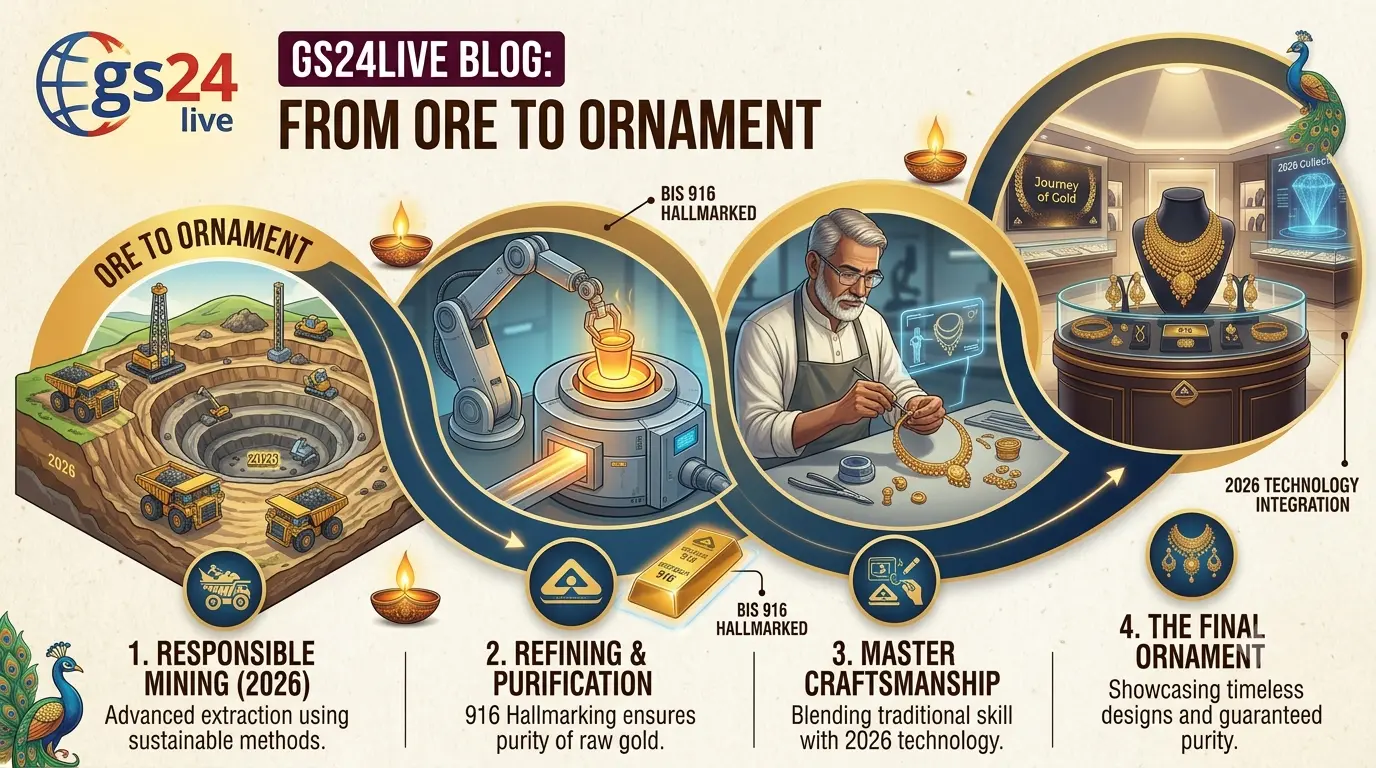
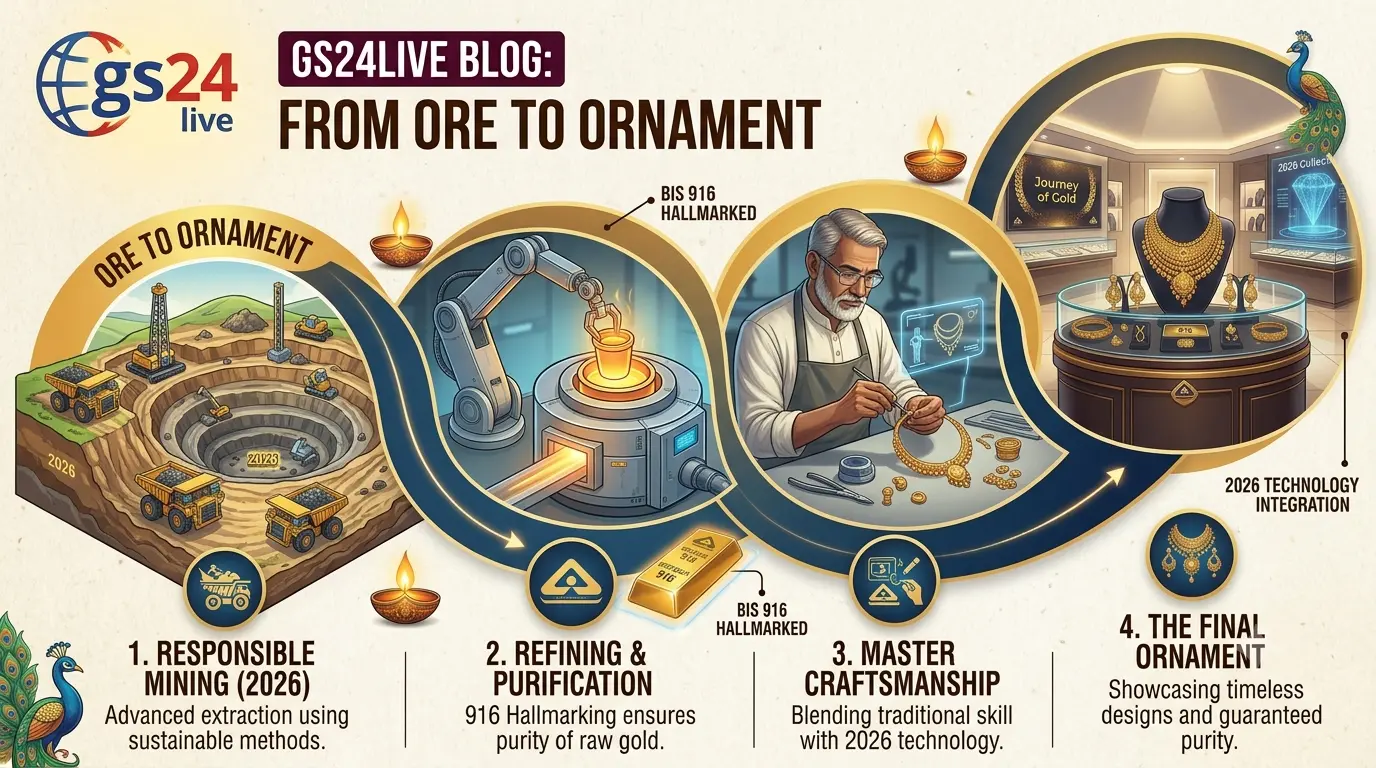
The bangle on your wrist began as rock underground — but the shape you recognise was born in a workshop: a CAD file on a screen, a wax tree in a flask, molten 916 poured at dawn, hours of filing, stones set under a loupe, a BIS centre stamp, and finally a tag on CG Road. Understanding how gold jewellery is made means following metal from raw feedstock through karigar hands into finished ornament — not just the mine headline, but the manufacturing decisions that determine durability, weight, and the invoice you sign.
This guide focuses on the jewellery-making path: brief ore-to-refinery context, then deep coverage of alloying, design, casting, finishing, hallmarking, retail handoff, and quality checks. Import logistics and wholesale bullion economics live in our journey of gold mine to jewellery store guide — one link only. Recycled scrap loops are in our gold recycling process guide. Check live rates on GS24LIVE's gold price today page before comparing workshop quotes to board rates.
Key Takeaways
- Gold ore becomes jewellery through extraction, refining to 999, then workshop alloying to 916 (22K) for most Indian bridal pieces.
- Modern manufacturing combines CAD design, wax-tree casting, machine chains, and hand finishing — method varies by product and cluster.
- Casting turns alloy into raw forms; filing, setting, and polish create wearable surfaces — metal loss here feeds making charges.
- BIS hallmarking assays finished pieces and assigns HUID before retail — mark reading in our 22K guide, not repeated here.
- Quality checks at weight, purity, stone security, and clasp strength protect buyers before the showroom tag is applied.
Before the Workshop: Ore, Extraction, and Refining (Brief)
Gold mining produces ore with tiny concentrations of metal. Crushers and chemical processes extract concentrate; refineries purify to 999 fineness bars or grain. In India, most workshop feedstock arrives as imported or recycled bullion — not directly from domestic mines. The geological and import pipeline is covered in the journey of gold guide; this article starts where workshops receive 999 grain or wire from a saraf.
Whether metal came from a South African mine or a melted Manek Chowk chain, the workshop sees the same input: certified feedstock ready to alloy.
Alloying: Why Your Necklace Is 916, Not 999
Pure gold is too soft for daily-wear bridal sets. Workshops melt 999 feedstock with measured copper and silver to hit 916 fineness (22K). The ratio controls colour, hardness, and casting behaviour. Why India defaults to 916 culturally is in our 916 popularity guide — here we note only that alloying happens before any design work, in controlled melts with batch tests.
| Karat | Gold content | Typical jewellery use | Workshop note |
|---|---|---|---|
| 24K (999) | ~99.9% | Coins, bars, some plain sets | Soft; limited stone retention |
| 22K (916) | 91.6% | Bridal, chains, bangles | Default Indian manufacturing grade |
| 18K (750) | 75.0% | Diamond fashion, export lines | Harder prongs; paler tone |
Jewellery Design: From Sketch to CAD File
Custom bridal orders begin with design — hand sketches, reference photos, or CAD models specifying weight targets, stone layout, and shank thickness. CAD allows weight estimation before metal is cast, reducing costly rework. Machine-chain factories skip individual CAD per link but use parametric templates for gauge and length.
- Bridal custom: 2–6 weeks design iteration before wax approval.
- Catalogue sets: Factory repeats proven moulds — faster turnaround.
- Weight budget: Families often cap gross grams; design adjusts volume accordingly.
Casting: Where Metal Takes Shape
Casting methods define how molten alloy fills a mould:
Lost-wax (investment) casting
Wax models attach to a tree; plaster investment encases them; wax burns out; 916 melt fills cavities. Used for intricate bridal sets, jhumkas, and filigree-heavy pieces across Jaipur and Ahmedabad job shops.
Machine chain production
Surat plants extrude wire, form links continuously, solder at speed — high volume, tight tolerances, lower per-link labour than hand chains.
Hand forging
Hammer and die shape solid metal for heavy kada and traditional forms — slower, premium labour, excellent for thick gauges.
After Casting: Filing, Soldering, and Assembly
Raw castings show sprue marks, parting lines, and rough surfaces. Karigars file, emery, and solder sub-components — joins on complex sets must survive daily wear. Solder alloy matches 916 where possible; mismatched solder shows at buy-back assay. Metal filed away becomes dust collected for internal recycle — part of making charge economics in our making charges guide.
Stone Setting and Final Polish
Polki, rubies, emeralds, and diamonds receive prong, bezel, or traditional kundan-style mounts depending on design. Setting stresses metal — another reason 916 beats 24K for ornate work. Final polish uses rouge and buffing wheels; pre-delivery shine is cosmetic but removes microscopic surface metal — see weight loss guide if polishing repeats over decades.
Hallmarking: BIS Verification Before Sale
Finished pieces ship to BIS-recognised assaying and hallmarking centres. Labs test fineness; compliant pieces receive BIS logo, purity mark (916/750), and six-digit HUID. Retailers should not sell new hallmarked jewellery without complete marks — verification steps in our 22K vs 24K guide and assay methods in our purity testing guide, linked not repeated.
Retail Process: From Factory Floor to Showroom Tag
| Step | Location | What happens |
|---|---|---|
| Wholesale pickup | Surat / Mumbai job worker | Sets bulk-shipped to retail chains |
| Inventory logging | Showroom back office | HUID scanned into stock system |
| Board pricing | CG Road counter | Morning 22K rate + making applied |
| Customer sale | Retail floor | Weigh, invoice, GST lines |
| After-sales | Same showroom | Resize, polish, buy-back later |
Your ornament's price stacks metal (from refined feedstock), labour (design through polish), hallmark fees, brand margin, and GST — MCX landed-cost layers sit upstream in the journey guide.
Quality Checks at Every Stage
| Stage | Check performed | Who cares |
|---|---|---|
| Alloy melt | Batch karat test | Manufacturer |
| Post-cast | Visual porosity, weight vs CAD | Job worker QC |
| Pre-setting | Shank thickness, joint strength | Master karigar |
| Post-polish | Surface pit, clasp operation | QC bench |
| Hallmark centre | Fire assay / XRF fineness | BIS lab |
| Retail sale | Weigh in customer view, HUID match | You |
Full Manufacturing Process Timeline (Illustrative)
| Product type | Typical lead time | Bottleneck stage |
|---|---|---|
| Machine chain (catalogue) | 1–3 days from stock | Inventory pull |
| Standard bridal set (mould repeat) | 2–4 weeks | Cast + polish queue |
| Custom CAD bridal with stones | 6–12 weeks | Design approval + casting |
| Heavy hand-forged kada | 3–8 weeks | Forging + finish labour |
Surat, Jaipur, and Ahmedabad: Where Ornaments Are Born
Surat dominates machine chains and volume casting exports. Jaipur specialises in kundan-meena and traditional forms. Ahmedabad retail pulls from both — CG Road showrooms source inventory nationally but rely on Gujarat job workers for custom orders during wedding season. Ask your salesman whether a set was Surat machine-made or Ahmedabad custom-cast — not for snob value, but to set realistic repair and resize expectations.
Risks When Manufacturing Quality Is Skipped
Hollow casts sold as solid, under-karat alloy despite 916 stamp (counterfeit hallmark — scams guide), and weak prongs on rushed festival orders cause most post-purchase failures. Insist on BIS HUID on new pieces and weigh at purchase. Manufacturing shortcuts save the producer rupees; they cost you on the first stone loss or buy-back assay failure.
What Smart Buyers Should Verify
- Ask manufacturing method — cast, machine, or forged — for repair planning.
- Match invoice gross weight to scale at billing; photograph HUID.
- Confirm stones billed separately from metal where applicable.
- For custom orders, approve CAD or sample weight before full melt.
- Understand making charges reflect labour through casting and polish — making charges guide linked once.
Frequently Asked Questions
1. How is gold jewellery made step by step?
Refined gold is alloyed to 916, designed (CAD or catalogue), cast or forged, filed and assembled, stones set, polished, hallmarked at a BIS centre, then priced and sold at retail with HUID on tag.
2. How long does it take to make gold jewellery?
Catalogue chains: days. Custom bridal with CAD: often 6–12 weeks. Festival queues extend lead times — order early.
3. Is all gold jewellery made from newly mined gold?
Much feedstock is imported bullion or recycled scrap refined back to 999 — atoms may have cycled many times. See recycling guide for scrap loop detail.
4. What is the difference between casting and machine-made chains?
Casting uses moulds for complex shapes; machine plants extrude and link wire continuously for uniform chains at scale — both start from 916 alloy.
5. When does hallmarking happen?
After manufacturing and before retail sale — BIS centre tests fineness and assigns HUID. Do not buy new jewellery without complete marks.
6. Why does manufacturing affect my final price?
Labour, cast loss, stone work, and brand margin stack on metal value — making charges and invoice break-ups are in our dedicated guides; metal alone is never the full bill.
Data Sources and References
- Bureau of Indian Standards (BIS) — hallmarking framework for finished jewellery.
- World Gold Council — gold supply, refining, and jewellery demand context.
- London Bullion Market Association (LBMA) — refinery standards for feedstock.
- Gem & Jewellery Export Promotion Council (GJEPC) — India manufacturing cluster data.
- Reuters — jewellery manufacturing and trade news.
Conclusion
From ore to ornament is a long chain — geology and refining feed workshops where design, alloying, casting, and polish transform bullion into cultural objects. The manufacturing path explains why two 916 necklaces with identical weight can differ in price: method, labour, and QC are invisible on the tag but real on the invoice.
Next time you try on a set on CG Road, you are wearing metal that passed through a refinery melt and a karigar's file — know the steps, verify hallmark proof, and let understanding of how gold jewellery is made turn showroom pressure into informed questions.
Disclaimer: This article is for informational and educational purposes only. Manufacturing methods vary by workshop. Verify hallmark and invoice details on every purchase.
Keywords: how gold jewellery is made, gold jewellery manufacturing India, gold casting process, 916 alloying jewellery, BIS hallmarking steps, jewellery design to retail, Surat gold manufacturing.