
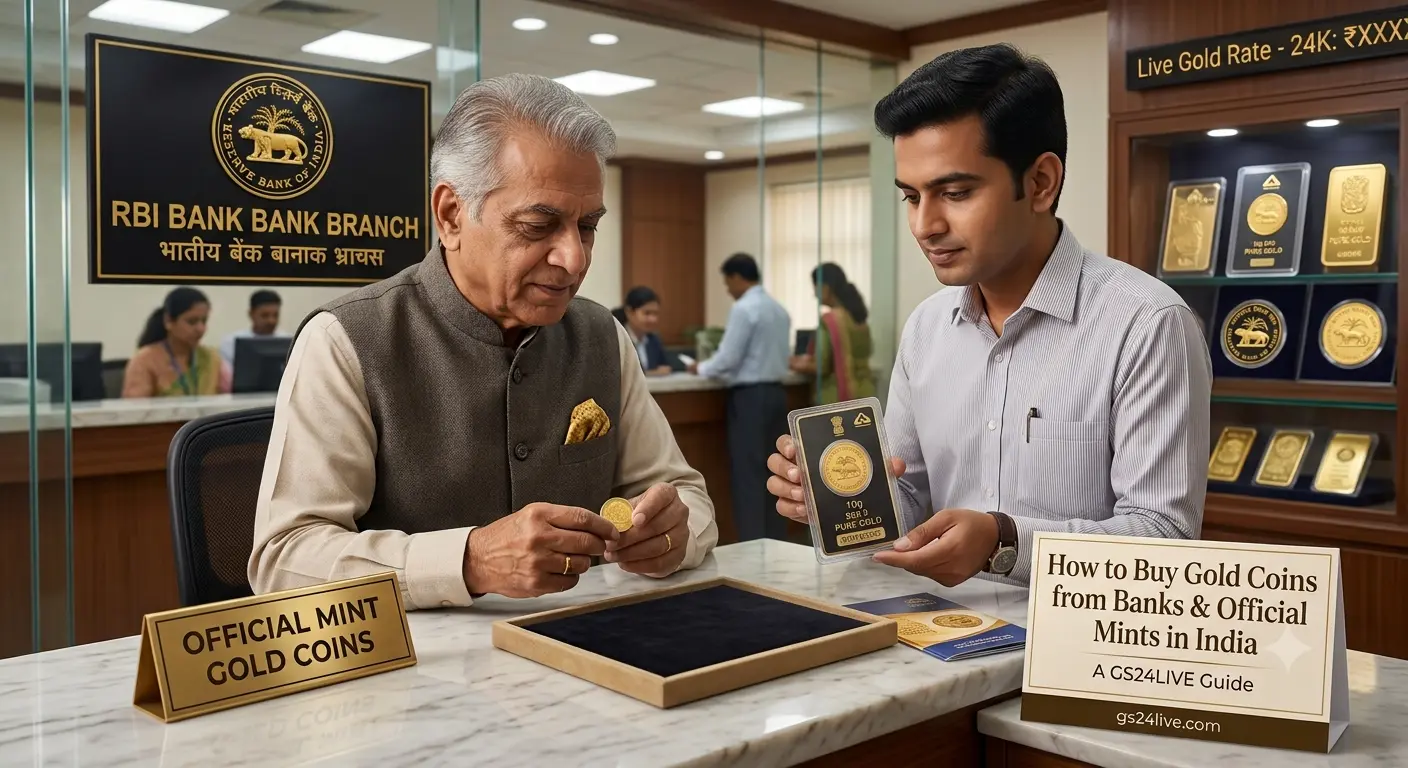
Every festival season, bank branches in Ahmedabad put up small counter posters for 24K gold coins, and customers assume a bank stamp automatically means the safest way to buy metal. It usually is safer than an unknown roadside seller — but "safe" does not mean "simple." Banks, government-backed mints, and jewellers sell coins through very different processes, with different premiums, different paperwork, and very different buy-back promises. Learning how to buy gold coins from bank India counters properly means understanding what you are actually paying for beyond the metal weight.
This guide compares the three main coin-buying channels, breaks down a real premium-over-spot example, lists practical fake-coin checks, and covers Ahmedabad-specific counter habits. It assumes you already know the difference between jewellery and investment-grade gold buying and how a Sovereign Gold Bond compares to physical gold — both are linked once here rather than re-explained. Check GS24LIVE's live board before any counter visit so you can judge the quoted premium against the day's actual rate.
Key Takeaways
- Banks do not mint their own coins — they resell coins sourced from refiners like MMTC-PAMP or foreign mints, and most Indian banks will not buy the coin back.
- Government and refiner mints sell tamper-evident sealed coins with serial numbers and assay certificates, usually at a lower premium than a bank counter.
- The premium over spot price — not the announced gram rate alone — decides whether a coin purchase was fairly priced.
- Smaller denominations (0.5g–2g) carry a noticeably higher percentage premium than 10g or 20g coins.
- A sealed, serial-numbered coin with an intact tamper strip is far easier to resell at a fair rate than a loose or resealed one.
Bank Counters, Mint Outlets, and Jeweller Coins: Three Different Channels
A bank coin sale is essentially a retail partnership: the bank takes orders, collects payment, and hands over coins that were manufactured and packed by a refiner such as MMTC-PAMP, and imported or sourced foreign mint coins in some cases. The bank adds its own margin on top of the refiner's ex-works price. Most public and private banks that sell coins — a well-known example is the State Bank of India gold coin counter — explicitly state they do not repurchase the coin later; you sell it back to a jeweller or bullion dealer instead.
An official mint or refiner outlet — a direct MMTC-PAMP showroom, for instance — sells the same style of tamper-sealed coin without the bank's added retail layer, which is why mint-direct premiums are often a percentage point or two lower than a bank branch quote for an identical weight and purity. Jewellers also sell coins, sometimes their own house-branded ones, at a premium that can include local design costs and are not always assay-certified to the same international standard as a refiner coin.
| Channel | Typical premium over spot | Buy-back promise | Documentation |
|---|---|---|---|
| Bank counter | Moderate to high | Usually none — sell elsewhere | Bank invoice + refiner certificate |
| Official mint / refiner outlet | Lower to moderate | Sometimes, on their own coins | Assay certificate, tamper seal, serial number |
| Jeweller-sold coin | Variable, sometimes highest | Often yes, at their own rate | Shop invoice; certificate quality varies |
What's Actually Inside the Packet: Seals, Serials, and Certificates
A genuine investment coin from a recognised refiner arrives inside a sealed blister or assay card, laser-etched with a unique serial number that matches the printed certificate. The certificate states purity (typically 999.9 for pure gold coins), weight, and the refiner's name and logo. Do not accept a coin outside its original packaging as equivalent — once a seal is broken, resale value drops because the next buyer cannot independently confirm the coin was never swapped or shaved.
Photograph the sealed packet, the serial number, and the certificate before you leave the counter, and keep the original bank or mint invoice separately from the coin itself. If you ever need a lab check beyond the seal, our dedicated gold purity testing methods guide covers XRF, fire assay, and touchstone options in depth — this article will not repeat that testing science.
Worked Example: What You Actually Pay Over Spot
Suppose the day's reference gold rate works out to roughly ₹9,800 per gram for 999 purity on the wholesale board. A bank counter quoting a 5g coin at ₹52,000 is charging roughly ₹49,000 for the metal plus ₹3,000 in packaging, certification, and channel margin — a premium of about 6%. The same weight bought directly from a mint outlet at ₹50,800 reflects a premium closer to 3.7%. Over a 5g purchase that gap is only a few hundred rupees, but on a 20g or 50g coin the absolute premium difference becomes meaningful, which is why serious buyers compare multiple counters before committing to a large single purchase.
Always ask the counter to write the premium as a separate line item, not bundled silently into a "final price." A counter that refuses to break down the premium is not necessarily dishonest, but it removes your ability to compare channels fairly.
Choosing a Denomination That Matches Your Purpose
Coins commonly come in 0.5g, 1g, 2g, 5g, 8g, 10g, 20g, and 50g sizes, though not every bank stocks every size year-round. Small coins (0.5g–2g) are popular as gifts and token investments but carry a disproportionately high percentage premium because fixed packaging and certification costs are spread over less metal. Larger coins (10g and above) dilute that fixed cost and usually offer a better premium-per-gram, but they concentrate more rupee value into a single unit, which matters for insurance and storage planning.
- Gifting occasions: 1g–2g coins keep the rupee outlay modest while still being "real gold" gifts.
- Long-term accumulation: 5g–10g coins usually balance premium efficiency with manageable resale lot sizes.
- Bulk allocation: 20g–50g coins suit buyers who already have locker access and want the lowest percentage premium.
Fake Coin and Counter-Fraud Red Flags
Most bank and mint coin fraud does not happen at the official counter itself — it happens afterward, in resale or informal swap situations, or with unofficial sellers claiming to be "bank-authorised agents" outside branch premises. Watch for coins sold loose without any seal, sellers who cannot produce a matching certificate number, prices quoted noticeably below every other counter's rate that day, and pressure to pay in cash with no invoice. A genuine bank or mint transaction always generates a proper GST invoice and, for larger amounts, standard KYC documentation.
Broader jewellery-specific fraud patterns — fake hallmarks, bait pricing, and old-gold exchange tricks — are covered fully in our gold jewellery scams guide; this article limits itself to coin-channel specific checks rather than repeating that fraud checklist.
Ahmedabad Coin Desk Habits: Branches, Bullion Lanes, and Timing
In Ahmedabad, several public-sector and private bank branches on CG Road and Ashram Road run coin counters seasonally, especially around Akshaya Tritiya and Dhanteras, and they frequently sell out of small denominations within days. Calling the branch to confirm stock before travelling saves a wasted trip. Manek Chowk bullion dealers also stock refiner coins and can sometimes match or beat a bank's quoted premium for larger orders, though you should independently verify seal and certificate quality rather than assuming a bullion-lane dealer stocks only genuine sealed stock.
- Ask the branch for that morning's exact per-gram basis before agreeing to a headline coin price — banks sometimes quote against a slightly stale rate.
- Compare the branch quote against the live rate on GS24LIVE and against our MCX vs local market rate guide to understand why a shop or bank premium can differ from the futures screen.
- For coin purchases meant purely as a small annual saving habit, many Ahmedabad families set a fixed festival budget rather than chasing the "best" day to buy, since coin premiums move less dramatically day-to-day than jewellery-making costs.
| Buying season | Typical Ahmedabad coin demand pattern | Practical note |
|---|---|---|
| Akshaya Tritiya | Sharp short-term spike, small denominations sell out fast | Pre-book at bank branches where available |
| Dhanteras / Diwali week | High demand across bank, mint, and jeweller channels | Compare at least two channels before paying |
| Regular months | Steady but lower footfall; better negotiating room on larger lots | Good window for 10g+ allocation buys |
| Wedding-linked gifting | Demand for 1g–5g gift coins rises around ceremony dates | Confirm packaging condition suits gifting presentation |
Risks When a Bank Won't Buy Back What It Sold You
The most common disappointment with bank-bought coins is discovering, only at resale time, that the branch that sold the coin has no buy-back scheme at all. You are then routed to a jeweller or bullion dealer, who will value the coin on melt weight and purity rather than on the original invoice price, and who may apply a deduction if the seal has been broken or the coin looks handled. Treat a coin purchase as a metal holding you will eventually sell elsewhere — not as a round-trip transaction with the same counter.
A second, quieter risk is tax documentation. Keep every coin invoice; without it, establishing your cost basis and holding period later becomes harder. Full capital-gains and GST treatment for physical gold is covered in our gold taxation guide — this article will not repeat that tax maths here.
A Practical Buying Strategy for First-Time Coin Buyers
- Decide your purpose first — gifting, small accumulation, or bulk allocation — before picking a denomination.
- Call at least two counters (a bank and a mint outlet, or a bank and a Manek Chowk bullion dealer) and ask for that day's per-gram premium, not just a headline price.
- Confirm the coin will arrive sealed with a matching serial number and certificate; refuse loose or resealed stock.
- Ask directly whether the seller offers any buy-back, and at what deduction, so you are not surprised years later.
- Photograph the sealed coin, certificate, and invoice the same day, and store the invoice separately from the physical coin.
- Store small coins the same way you would store jewellery investment pieces — a bank locker suits bulk holdings better than a home drawer.
Frequently Asked Questions
1. Which banks sell gold coins in India?
Several public and private banks run seasonal or year-round gold coin counters, typically reselling refiner-minted coins such as those from MMTC-PAMP rather than minting their own.
2. Do banks buy back the gold coins they sell?
Most Indian banks do not repurchase coins. Plan to sell through a jeweller or bullion dealer at melt-based valuation instead.
3. Is a mint-direct coin always cheaper than a bank coin?
Usually the premium is lower at a mint or refiner outlet because there is no added bank retail margin, but always compare the actual quoted premium on the day rather than assuming.
4. What purity should an investment gold coin have?
Most investment coins are 999 or 999.9 fine gold; the certificate and packaging should state this clearly alongside the weight.
5. Can I return a bank gold coin if I change my mind?
Return policies vary by bank and are usually limited to a short window with the seal intact; check terms before purchase rather than assuming a standard retail return applies.
6. Are small 1g coins a bad investment because of the premium?
Not necessarily bad, but the percentage premium is higher than larger coins, so 1g coins suit gifting and habit-building more than pure premium efficiency.
Data Sources and References
- MCX India — reference futures pricing used to judge coin premiums.
- World Gold Council — retail investment coin demand trends in India.
- Bureau of Indian Standards (BIS) — purity and hallmarking standards referenced by refiners.
- Reserve Bank of India — banking-channel context for gold coin retail sales.
- Reuters — market reporting on bullion coin demand.
Conclusion
Buying gold coins from a bank counter is convenient and reasonably safe, but it is one of three channels — alongside official mints and jewellers — each with different premiums and buy-back terms. Comparing the actual premium over spot, insisting on a sealed and serial-numbered coin, and asking upfront about resale terms will save more money than chasing the "best" festival day to buy.
Treat every coin purchase as a paperwork event, not just a metal transaction: photograph the seal, keep the invoice, and store both safely. That habit protects the value of the coin far more than the channel you bought it from.
Disclaimer: This article is for informational and educational purposes only. Precious metal investments are subject to market risks. Premiums, buy-back policies, and stock availability vary by bank and branch; verify current terms and live prices before purchasing.
Keywords: buy gold coins from bank India, MMTC-PAMP gold coins India, SBI gold coin scheme, official mint gold coins India, bank gold coin premium, 24K gold coin buying guide, gold coin denominations India.