
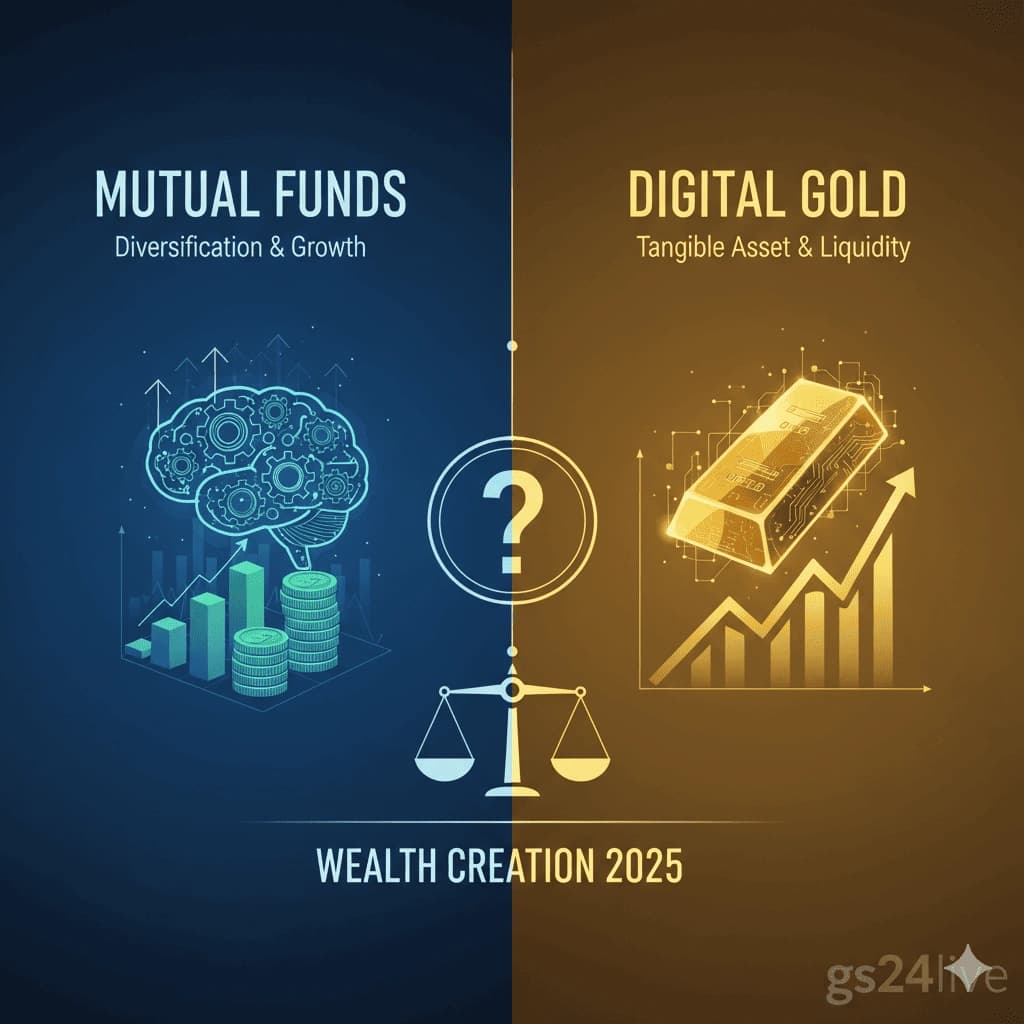
In 2025, Indian investors are increasingly evaluating where to allocate their money for maximum returns and stability. Among the most discussed options are mutual funds and digital gold. While both serve different purposes, choosing the right one depends on your financial goals, risk tolerance, and investment horizon.
With rising inflation, changing market dynamics, and easy access to digital platforms, investors are no longer relying on traditional methods alone. Instead, they are comparing mutual funds vs digital gold to build a more balanced and future-ready portfolio. If you are also comparing precious metals, you can read our gold vs silver investment guide for deeper insights.

Key Takeaways
- Digital gold apps offer small-ticket accumulation; gold mutual funds offer AMC regulation and exchange liquidity.
- Neither is physical jewellery — making charges do not apply, but fees and tax paths differ.
- ETF and SGB comparisons live in dedicated articles — link only.
- Check platform custody, spread, and exit rules before large allocations.
- Match product to horizon: wedding liquidity needs differ from decade-long savings.
Mutual Funds Performance Trend
Mutual funds remain one of the most popular investment options in India. They provide exposure to equities, bonds, and hybrid assets, allowing investors to benefit from long-term economic growth.
Historically, equity mutual funds have delivered higher returns compared to traditional assets, especially when held over longer periods. Compounding plays a key role, making systematic investment plans (SIPs) highly effective for wealth creation.
However, mutual funds are subject to market risks. Their performance depends on economic conditions, company earnings, and global financial trends.
Digital Gold: Stability and Accessibility
Digital gold has emerged as a modern way to invest in gold without physical storage concerns. Investors can buy, sell, and hold gold online through platforms like Paytm, PhonePe, and Groww.
Unlike mutual funds, digital gold is not directly linked to stock market performance. Instead, it follows gold price trends, which are influenced by inflation, currency movements, and global uncertainty. To understand how gold behaves during market cycles, see our Jan 2026 bullion rally guide.
This makes digital gold a preferred choice for investors seeking stability, liquidity, and safety.
Key Differences Between Mutual Funds and Digital Gold
Understanding the core differences between these two investment options is essential:
- Returns: Mutual funds offer higher long-term returns; digital gold offers stable value preservation.
- Risk: Mutual funds are market-linked; digital gold depends on gold price movements.
- Liquidity: Digital gold is instant; mutual funds may take 1–3 days.
- Purpose: Mutual funds are for growth; gold is for safety and hedging.
If you are exploring silver as an alternative, our gold vs silver investment guide explains how silver compares with gold and other assets.
Market Factors Influencing Both Investments
Several macroeconomic factors impact both mutual funds and digital gold:
- 📉 Inflation increases gold demand
- 📊 Economic growth boosts mutual fund returns
- 💲 Currency fluctuations affect gold prices
- 🌍 Global events influence both markets
For example, during uncertain times, gold performs better, while during economic expansion, mutual funds outperform.
Investment Strategy for 2025
Instead of choosing one over the other, investors should consider combining both:
- 📊 Allocate 60–70% to mutual funds for growth
- 🛡️ Allocate 20–30% to gold for stability
- 📉 Invest systematically rather than lump sum
- 📈 Focus on long-term financial goals
This hybrid approach helps balance risk while maximizing returns. You can also monitor daily rates on our live gold and silver price page before making decisions.
Advantages of Combining Both Investments
- ✔ Diversification reduces overall risk
- ✔ Stability during market volatility
- ✔ Better long-term wealth creation
- ✔ Flexibility in asset allocation
Taxation in India: Mutual Funds vs Digital Gold
Returns are only part of the story — how each option is taxed affects what you actually keep. Tax rules change with each Finance Act, so treat the table below as a general guide and confirm current rules with a qualified professional before investing.
| Aspect | Equity Mutual Funds | Digital Gold |
|---|---|---|
| What you own | Units of a market-linked fund | Gold backed by physical metal |
| Return driver | Equity/debt market performance | Gold price movement |
| Typical use | Long-term growth via SIP and compounding | Stability, hedging, and liquidity |
| General tax note | Capital-gains rules vary by fund type and holding period | Taxed as a capital asset; holding period affects treatment |
How to Start With Each
Getting started is straightforward for both:
- Mutual funds: Complete KYC, pick a fund matching your goal and risk, and automate a monthly SIP rather than trying to time the market.
- Digital gold: Buy in small amounts from a reputable platform, check the buy-sell spread and storage terms, and keep records for tax purposes.
- Both together: Use mutual funds as the growth engine and digital gold as the stabiliser, rebalancing roughly once a year.
If you are weighing physical metals instead, compare the options in our gold vs silver investment guide, see how Ahmedabad buyers split retail vs investment purchases, and track the live gold price today.
Ahmedabad SIP Habits: App Gold vs Fund Factsheets
Salaried buyers on SG Highway often run parallel ₹2,000 monthly app gold and gold fund SIPs without comparing expense stacks. Log all-in cost per gram annually — marketing "zero commission" apps may hide spread.
Risks of Unregulated Platform Assumptions
Not every app gold product shares the same custody or exit window. Mutual funds carry market risk but clearer disclosure — read scheme documents before switching physical wedding budgets to apps.
Tax and Exit Paths: Why Product Choice Outlasts the SIP Amount
Digital gold apps, gold savings funds, and sovereign gold bonds sit in different regulatory buckets — exit timelines and capital-gains treatment differ even when the underlying metal story sounds identical. Before you move a ₹10,000 monthly habit from one app to another, screenshot the scheme document section on redemption and storage.
For ETF mechanics and demat liquidity, see the Ahmedabad gold ETF guide — not repeated here.
Liquidity Weekend Test
Before you commit a wedding fund to an app, try a small redemption on a Saturday — if settlement waits until Monday while MCX gaps, your "digital" gold was never as liquid as the marketing suggested. Mutual fund units on exchange may behave differently; read the factsheet exit clause.
Spread vs Expense Ratio: The Hidden Stack
Digital gold platforms often earn on buy-sell spread while mutual funds disclose expense ratio in the factsheet — add both to a one-year spreadsheet before declaring either “cheaper.” A 0.5% annual fee and a 2% round-trip spread are not interchangeable even when marketing copy treats them that way.
Match the Product to the Wedding Calendar
If redemption must happen before a fixed muhurat date, confirm cut-off times in writing — app gold and fund units follow different settlement clocks, and MCX volatility on the eve of redemption can change the rupees you receive.
Frequently Asked Questions1. Which is better: mutual funds or digital gold?
They serve different goals — mutual funds for long-term growth, digital gold for stability and hedging. Most investors benefit from holding both.
2. Is digital gold safe?
When bought from reputable, insured platforms it is backed by physical gold, but always check storage terms, the buy-sell spread, and any custodian fees.
3. Can I invest in both?
Yes. A common split is a larger allocation to mutual funds for growth and a smaller one to gold for stability.
4. Which is more liquid?
Digital gold can usually be sold instantly, while mutual fund redemptions typically settle in 1–3 working days.
5. How are they taxed in India?
Both are taxed as capital assets, but treatment varies by product and holding period and changes with Finance Acts — verify current rules with a tax professional.
6. Is digital gold better than physical gold?
Digital gold avoids storage and purity worries and suits investment, while physical gold remains preferred for cultural and jewellery use.
7. Can I convert digital gold to physical gold in India?
Most platforms allow redemption as coins or bars above a minimum weight; check delivery charges and hallmark certification on redemption.
Data Sources and References
- Multi Commodity Exchange of India (MCX) – the exchange reference behind the mutual funds vs digital timing and board-gap examples in this guide.
- World Gold Council – industry demand statistics used to support the mutual funds vs digital jewellery vs investment framing.
- London Bullion Market Association (LBMA) – London benchmark context behind the mutual funds vs digital global spot discussion.
- Reserve Bank of India (RBI) – Indian macro reference for the mutual funds vs digital interest-rate and currency angles in this article.
- International Monetary Fund (IMF) – international macro research cited where mutual funds vs digital depends on growth and risk appetite.
Conclusion
Mutual funds and digital gold are not competing investments — they are complementary. While mutual funds drive long-term growth, digital gold provides stability and protection. A balanced portfolio combining both can help investors achieve consistent wealth creation in 2025 and beyond.
Disclaimer: This article is for informational purposes only.
Keywords: mutual funds vs digital gold, digital gold India, gold mutual fund comparison, app gold vs MF