
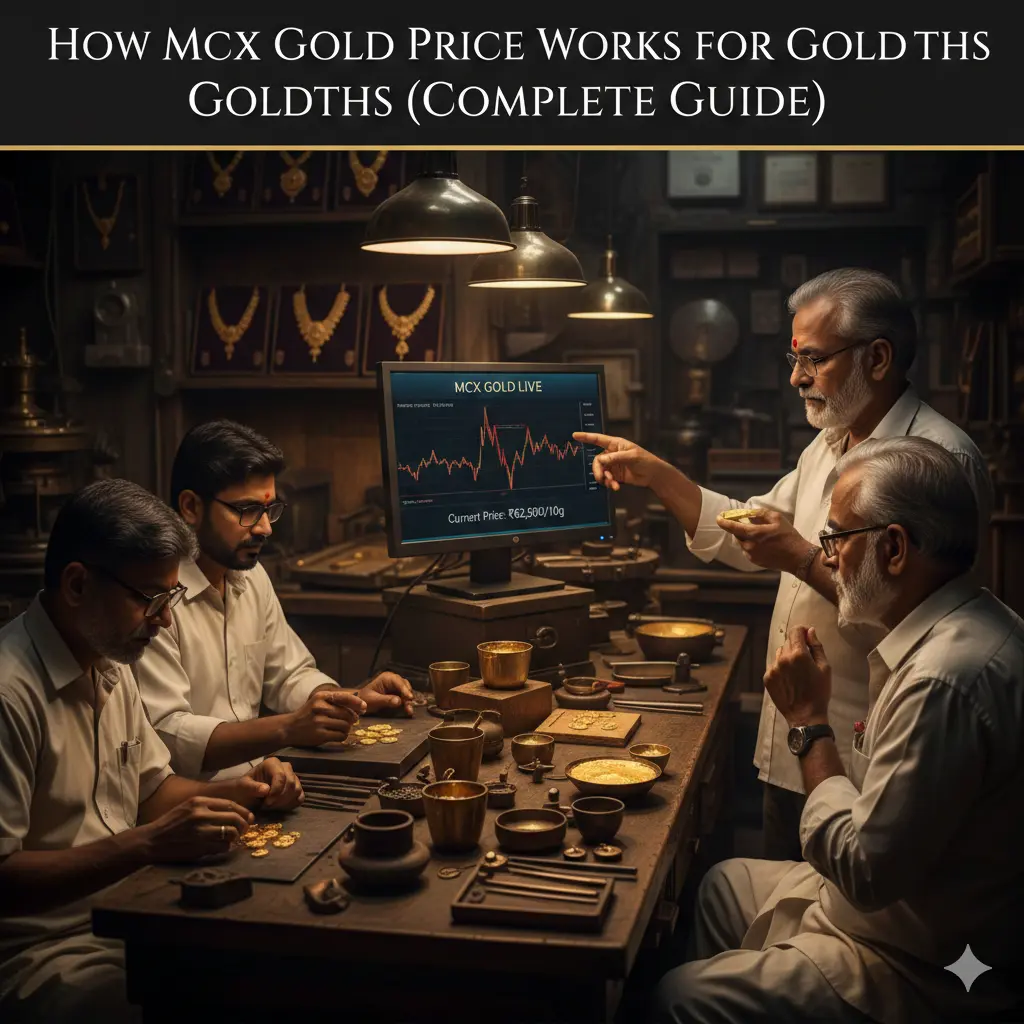
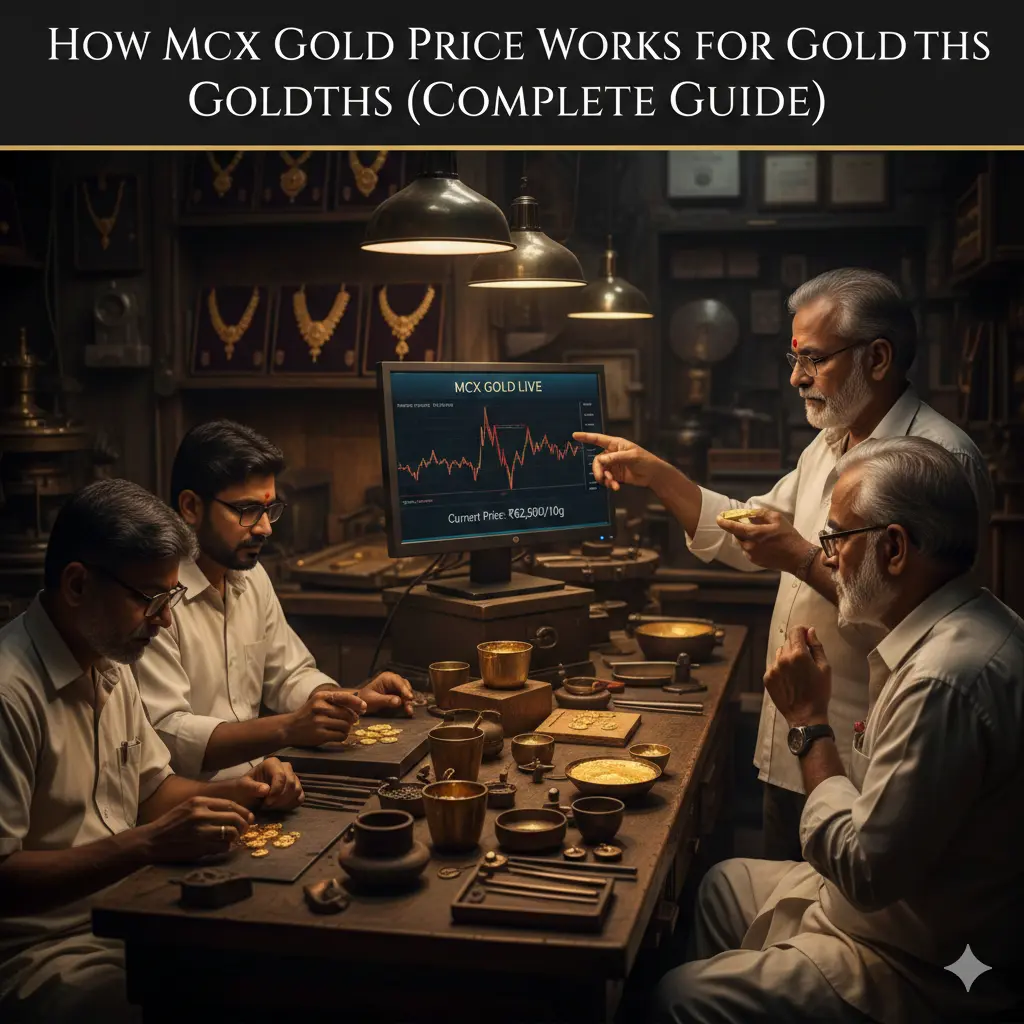
Gold has always been a central part of the jewellery business in India. For goldsmiths, jewellery manufacturers, and bullion traders, understanding how gold prices are determined is extremely important for maintaining profitability and making informed purchasing decisions.
In modern bullion markets, the MCX gold price has become one of the most important reference points used across the jewellery industry. The Multi Commodity Exchange of India (MCX) provides real-time gold pricing that reflects the broader market sentiment and global commodity trends.
For goldsmiths, the MCX price does not represent the final jewellery price, but it provides the most reliable base value of gold in the wholesale market. By understanding how MCX pricing works, goldsmiths can improve purchasing decisions, reduce pricing errors, and manage market volatility more effectively. You can watch the same benchmark on our live gold price today page.
Key Takeaways
- MCX is a hedging and timing reference — not the invoice price for a finished necklace.
- Gold Guinea and Petal contracts let smaller workshops participate without 1 kg lots.
- Convert MCX 24K to 22K before quoting bridal jobs — full landed-cost steps are in the MCX vs local guide.
- Evening session overlap is when many Surat plants schedule bulk wire purchases.
- Weekend global moves gap Monday boards — confirm Monday feed before honouring Friday verbal rates.
Understanding the MCX Gold Market
For a goldsmith or workshop owner, MCX is best understood as the wholesale price screen that sits upstream of every retail counter — the exchange where gold, silver, and other commodities trade as standardized futures contracts rather than physical bars handed across a shop counter.
Unlike local jewellery markets, MCX does not sell physical gold directly to consumers. Instead, it allows traders and businesses to trade gold futures contracts. These contracts represent agreements to buy or sell gold at a specific price at a future date.
Because MCX trading is linked to global commodity markets, its prices move continuously throughout the trading day. These movements reflect real-time supply and demand conditions, making MCX prices one of the most reliable indicators of gold market trends.
Different Gold Contracts Available on MCX
To accommodate traders with different investment capacities, MCX offers multiple gold contract types.
| Contract Type | Quantity |
|---|---|
| Gold | 1 Kilogram |
| Gold Mini | 100 Grams |
| Gold Guinea | 8 Grams |
| Gold Petal | 1 Gram |
These different contract sizes allow both large institutional traders and smaller jewellery businesses to participate in the market.
Three “Day Shapes” Behind the Same Bench Rate
Scenario A – Quiet drift: Global desks are calm and USD/INR barely moves. MCX ticks in a narrow band; your supplier’s phone quote may update only a few times. Here the risk is boredom—assuming nothing will change just before a US data print hits the evening session.
Scenario B – Evening pulse: London and New York wake up while your shop is still open. Liquidity deepens and candles stretch. A rate you confirmed at 4:30 p.m. can look “wrong” by 8:00 p.m. even though your making charges did not move—only the futures curve did.
Scenario C – Gap Monday: Weekend headlines reprice metal before India reopens. The first MCX print may jump over several micro-rates you mentally cached on Saturday. Customers see one headline; you need a rule for whether Saturday’s advance booking still honours Sunday’s verbal rate.
| Situation | What MCX tends to show | Practical bench habit |
|---|---|---|
| Low drama day | Small-bodied candles | Refresh board once mid-session; log supplier spread |
| High drama evening | Fast extension or wicks | Split raw buys; postpone hero stones if rupee leg unclear |
| Gap reopen | Open away from prior close | Quote provisional “subject to first bullion feed” until two sources agree |
How the Tape Can Move While You Solder
The line chart below is a simplified intraday teaching curve only—it is not today’s MCX file. Use it to explain to apprentices why “live” does not mean constant, yet still demands attention when overlap starts.
Key Factors That Influence MCX Gold Price
The MCX gold price is influenced by a combination of global and domestic factors. Understanding these influences helps goldsmiths interpret price movements more accurately.
- International Gold Prices: Global markets such as the London Bullion Market and COMEX strongly influence MCX prices.
- USD-INR Exchange Rate: Since gold is priced internationally in US dollars, currency movements directly affect domestic prices.
- Inflation Expectations: Investors often move capital into gold during inflationary periods.
- Interest Rate Changes: Central bank policies influence investor demand for gold.
- Geopolitical Events: Global economic uncertainty can increase gold demand as a safe-haven asset.
Gold Price Components in the Retail Market
The chart below illustrates how the final gold price seen in jewellery stores is composed of several components beyond the base MCX price.
While MCX provides the wholesale market price, the retail gold price includes import duty, GST, transportation costs, and dealer margins.
Difference Between MCX Gold Price and Local Jewellery Price
| Factor | MCX Price | Jewellery Market Price |
|---|---|---|
| Market Type | Futures trading market | Physical retail market |
| Taxes | Not included | Includes GST |
| Making Charges | Not applicable | Added to jewellery |
| Dealer Margin | Not included | Included |
Because of these additional costs, jewellery prices are usually higher than MCX prices. For the breakdown that customers ask about most, see our gold making charges guide, and for a deeper comparison read MCX vs local market gold rate.
Same Metal, Two Stories: Bars vs Your Counter
Scenario – Quoting a bridal set: You read MCX as “metal only,” then must add hallmarking logistics, GST, and the cushion that covers stone risk and rework. The stacked bar below rounds rupee layers so staff can see why a customer cannot buy at the futures strip printed on TV.
How Goldsmiths Use MCX Prices in Daily Business
Goldsmiths and jewellery manufacturers rely heavily on MCX prices to manage business operations and inventory decisions.
- Purchasing raw gold at favorable market prices
- Setting daily jewellery shop rates
- Managing profit margins
- Monitoring market trends
- Reducing risk during price volatility
By monitoring MCX gold prices regularly, jewellery businesses can make more informed purchasing decisions.
Common Mistakes Goldsmiths Should Avoid
- Using MCX price as the final retail selling price
- Ignoring currency exchange movements
- Tracking outdated gold price data
- Making bulk purchases without analyzing market trends
- Depending on only one source for price information
Practical Tips for Using MCX Prices Effectively
- Track live MCX gold prices throughout the trading day
- Compare MCX prices with local bullion market rates, and learn when to buy or sell using the MCX live price
- Follow global economic news affecting gold markets
- Maintain daily records of price movements
- Avoid emotional buying or selling decisions — and understand why different apps show different prices before reacting
When to Pause a Workshop Purchase
Scenario – “Price feels too good”: MCX suddenly trades softer while physical premia stay firm. That divergence sometimes means currency noise, sometimes delayed bullion arrivals. Instead of maxing inventory on the first soft tick, confirm two independent wholesaler quotes.
Scenario – Chasing a vertical: A vertical rally rarely leaves equal room for making charge hikes. If you chase raw at the spike but keep retail flat, margin compresses. Mark mental support and resistance from your own purchase history—not from a blog number—to know where your process says stop.
The horizontal chart below is generic illustration only; draw your own bands on the platform you actually execute through.
Surat and Ahmedabad Workshops: Daily MCX Routine
Machine-chain plants in Surat often check MCX at 9:05 AM and 8:30 PM; Ahmedabad job workers may rely on supplier WhatsApp quotes indexed to the evening close. Log both the MCX print and the supplier spread daily — disputes happen when only one number is recorded.
- Split large orders across two sessions when evening volatility exceeds your margin cushion.
- Keep contract month notation on purchase logs — roll week changes the futures curve.
Risks When Workshops Misread MCX
Quoting bridal jobs at raw MCX without making charges and GST erodes profit on delivery day. Chasing a soft tick while physical premium stays firm leaves you under-hedged into a rally. Formal hedging without roll discipline can disconnect futures P&L from physical stock.
Surat and Ahmedabad Workshops: Daily MCX Routine
Machine-chain plants in Surat often check MCX at 9:05 AM and 8:30 PM; Ahmedabad job workers may rely on supplier WhatsApp quotes indexed to the evening close. Log both the MCX print and the supplier spread daily — disputes happen when only one number is recorded.
- Split large orders across two sessions when evening volatility exceeds your margin cushion.
- Keep contract month notation on purchase logs — roll week changes the futures curve.
Risks When Workshops Misread MCX
Quoting bridal jobs at raw MCX without making charges and GST erodes profit on delivery day. Chasing a soft tick while physical premium stays firm leaves you under-hedged into a rally. Formal hedging without roll discipline can disconnect futures P&L from physical stock.
Frequently Asked Questions1. How does a goldsmith calculate today's 22K selling price from MCX?
Start with MCX 24K base, convert to 22K purity, then add import duty, GST, dealer margin, and per-design making charges.
2. How often does MCX gold price change?
MCX gold prices change continuously during trading hours based on market activity.
3. Why do goldsmiths follow MCX prices?
MCX provides real-time market direction for timing bulk purchases and setting transparent counter rates.
4. Can a goldsmith hedge inventory using MCX futures?
Larger workshops sometimes do; small shops typically track MCX for purchase timing rather than formal hedging.
5. What happens to shop rates when MCX is closed on weekends?
Dealers may hold Friday's base or adjust for weekend global moves when counters reopen Monday morning.
Data Sources and References
Source notes for this MCX gold price goldsmiths guide come from exchange, central-bank, and industry publications that Indian readers can verify independently.
- Multi Commodity Exchange of India (MCX) – live gold and silver futures source for the MCX gold price goldsmiths comparisons discussed above.
- World Gold Council – global gold research desk referenced for the MCX gold price goldsmiths long-horizon context.
- London Bullion Market Association (LBMA) – precious-metals standards source used where MCX gold price goldsmiths meets international pricing.
- Reserve Bank of India (RBI) – domestic policy source linked wherever MCX gold price goldsmiths meets rupee or liquidity conditions.
- International Monetary Fund (IMF) – world economic outlook source supporting the MCX gold price goldsmiths scenario discussion.
Disclaimer: GS24LIVE publishes independent research and market analysis based on publicly available financial data. This article is intended for informational and educational purposes.
Keywords: MCX gold price goldsmiths, goldsmith gold rate India, jewellery workshop MCX hedge, convert MCX to 22K shop rate